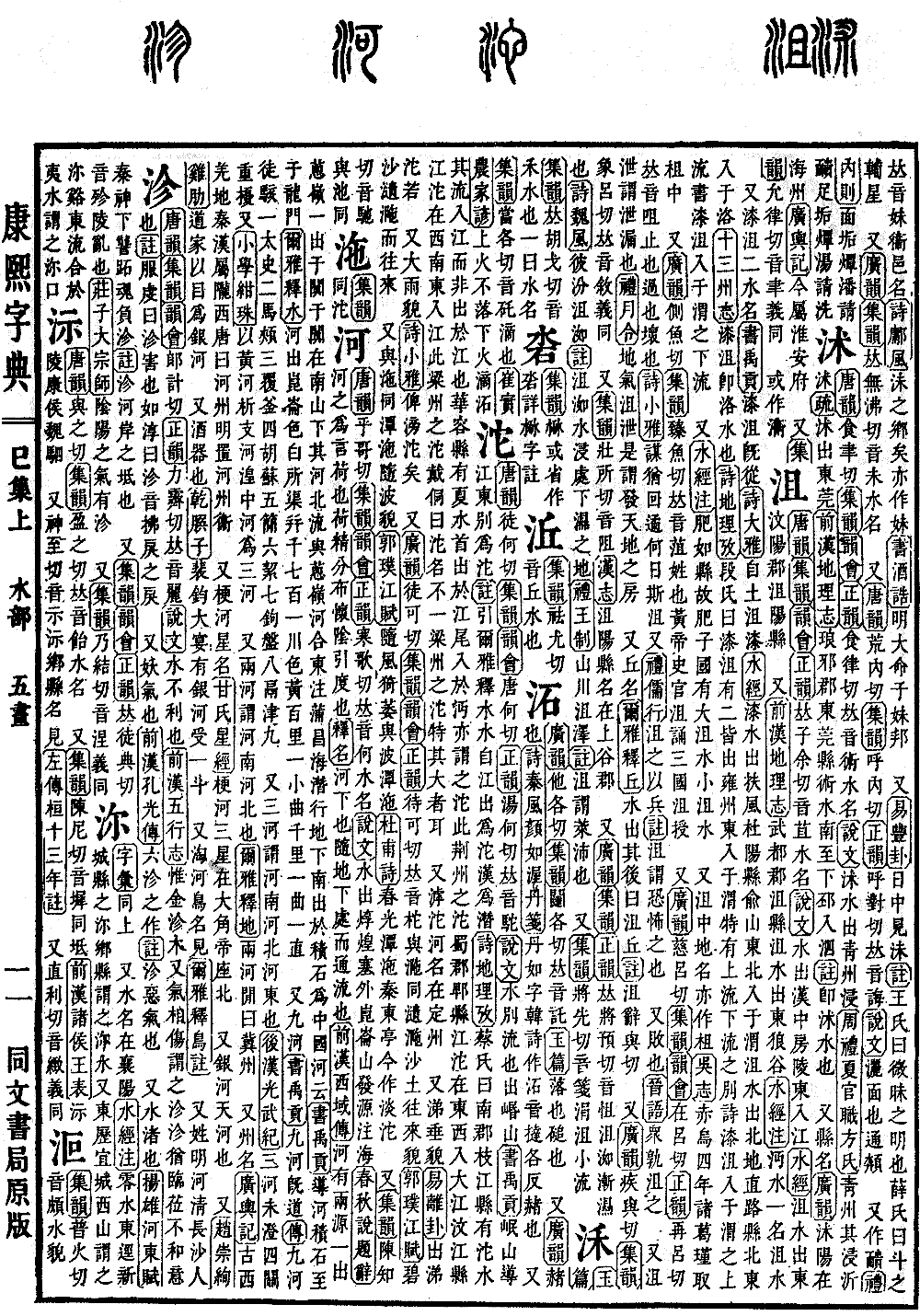
Si Collection, Upper Volume
Radical: Water (shuǐ)
Kangxi stroke count: 9
Page 613, Entry 02
Pronounced ju. The sound is the same as ju. It is the name of a river.
Shuowen Jiezi states: The Ju River originates in Fangling, Hanzhong, and flows east into the Yangtze River.
Shuijing states: The Ju River originates in Juyang County, Dongwenyang Commandery.
Also, Book of Han (Qian Hanshu), Geographical Treatise records: Ju County in Wudu Commandery has a Ju River, which originates in Donglang Valley.
Shuijing Zhu states: Another name for the Mian River is the Ju River.
Also, the Qi River and the Ju River are two separate river names.
Book of Documents (Shangshu), Tribute of Yu (Yugong) records: The Qi River and the Ju River have been dredged and flow smoothly.
Book of Odes (Shijing), Greater Odes (Daya) states: From the Du River to the Qi and Ju Rivers.
Shuijing states: The Qi River originates in Mount Yu, Duyang County, Fufeng, and flows northeast into the Wei River. The Ju River originates north of Zhilu County, Beidi, and flows east into the Luo River.
Thirteen Provinces Gazetteer (Shisanzhou Zhi) states: The Qi and Ju are the Luo River.
Examination of Geography in the Book of Odes (Shijing Dili Kao) records: Master Duan states: There are two Qi and Ju rivers, both originating in Yong Province and flowing east into the Wei River, differing only by upper and lower reaches. The Qi and Ju mentioned in the Book of Odes are the upper reaches flowing into the Wei River. The Qi and Ju in the Book of Documents are the lower reaches flowing into the Wei River.
Also, Shuijing Zhu records: Feiru County was the ancient state of Feizi, and it has a Great Ju River and a Small Ju River.
Also, Juzhong is a place name. It is also written in a variant form (zha).
Records of the Three Kingdoms (Sanguozhi), Annals of Wu (Wuzhi) records: In the fourth year of Chiwu, Zhuge Jin attacked and captured Juzhong.
Also, pronounced zu. It is a surname. The official historian of the Yellow Emperor was named Ju Song, and in the Three Kingdoms period, there was Ju Shou.
Also, pronounced ju (rising tone). It means to stop, reproach, or spoil.
Book of Odes (Shijing), Lesser Odes (Xiaoya) states: Your schemes are deviant and corrupt; when will they ever cease?
Also, Book of Rites (Liji), Conduct of Scholars (Ruxing) states: Use weapons to threaten him.
Commentary states: Ju means to make him afraid.
Also, it means to frustrate or defeat.
Discourses of the States (Guoyu), Narratives of Jin (Jinyu) states: Among the crowd, who can defeat him?
Also, juxie means to leak or divulge.
Book of Rites (Liji), Monthly Ordinances (Yueling) states: The earth's vapor leaks out; this is called opening the chamber of heaven and earth.
Also, a type of mound.
Erya, Explanation of Mounds (Shiqiu) states: A mound from behind which water flows is called a juqiu.
Commentary states: Ju is pronounced ci-yu.
Also, pronounced xu. It carries the same meaning.
Also, pronounced zu.
Book of Han (Hanshu), Geographical Treatise records: Juyang is a county name, located in Shanggu Commandery.
Also, pronounced ju (falling tone). Juru means low and wet.
Book of Odes (Shijing), Odes of Wei (Weifeng) states: That low and wet land by the Fen River.
Commentary states: Juru refers to a place soaked by water, low-lying and damp land.
Book of Rites (Liji), Royal Regulations (Wangzhi) states: Mountains, rivers, marshes, and low-lying, damp lands.
Commentary states: Ju refers to marshes overgrown with water plants.
Also, pronounced jian. Juanju means a small, trickling stream.