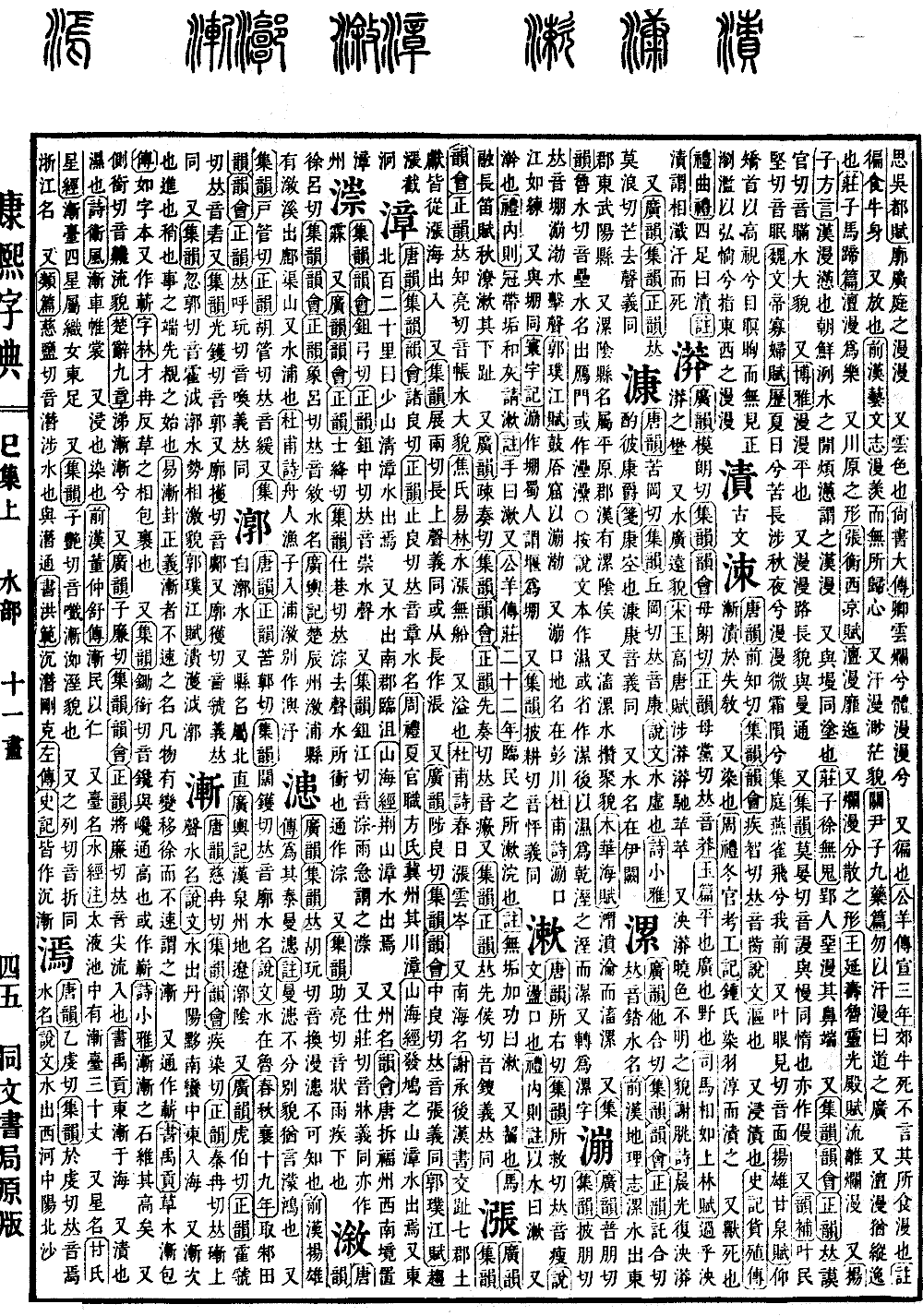
Si Collection, Upper Volume
Radical: Water (shuǐ)
Page 647, Entry 15
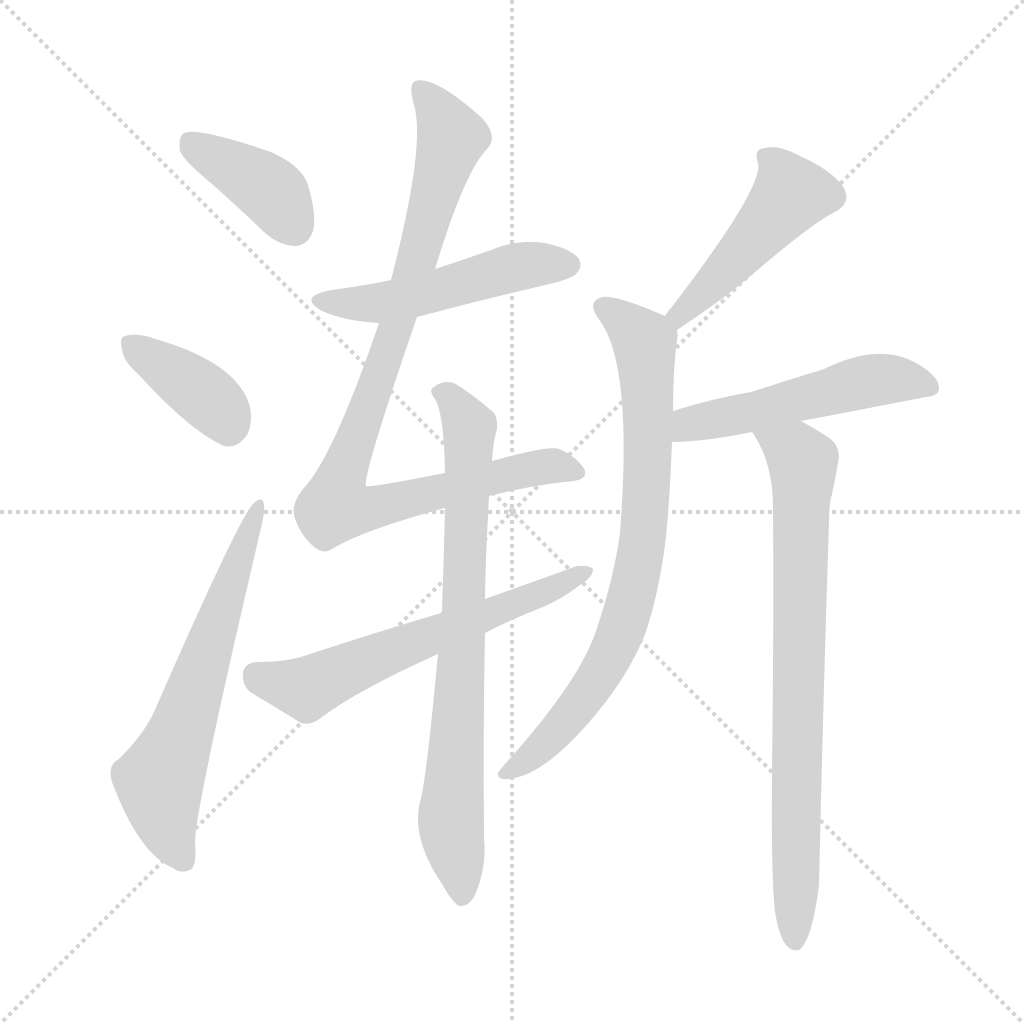
Pronounced jiǎn (rising tone).
A name of a river. According to the Explaining Graphs and Analyzing Characters (Shuowen), the river originates in the south of Yixian, Danyang, and flows eastward into the sea. It also indicates gradual progress, advancement by degrees, or slightness. It also refers to the beginning or the initial signs of a matter.
The Correct Meaning of the Hexagram Jian (Yi: Jiangua Zhengyi) states: Jian signifies a lack of haste. Whenever something changes or moves slowly and not rapidly, it is called jian.
Also written in the variant form (qián).
In the Book of Documents (Shangshu): The growth of plants gradually encompasses. The Explanatory Text (Shiwen) notes: Pronounced as the original character, and some editions write it as (qián).
The Dictionary of Characters (Zilin) records: Pronounced as cái rán, referring to the appearance of plants entwining one another.
Pronounced chán. Equivalent to the character (chán). It means high. Sometimes written as (zhǎn).
In the Book of Odes (Shijing): The towering rocks, they are indeed high.
Pronounced jiàn. Refers to the appearance of flowing.
In the Songs of Chu (Chuci): The tears are flowing down.
Pronounced jiān. Refers to flowing into.
In the Book of Documents (Shangshu): Flowing eastward into the sea.
It also refers to soaking or moistening.
In the Book of Odes (Shijing): Soaking the carriage curtains and garments.
It also refers to imbuing or influencing.
In the History of the Former Han Dynasty (Qian Han Shu), Biography of Dong Zhongshu: Imbuing the people with benevolence.
The name of a terrace. In the Commentary on the Water Classic (Shuijingzhu): There is a Jian Terrace in the Taiye Pond, thirty zhang high.
A name of a star. In the Gan School's Classic of Stars (Gan Shi Xing Jing): The Jian Terrace consists of four stars, located near the foot of the Vega star.
Pronounced jiàn. Jian-ru refers to a damp appearance.
Pronounced zhé. Equivalent to (zhé). A name of a river.
Pronounced qián. To wade across water. Equivalent to (qián).
In the Book of Documents (Shangshu): Immersing deeply to control the rigid. In the Zuo Tradition (Zuo Zhuan) and the Records of the Grand Historian (Shiji), it is written as (chén jiǎn).
Textual Research: Also written as (qián). In the Book of Documents (Shangshu): The growth of plants gradually encompasses. The Commentary says: Read as the original character, and some editions write it as (qián). Note: The original book text has been corrected to replace Commentary with Explanatory Text.