Si Collection, Upper Volume
Radical: Water (shuǐ)
Entry: 浸
Kangxi stroke count: 11
Page 625, Entry 15
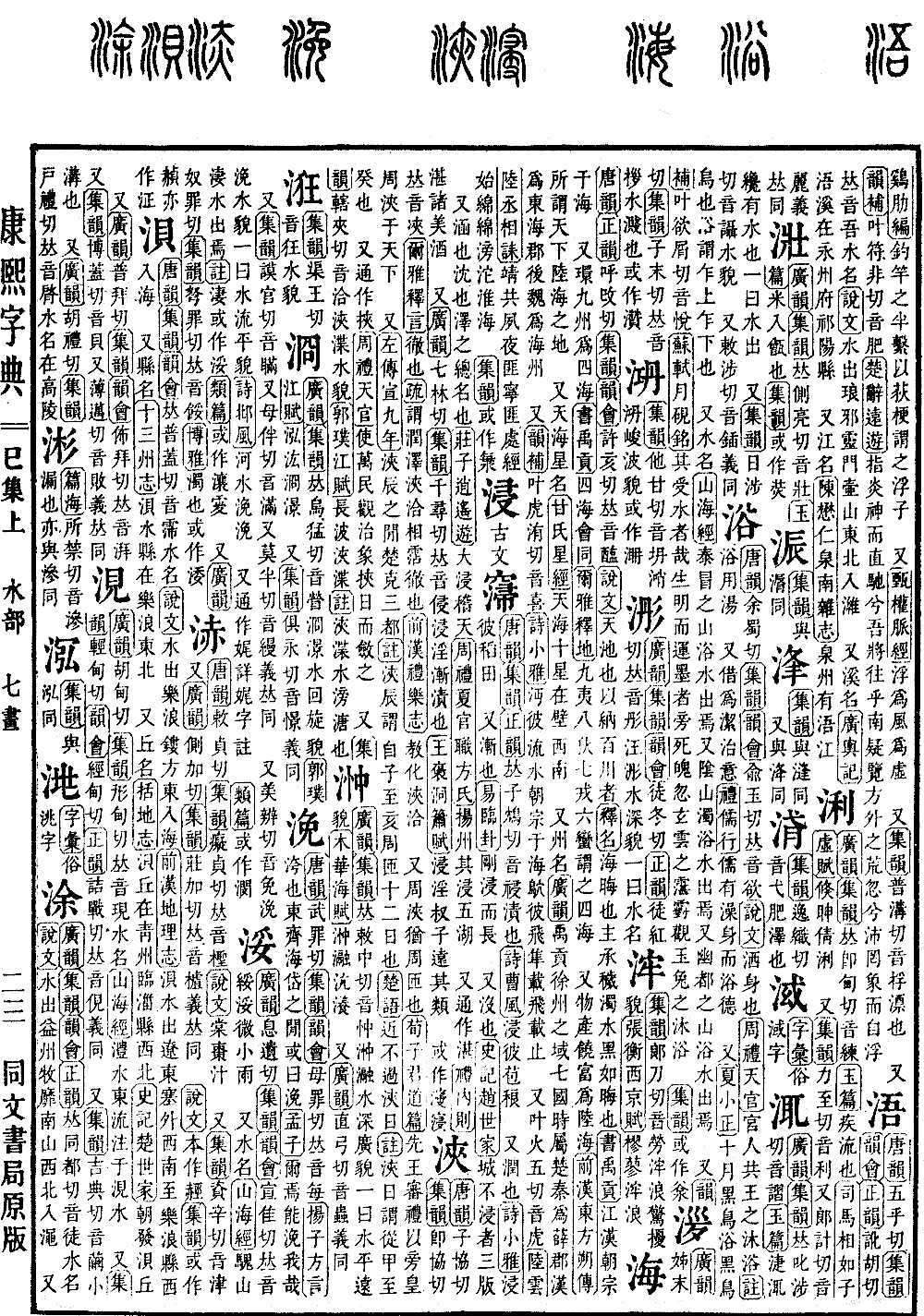
Ancient form. From Tang Rhymes (Tangyun), Collected Rhymes (Jiyun), and Correct Rhymes (Zhengyun), pronounced jin. To soak. Book of Odes (Shijing), Cao Wind: To soak those rushes. Also, to moisten. Book of Odes (Shijing), Lesser Odes: To moisten those rice fields. Also, to advance gradually. Book of Changes (Yijing), Lin Hexagram: The strong advance and grow. Also, to submerge. Records of the Grand Historian (Shiji), House of Zhao: Walls not submerged for three spans. Also, to contain, to sink; a general term for bodies of water. Zhuangzi, Free and Easy Wandering: Great floods reaching the heavens. Rites of Zhou (Zhouli), Summer Offices: The waters of Yang Province are the Five Lakes. Also, used interchangeably with the character pronounced zhan. Book of Rites (Liji), Inner Chapters: Soaked in fine wine. Also, from Wide Rhymes (Guangyun) and Collected Rhymes (Jiyun), pronounced qin. To permeate or soak gradually. Wang Bao, Rhapsody on the Bamboo Flute: Permeating, moving far like its kin. Sometimes written in the variant forms jin or jin.