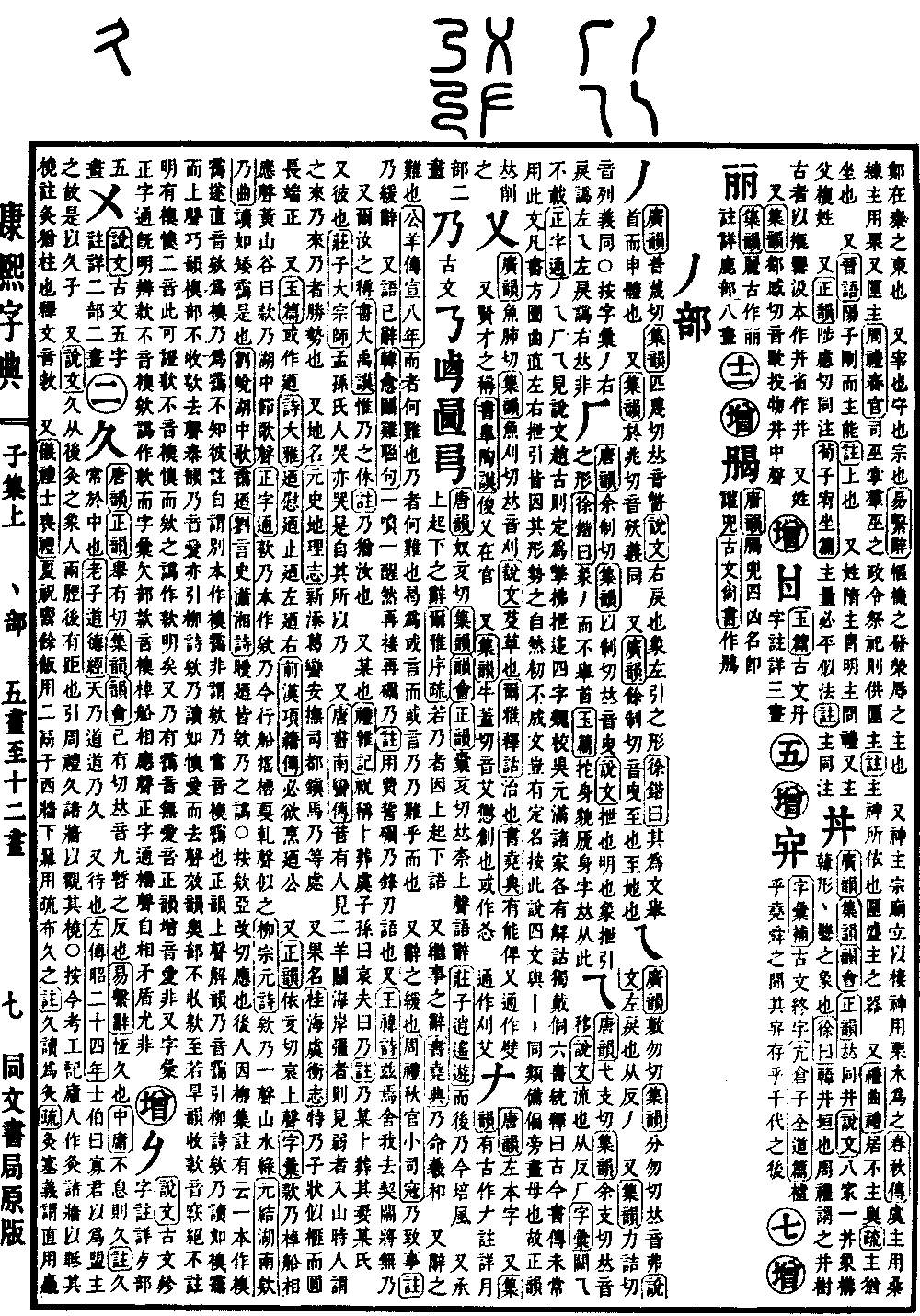
Zi Collection, Page Position: Upper
Radical: Slash (piě)
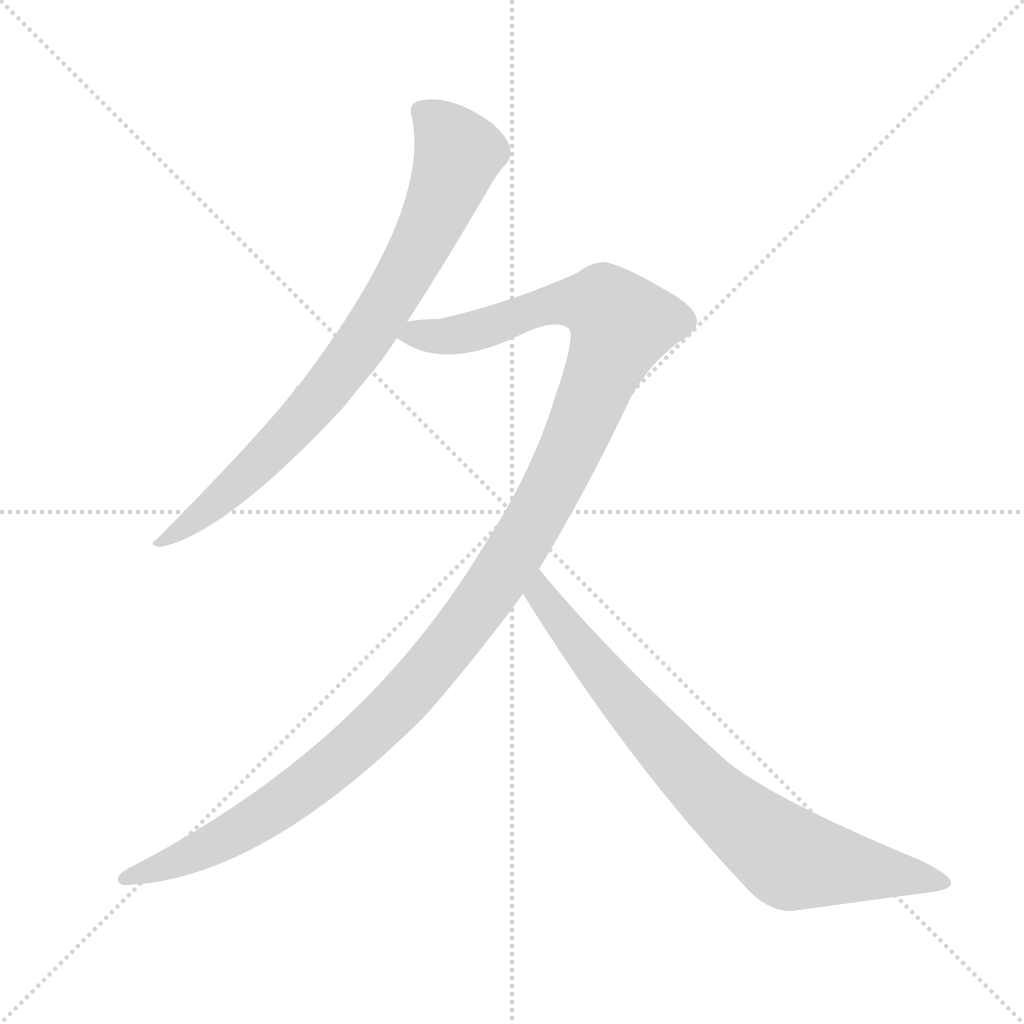
Character: jiǔ
Kangxi Stroke Count: 3
Page 81, Position 19
Tang Rhymes (Tangyun) and Correct Rhymes (Zhengyun) give the pronunciation as a combination of jǔ and yǒu. Collected Rhymes (Jiyun) and Rhyme Assembly (Yunhui) give it as a combination of yǐ and yǒu. It is pronounced the same as the word for nine, jiǔ. It is the antonym of brief. In the Appended Statements (Xici) of the Book of Changes (Yijing), it represents constancy and endurance. The Doctrine of the Mean (Zhongyong) states that if something does not cease, it can endure for a long time. The Commentary (Zhu) explains that jiǔ means to exist within something constantly. The Classic of the Way and Virtue (Daodejing) of Laozi says that Heaven is the Way, and the Way is long-enduring. It also carries the meaning of waiting. In the Zuo Commentary (Zuo Zhuan), 24th year of Duke Zhao, Shibo said: Because of the alliance leader, our ruler has made you wait for a long time. Furthermore, Explaining Graphs and Analyzing Characters (Shuowen Jiezi) explains: jiǔ refers to applying moxibustion from behind; the character form resembles a person's two calves with a support behind them. It cites the Rites of Zhou (Zhouli), stating: Propping a weapon against a wall to observe its curvature. Note: In the current Record of Trades (Kao Gong Ji), section on the Lu People, it is written as the character for moxibustion, jiǔ, meaning to prop against a wall to observe curvature. The commentary says that jiǔ is like a pillar or support. The phonetic explanation gives the pronunciation as jiù. Also, the Book of Etiquette and Ceremonies (Yili), section on the Rites for the Death of an Officer, records: The Xia invoker cooks the remaining rice and places it in two vessels under the western wall, not covering them with fine cloth, but using a coarse cloth jiǔ to cover them. The commentary states that jiǔ is read as the character for moxibustion. The Sub-commentary (Shu) explains that this refers to plugging or blocking, meaning to directly use coarse cloth to cover the vessel mouth as a plug. In the Rhyme Supplement (Yunbu), the rhyming pronunciation is given as a combination of jǔ and lǐ, pronounced the same as jǐ. In the Odes of Bei from the Book of Odes (Shijing), in the line "How long it has been, there must be a reason," jiǔ rhymes with yǐ. In the Minor Odes (Xiaoya), in the line "Returning from Hao, my journey was long and enduring," it rhymes with xǐ and zhǐ. In the Summons of the Soul (Zhaohun) from the Songs of Chu (Chuci), in the line "Layered ice towers high, flying snow for a thousand miles. Return, return, one cannot stay for long," jiǔ rhymes with lǐ.