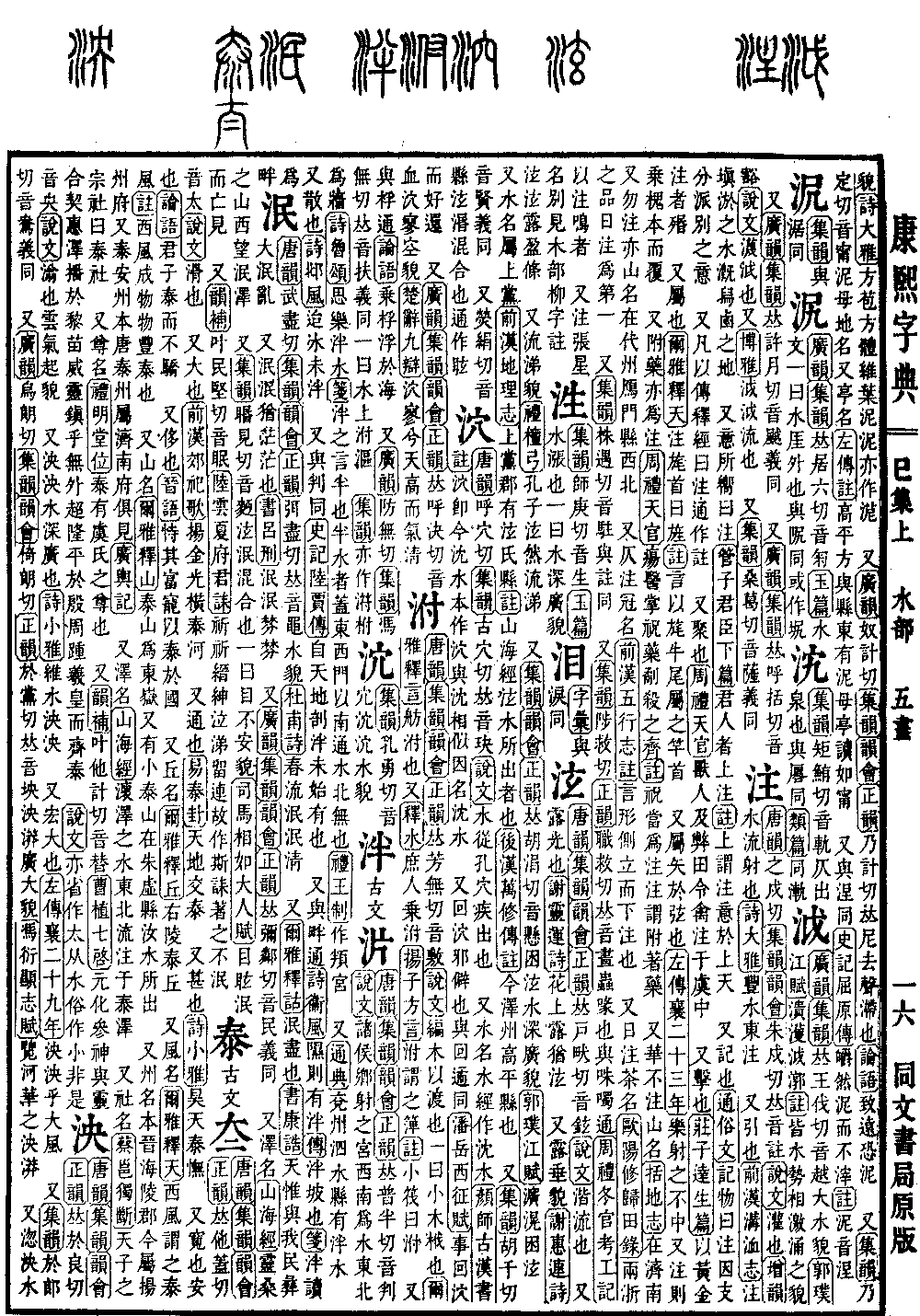
Si Collection, Upper Volume
Radical: Water (shuǐ)
Kangxi Strokes: 12
Page 618, Entry 07
Dictionary of Characters (Zihui): Same as the character for tears.
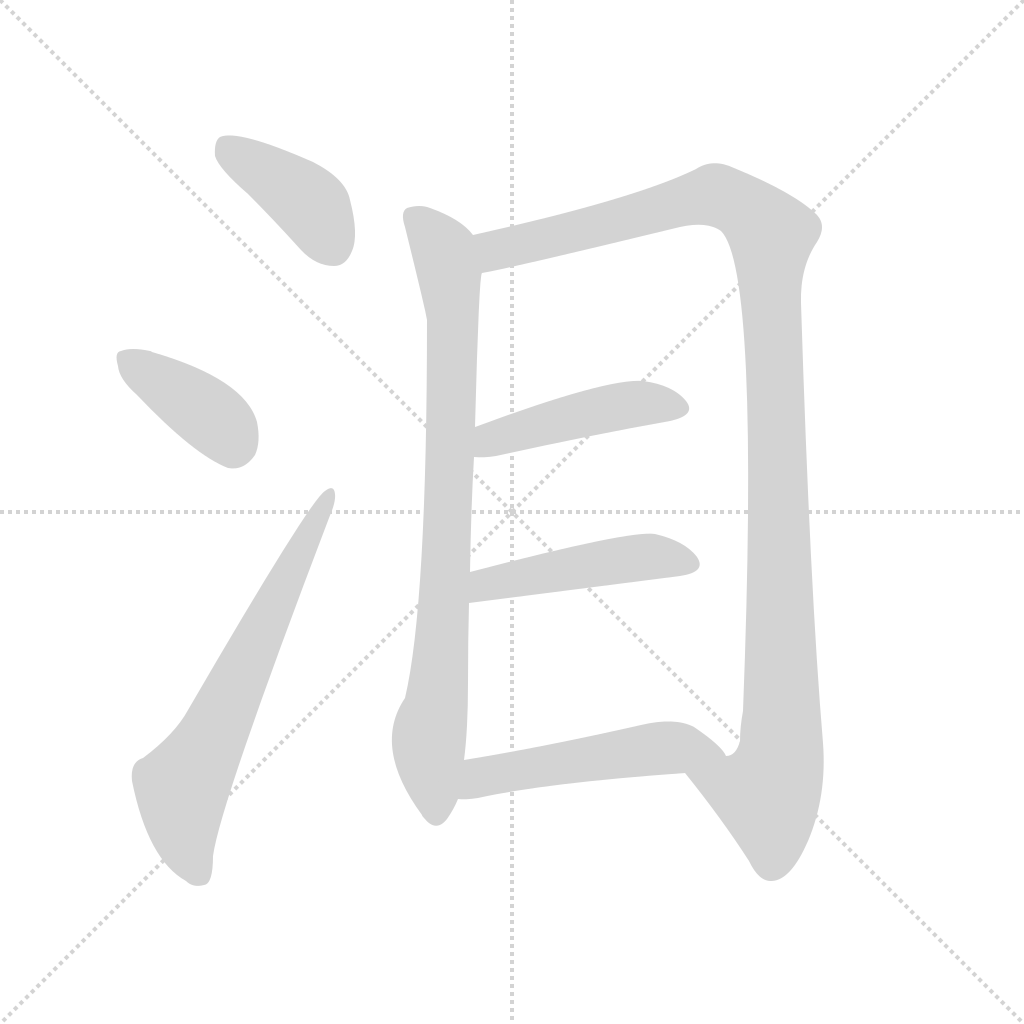
Tears
Guangyun (Guangyun), Jiyun (Jiyun), Yunhui (Yunhui), Zhengyun (Zhengyun): Pronounced lei (falling tone). The liquid from the eyes.
Compendium of Materia Medica (Bencao): Tears are the liquid of the liver.
Book of Master Tan on the Transformation of Things, Jade and Pearl Chapter (Tanzi Huashu Zhuyu Pian): When sorrowful, tears will fall.
Also, Jiyun (Jiyun): Pronounced lü (falling tone). Same meaning.
Also, Jiyun (Jiyun), Yunhui (Yunhui): Pronounced li (falling tone); Zhengyun (Zhengyun): Pronounced li (falling tone). The appearance of rapidly flowing water.
Zhang Heng, Rhapsody on the Southern Capital (Nandu Fu): The water flows rapidly and turbulently.
Commentary: Citing the Huainanzi (Huainanzi), water tears through and breaks boats. Note: In the original text of the Huainanzi, Principles of Sovereignty (Zhu Shu Xun), it was written as the character for contrary (li). In ancient times, the characters for tears and contrary were used interchangeably.
Also, Jiyun (Jiyun): Pronounced lie (falling tone). Same meaning.
Also, chilly and tearful, the appearance of cold and desolation.
Former Han, Rhapsody on Emperor Wu (Wudi Fu): The autumn air is mournful and chilly. It is also written as the character for contrary (li).