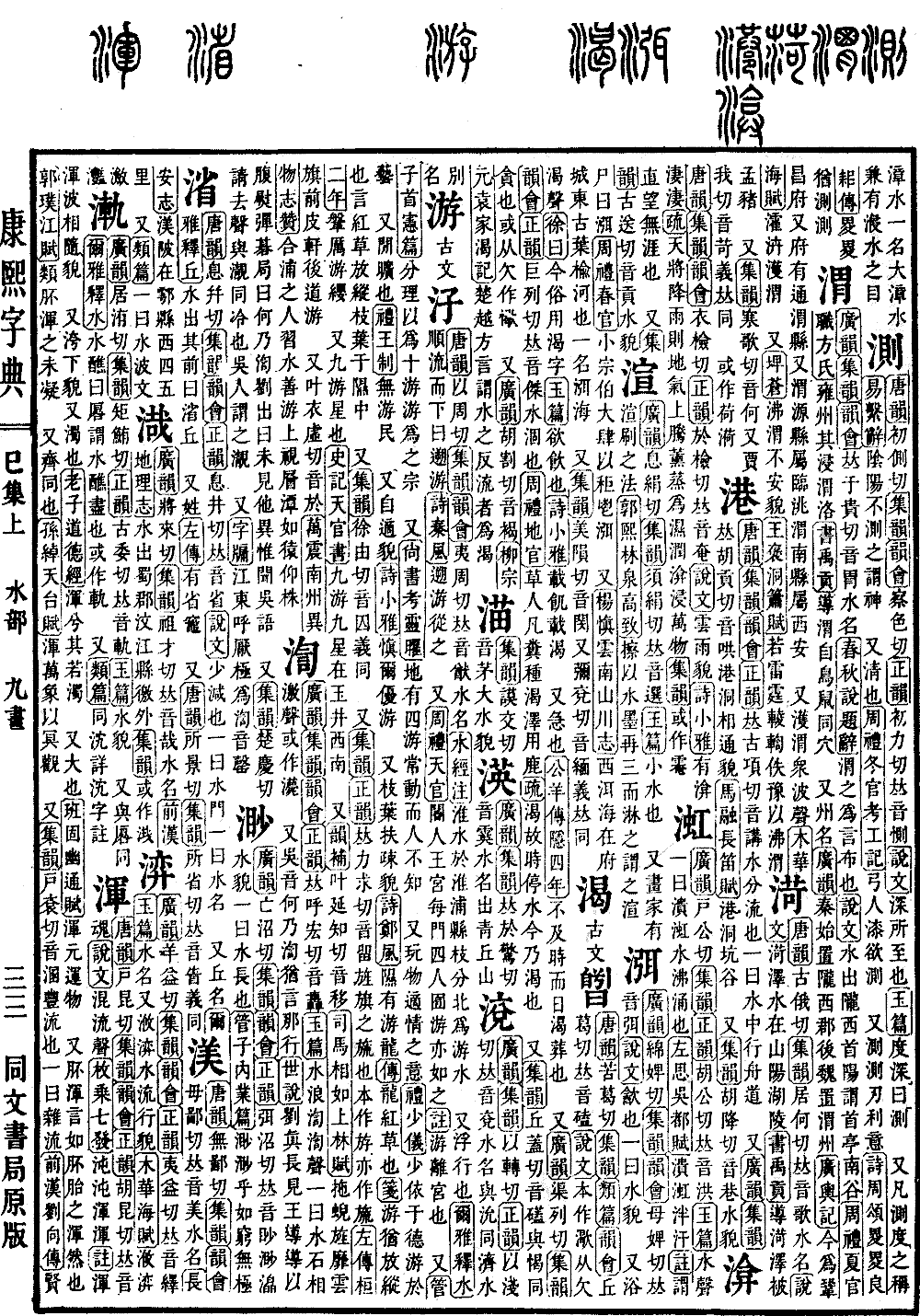
Si Collection, Upper Volume
Radical: Water (shuǐ)
浑
Kangxi strokes: 13
Page 635, Entry 01
Tang Rhymes (Tangyun): Pronounced hun (level tone).
Collected Rhymes (Jiyun), Rhyme Meetings (Yunhui), Correct Rhymes (Zhengyun): Pronounced hun (level tone).
Explanation of Graphs (Shuowen): The sound of turbulent flowing water.
Mei Cheng, Seven Stimuli (Qifa): Turbulent and surging.
Annotation: Surging, the appearance of water waves following one another. Also refers to a low-lying appearance. Also refers to being turbid.
Laozi, Classic of the Way and Virtue (Daodejing): Indistinct and chaotic, resembling turbid water.
Also refers to being vast.
Ban Gu, Rhapsody on the Dark and Mysterious (Youtongfu): The primeval vastness that moves all things.
Also refers to a formless embryonic state, referring to being undivided and holistic like an embryo.
Guo Pu, Rhapsody on the Yangtze River (Jiangfu): Resembling an embryo that has not yet coalesced.
Also refers to being uniform or blended together.
Sun Chuo, Rhapsody on Mount Tiantai (Tiantaifu): Blending all things together while deeply observing.
Also according to Collected Rhymes (Jiyun): Pronounced hun (falling-rising tone). Refers to a copious flow of water. One theory suggests it refers to mixed or turbulent water.
History of the Former Han (Qianhanshu), Biography of Liu Xiang: Worthy people and unworthy people are mixed together and indistinguishable.
Also according to Yangzi, Dialect (Fangyan): A word meaning grand or abundant.
Annotation: Full and plump appearance.
Also according to Literary Expositor (Erya), Interpretation of Evidences (Shizheng): A word meaning to fall or descend.
Annotation: The appearance of water falling.
Also a surname.
Zuo Commentary (Zuozhuan): Hun Han, a grandee of the State of Zheng.
Also pronounced gun (rising tone). Same as the character for rolling or rushing water. Refers to the appearance of a great torrent of water.
Xunzi, On Enriching the State (Fuguo pian): Wealth and goods rushing like a fountain source.