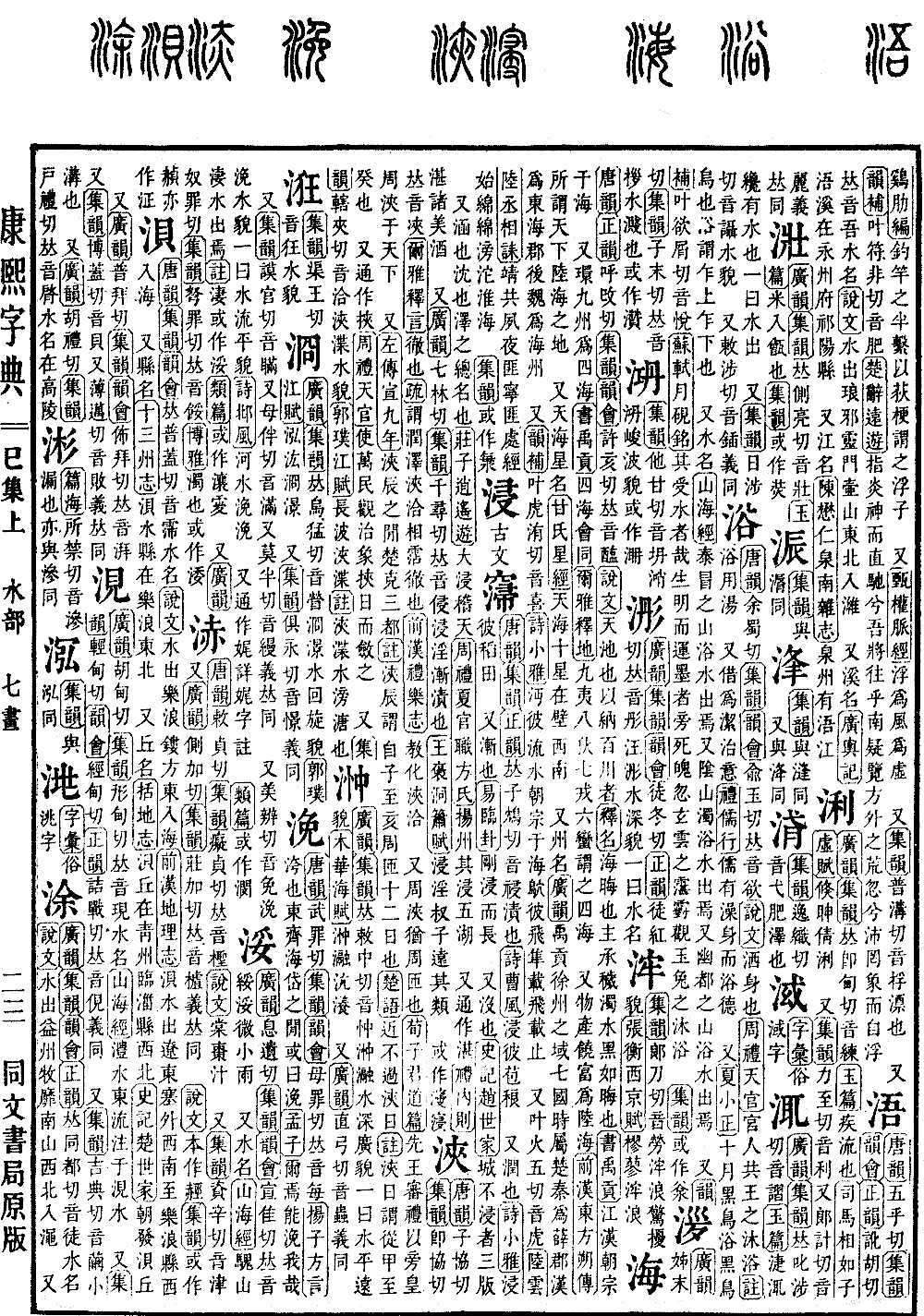
Si Collection, Upper Volume
Radical: Water (shuǐ)
Kangxi strokes: 11
Page 625, Entry 14
Pronounced hǎi. According to the Tang Rhyme (Tangyun) and Correct Rhyme (Zhengyun), it is pronounced hǎi. According to the Collected Rhymes (Jiyun) and Rhyme Anthology (Yunhui), it is pronounced hǎi, sharing the same pronunciation as the character for minced meat (hǎi).
The Explanation of Script and Elucidation of Characters (Shuowen Jiezi) defines it as the celestial pool, the place that contains the hundred rivers.
The Explanation of Names (Shiming) states that the sea implies darkness, as it primarily receives muddy waters, with a color as black as twilight.
The Book of Documents (Shangshu), section Tribute of Yu (Yugong), records: The Yangtze River and the Han River both flow into the great sea.
It also refers to the regions surrounding the Nine Provinces as the Four Seas. The Book of Documents (Shangshu), section Tribute of Yu (Yugong), states: Within the Four Seas, all come to pay homage and attend court.
The Erya (Erya), section Explanation of Lands (Shidi), records: The Nine Yi, Eight Di, Seven Rong, and Six Man are collectively referred to as the Four Seas.
It also refers to places with abundant resources as land seas. The Book of the Former Han (Qian Hanshu), Biography of Dongfang Shuo, states: This is what is known as the land sea of the world.
There is also the Celestial Sea, which is the name of a constellation. The Gan Family Star Scripture (Gan Shi Xingjing) records: There are ten stars in the Celestial Sea, located to the southwest of the Wall Mansion (bi).
It is also the name of a province. The Expanded Rhymes (Guangyun) records: It belongs to the region of Xu Province as mentioned in the Tribute of Yu (Yugong), was part of the Chu State during the Warring States period, was established as Xue Commandery during the Qin Dynasty, and was established as Donghai Commandery during the Han Dynasty. It was established as Hai Province during the Later Wei Dynasty.
According to the Rhyme Supplement (Yunbu), it is also pronounced xǐ.
The Book of Odes (Shijing), section Lesser Odes (Xiaoya), states: Those flowing waters, they flow into the great sea. That swift hawk, now it flies, now it rests.
It is also pronounced hǔ.
Lu Yun’s Eulogy for Prime Minister Lu (Lu Chengxiang Lei) states: Day and night respectful and cautious, without peace or dwelling. Beginning to plan for the long term, heavy rain pours into the Huai River and the sea.
The Collected Rhymes (Jiyun) notes that it is sometimes written in a variant form.