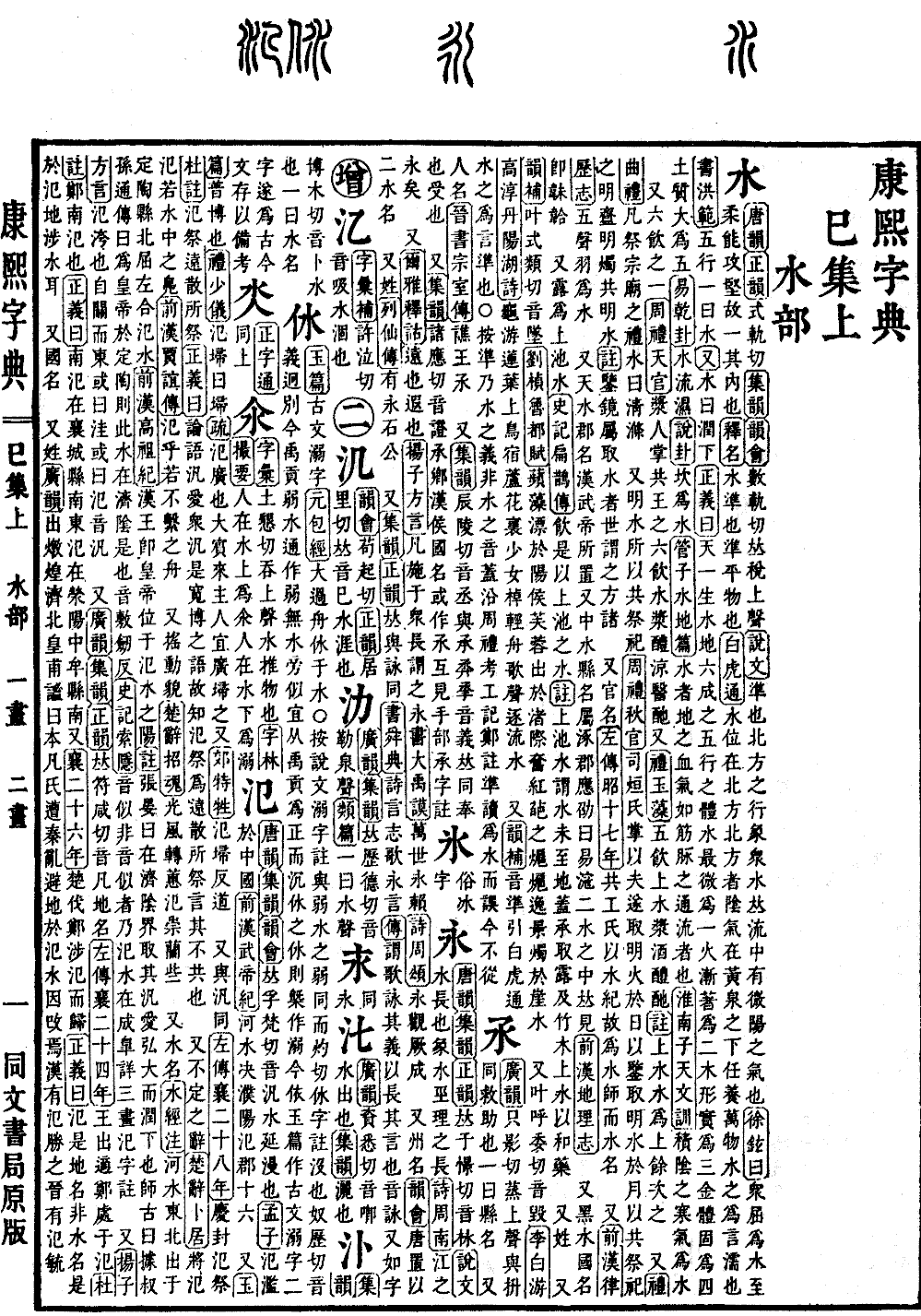
Si Collection, Upper Volume. Radical: Water (shuǐ). Kangxi stroke count: 6. Page 603, Entry 14.
Tang Rhyme (Tangyun), Collection Rhymes (Jiyun), and Dictionary of Rhymes (Yunhui) define the pronunciation as fan (falling tone), synonymous with the character fan (to overflow). It refers to the spreading or overflowing of water. Book of Mencius (Mengzi): It overflows into the Central States. History of the Former Han (Qianhan), Annals of Emperor Wu: The Yellow River breached its banks at Puyang, flooding and submerging sixteen commanderies. Furthermore, Jade Chapters (Yupian) defines it as meaning universal or extensive. Book of Rites (Liji), Minor Rites: A large-scale sweeping is called a sao. Commentary (Shu): Fan means vast. When distinguished guests arrive, the host should conduct a large-scale sweeping. Also, in the Suburban Sacrificial Rites (Jiaotesheng), it refers to extensively cleaning and repairing roads. It is also synonymous with the character fan (to float). Zuo Commentary (Zuozhuan), 28th Year of Duke Xiang: Qing Feng conducted a fan sacrifice. Du Commentary (Duzhu): A fan sacrifice refers to distributing sacrificial offerings to distant places. Correct Meaning (Zhengyi): The Analects contains the phrase to love the masses extensively. Fan is a term for being broad and extensive, thus we know that a fan sacrifice involves scattering offerings afar, which indicates a lack of reverence. It also functions as a term for uncertainty. Songs of Chu (Chuci), Divination by Lots: To drift about like a wild duck in the water. History of the Former Han, Biography of Jia Yi: Drifting like a boat without a mooring rope. It also describes a swaying appearance. Songs of Chu, Summons of the Soul: The breeze moves the fragrant herbs in the sunlight, swaying the clustered orchid plants. It is also the name of a river. Commentary on the Water Classic (Shuijingzhu): The river flows northeast, passing Dingtao County, where it turns north and merges on the left with the Fan River. History of the Former Han, Annals of Emperor Gaozu: The King of Han ascended the throne as emperor north of the Fan River. Commentary: Zhang Yan stated that within the territory of Jiyin Commandery, the name was chosen for its meaning of expansive, universal love and downward moisture. Shigu stated: According to the Biography of Shusun Tong, the imperial throne was ascended in Dingtao, so this river in Jiyin is correct. Pronounced fan (falling tone). Records of the Grand Historian (Shiji), Search for Mysteries (Suoyin): Pronounced si, which is incorrect. The one pronounced si is the Si River, located in Chenggao; see the detailed entry under the three-stroke character si. Furthermore, Master Yang’s Dialects (Yangzi Fangyan): Fan refers to low-lying areas where water collects. East of Hangu Pass, some places call this wa, while others call it fan, pronounced fan (falling tone). Furthermore, Broad Rhymes (Guangyun), Collection Rhymes (Jiyun), and Correct Rhymes (Zhengyun) define the pronunciation as fan, synonymous with the character fan. It is a place name. Zuo Commentary, 24th Year of Duke Xiang: The King of Zhou fled to the state of Zheng and resided in the Fan territory. Du Commentary: This is the Southern Fan of the state of Zheng. Correct Meaning: Southern Fan is south of Xiangcheng County, and Eastern Fan is south of Zhongmu County in Xingyang. Furthermore, 26th Year of Duke Xiang: The state of Chu attacked Zheng, crossed the Fan territory, and returned. Correct Meaning: Fan is a place name, not a river name, meaning they crossed the water at the Fan territory. It is also a name of a state and a surname. Broad Rhymes: The surname originated in the regions of Dunhuang and Jibei. Huangfu Mi stated: Originally the Fan family, they encountered the chaos of the Qin Dynasty and took refuge in the area of the Fan River, subsequently changing their name to Fan. During the Han Dynasty, there was Fan Shengzhi; during the Jin Dynasty, there was Fan Yu. It also rhymes with the sound xian (falling tone). Lu Ji, Poetic Exposition on Literature (Wenfu): Lacking the lingering taste of thick broth, like the sound of vermillion strings that are sparse and lacking in weight. Although one sings and three sigh in response, it is elegant but lacks aesthetic beauty. The character form is derived from the radical, which is different from the character si which uses the radical for the eleventh earthly branch.