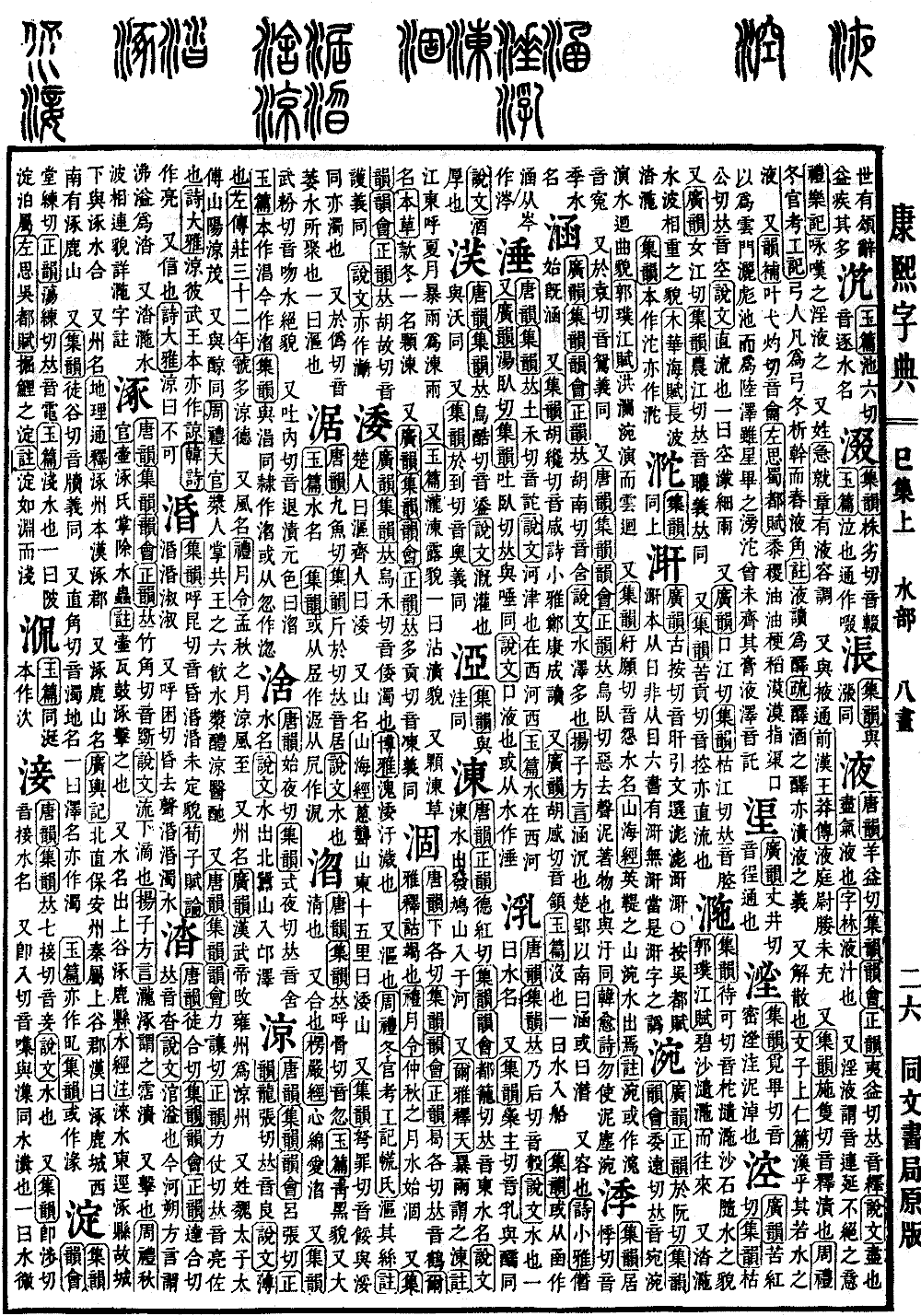
Si Collection, Upper Volume
Radical: Water (shuǐ)
涵
Kangxi Stroke Count: 12
Page 628, Entry 13
Broad Rhymes (Guangyun), Collected Rhymes (Jiyun), Rhyme Meetings (Yunhui), and Correct Rhymes (Zhengyun): Pronounced han. The sound is identical to the character for contain (han).
Explanation in Explaining Graphs and Analyzing Characters (Shuowen Jiezi): Refers to many bodies of water or marshes.
Yangzi's Dialects (Fangyan): Refers to sinking or being submerged. In the area south of Ying, the capital of Chu, it is called han, while in other regions it is called qian. It also carries the meaning of to contain or accommodate. The usage in the Book of Odes (Shijing), Lesser Odes of the Kingdom (Xiaoya), in the line "the beginning of the usurpation is already contained (han)," carries this meaning.
Collected Rhymes (Jiyun): Pronounced han. The sound is identical to the character for salty (xian). This is the pronunciation assigned by Zheng Xuan of the Han dynasty for the character in the Book of Odes (Shijing), Lesser Odes of the Kingdom (Xiaoya).
Broad Rhymes (Guangyun): Pronounced han. The sound is identical to the character for chin (han).
Jade Chapter (Yupian): Refers to sinking or being submerged. Another interpretation refers to water entering a boat.
Collected Rhymes (Jiyun): Records that this character may be written in a variant form using the component han (hán), or as the character for soaking (cén).