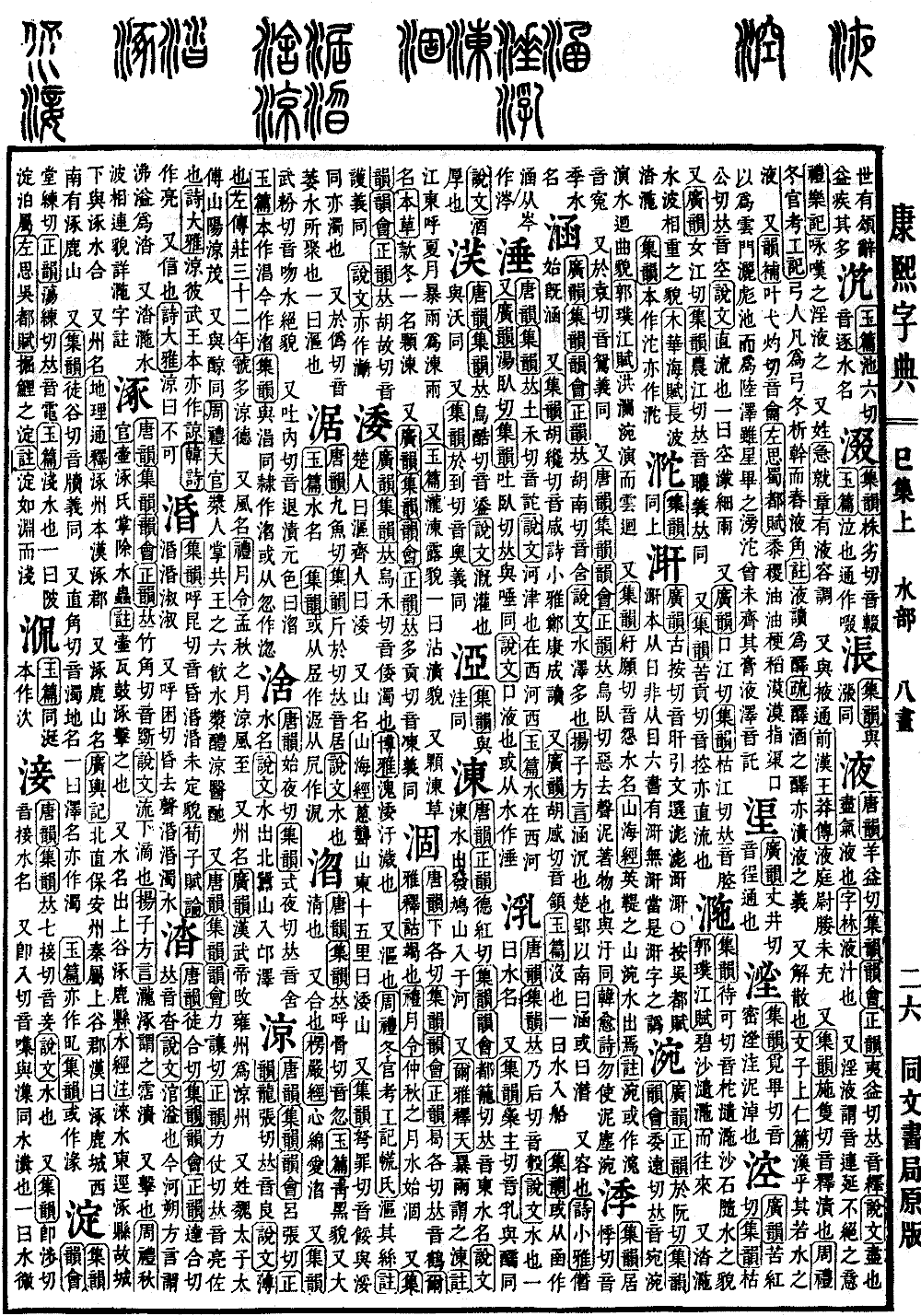
Si Collection, Upper Volume
Radical: Water (shuǐ)
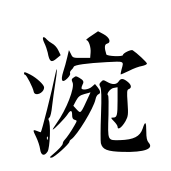
Wan
Kangxi stroke count: 12
Page 628, Entry 11
Pronounced wan (rising tone) according to Broad Rhymes (Guangyun) and Correct Rhymes (Zhengyun); pronounced wan (rising tone) according to Collected Rhymes (Jiyun) and Rhyme Collection (Yunhui). Wan-yan describes the appearance of water flowing in a swirling, winding manner. As seen in the Rhapsody on the River (Jiang fu) by Guo Pu: The vast waves swirl and twist, winding like clouds.
Also pronounced yuan (falling tone) according to Collected Rhymes (Jiyun). The name of a river. According to the Classic of Mountains and Seas (Shanhaijing), the Wan River originates from Mount Yingdi. Note: Wan is sometimes written in a variant form, pronounced the same as yuan. Also pronounced yuan (even tone), with the same meaning.
Also pronounced e (falling tone) according to Tang Rhymes (Tangyun), Collected Rhymes (Jiyun), Rhyme Collection (Yunhui), and Correct Rhymes (Zhengyun). Refers to mud adhering to an object. Identical in meaning to the character for filth (wu). As seen in the poetry of Han Yu: Do not let mud and dust soil it.