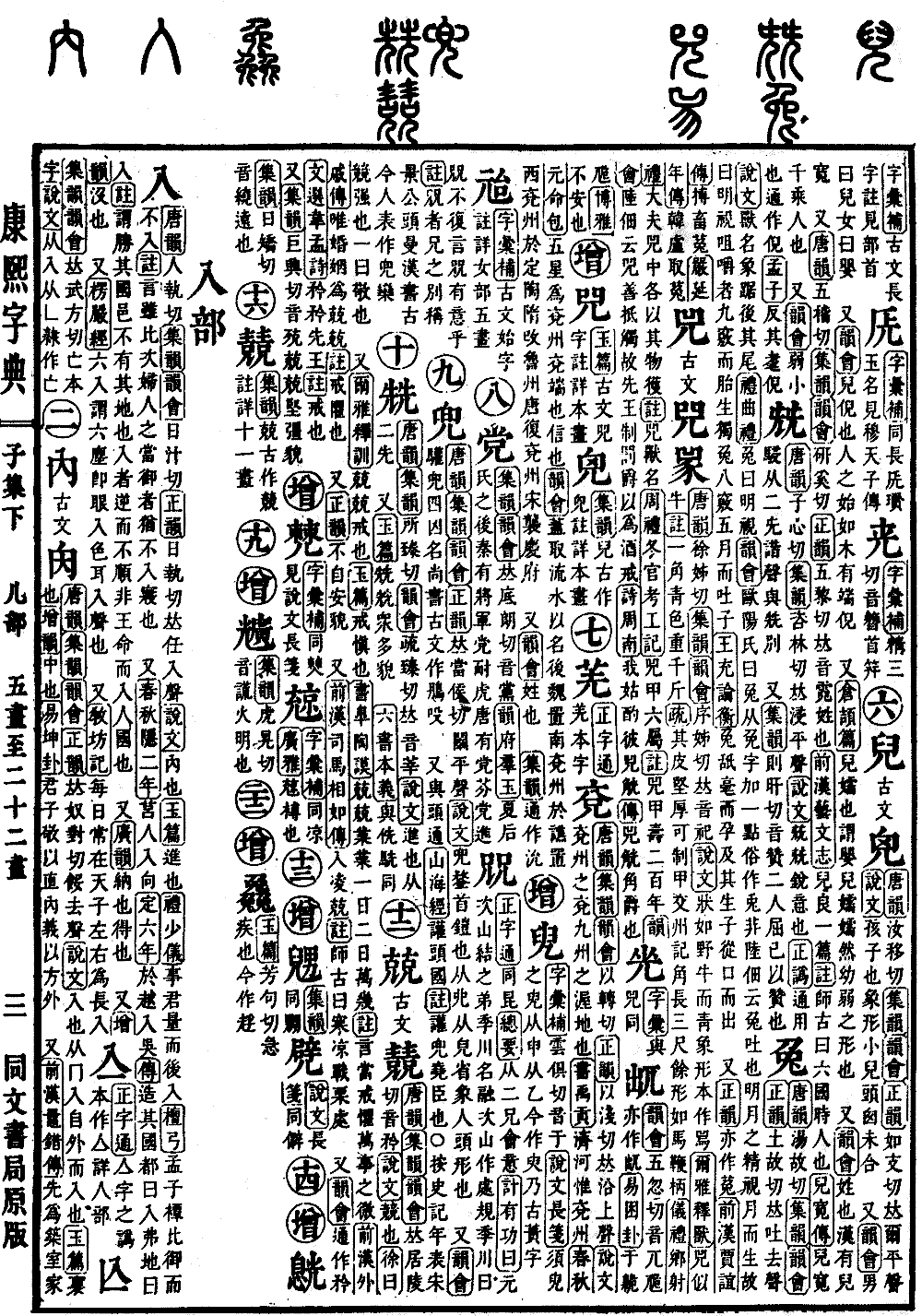
Zi Collection, Page Position: Lower
Radical: Enter (rù)
Kangxi stroke count: 2
Page 125, Entry 32
Pronounced ru (entering tone)
According to the Explanation of Words and Phrases (Shuowen Jiezi), it means to go inside.
According to the Jade Chapters (Yupian), it means to advance.
In the Book of Rites (Liji), specifically the section on minor protocols, it is written: When serving a ruler, consider the circumstances before entering.
In the Tan Gong chapter of the Book of Rites (Liji), it is written: Meng Xianzi compared the court ladies but did not enter. The commentary notes this means that although he compared the concubines who were scheduled to attend the ruler, he still did not enter the sleeping quarters.
In the Spring and Autumn Annals (Chunqiu), during the second year of Duke Yin, it is written: The people of Ju entered Xiang. During the sixth year of Duke Ding, it is written: The people of Yue entered Wu. The commentary states: To reach the capital of their state is called entering, and to do so without taking the land is also called entering. The commentary further notes: This refers to defeating the capital city of a state but not possessing the land itself. Entering denotes an act that is rebellious rather than compliant, as it involves entering the state of another person without the royal mandate.
According to the Extended Rhymes (Guangyun), it also means to receive or to obtain.
According to the Additional Rhymes (Zengyun), it also means to sink or disappear.
According to the Surangama Sutra (Lengyan Jing), the six entrances refer to the six dusts, meaning the eye enters the object of color, and the ear enters the object of sound.
According to the Records of the Music Academy (Jiaofang Ji), those who were constantly by the side of the Son of Heaven every day were called long-term entrants.
Textual correction: In the citation from the Tan Gong chapter, the text originally read Mengzi, but according to the original book, this has been corrected to Meng Xianzi.