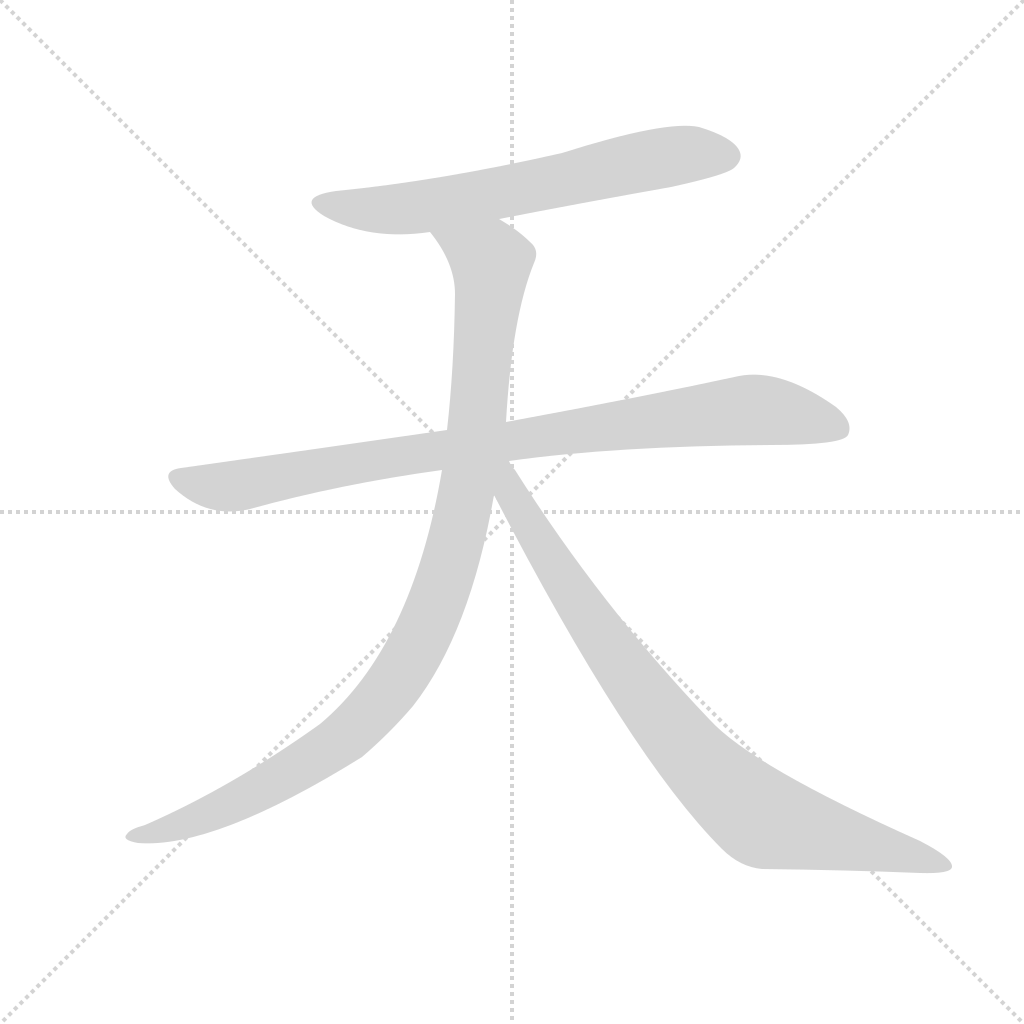
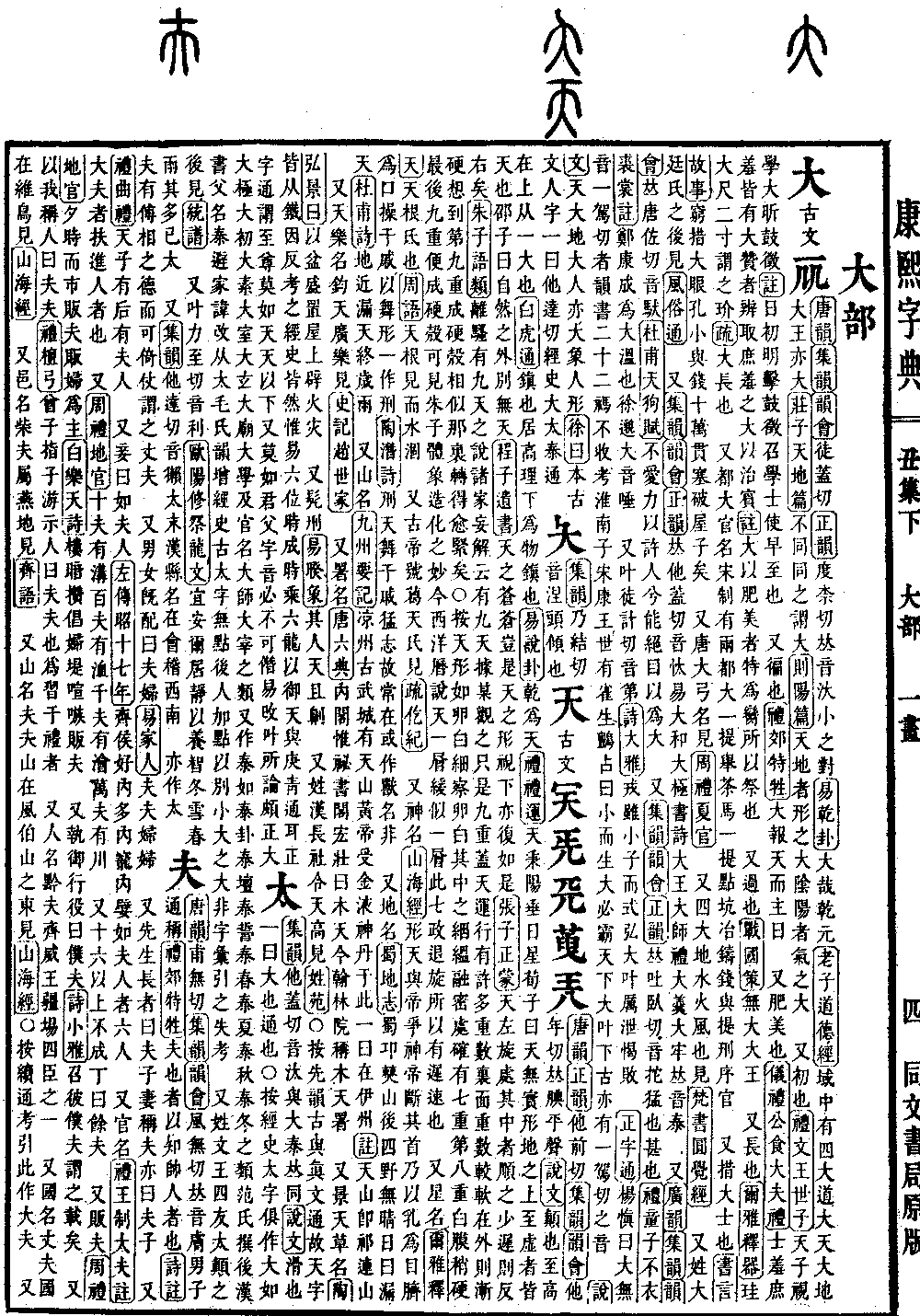
Chou Collection, Lower Volume
Radical: Big (dà)
Page 248, Entry 04
Ancient character form for heaven.
Pronounced tian (level tone).
In the dictionary Explanation of Graphs (Shuowen Jiezi), it is defined as the summit. It signifies that which is highest and above, derived from the characters one and big.
In the White Tiger Discussions (Baihu Tong), it is defined as to settle; it dwells on high to govern what is below, acting as a stabilizer for all things.
In the Book of Changes (Yijing), in the chapter Explanation of Trigrams (Shuogua), it says: Heaven is represented by the Creative (Qian).
In the Book of Rites (Liji), in the chapter Rites Operation (Liyun), it says: Heaven holds the yang essence, suspending the sun and stars.
Xunzi says: Heaven has no solid form; everything above the earth that is void is heaven.
Master Shao says: Apart from the natural order, there is no separate heaven.
In Master Cheng’s Posthumous Works (Chengzi Yishu), it says: The deep blue of the sky, is that truly the form of heaven? Looking downward from above, it appears the same.
In Master Zhang’s Correct Discipline (Zhengmeng), it says: Heaven rotates to the left; those who reside within it follow this motion, and if they lag slightly behind, they appear to move to the right.
In the Classified Conversations of Master Zhu (Zhuzi Yulai), it says: The Lisao mentions the Nine Heavens; various scholars have falsely interpreted this as meaning there are nine distinct heavens. In my view, it refers only to nine layers. Because heaven moves and operates with multiple layers, the inner layers are softer, while those further out gradually harden; thinking of the ninth layer, it becomes like a hard shell, where the rotation is even tighter. Note: The form of heaven is like the white of an egg. Carefully examining the egg white, its inner, dense, and harmonious essence has seven layers; the eighth layer of white membrane is slightly firmer, and the final ninth layer forms a hard shell. This shows the marvelous nature of Master Zhu’s understanding of creation. The current Western calendrical theories suggest that each layer of heaven is slower than the one within it; this explains the acceleration and deceleration in the retrocession of the seven luminaries.
Also, a star name. In the Literary Expositor (Erya), in the chapter Explaining Heaven (Shitian), it says: Heaven is the root and the base.
In the Discourses of the States (Zhouyu), it says: When the root of heaven appears, the waters dry up.
Also, an ancient imperial title. The Ge-Tian clan, see the Record of the Distant Antiquity (Shuwuji).
Also, a god’s name. In the Classic of Mountains and Seas (Shanhaijing), Xing-Tian contended with the Emperor for divine power; the Emperor cut off his head, so he used his nipples as eyes and his navel as a mouth, brandishing a shield and battle-axe in a dance. The character Xing is sometimes written as a variant form.
In the poems of Tao Qian, it says: Xing-Tian dances with shield and battle-axe, his fierce will remains as ever. Some write it as the name of a beast, which is incorrect.
Also, a place name. In the Records of Shu Territories (Shudizhi), the four wild areas behind Mount Gongbo in Shu have no clear days, and are called Leaking Heaven.
In the poems of Du Fu, it says: The land is close to Leaking Heaven, raining all year round.
Also, a mountain name. In the Record of the Nine Provinces Essentials (Jiuzhou Yaoji), the ancient Wu City of Liangzhou has Heaven Mountain; the Yellow Emperor received the divine elixir of golden fluid there. Another source says it is in Yizhou. Note: Heaven Mountain is the Qilian Mountains.
Also, Tian, a music name. The expansive music of Jun-Tian, see the Records of the Grand Historian (Shiji), in the chapter House of Zhao.
Also, a government office name. In the Tang Six Statutes (Tang Liudian), the inner cabinet only had the Secretariat; it was majestic and called the Wood Heaven. The modern Hanlin Academy is called the Wood Heaven Office.
Also, Jing-Tian, a plant name. Tao Hongjing says: If kept in a basin and placed on a roof, it wards off fire disasters.
Also, to shave the hair. In the Book of Changes (Yijing), in the chapter Opposition (Kui), it says: That person is shaved and his nose is cut off.
Also, a surname. Han dynasty magistrate of Changshe, Tian Gao. See the Surname Garden (Xingyuan).
Note: In terms of the Xian rhyme, in ancient times it was interchangeable with the Zhen and Wen rhymes, so the character Tian always followed the phonetic reading of tie and yin. Examining the classics and histories, this is always the case. Only in the Book of Changes, in the phrase, the six positions are completed by time, and riding the six dragons to control heaven, it is interchangeable with the Geng and Qing rhymes. The Correct Meaning of Characters (Zhengzitong) states: Nothing is more supreme than heaven, and below heaven, nothing is more supreme than the ruler and father; the pronunciation of the character must not be presumptuously altered for the sake of rhyming, and this argument is quite upright and grand.
The character Tian created by Empress Wu resembles the seal script form of heaven.