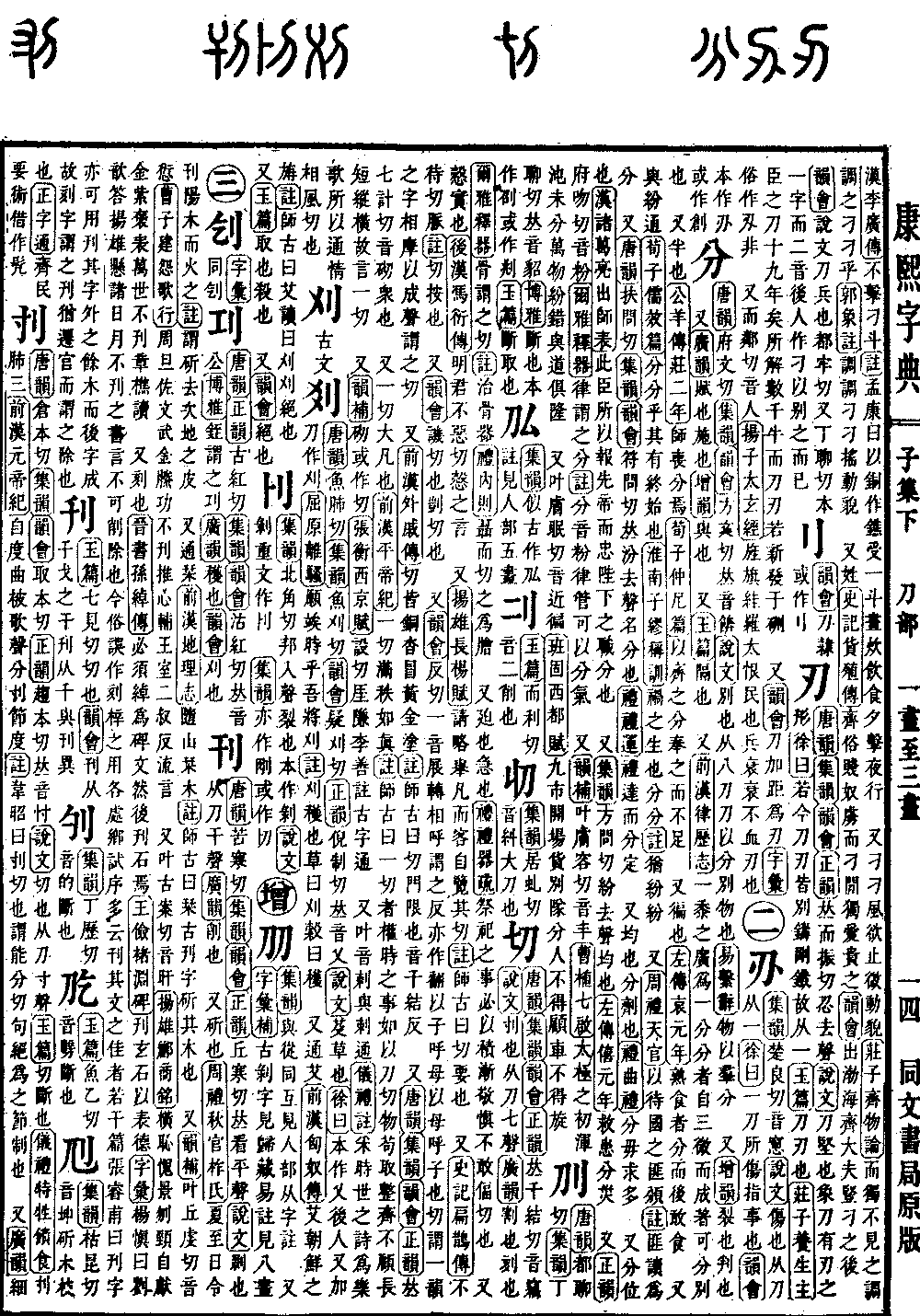
Zi Collection, Page Position: Lower. Radical: Knife (dao). Ren; Kangxi Strokes: 3; Page 136, Number 02. According to the Tang Rhymes (Tangyun), Collected Rhymes (Jiyun), Rhyme Assembly (Yunhui), and Correct Rhymes (Zhengyun), the pronunciation is ren, formed by the sounds of er and zhen, in the departing tone. Explaining Graphs and Analyzing Characters (Shuowen Jiezi) defines it as the hard part of a knife, and notes that it depicts the shape of a knife having an edge. Xu Kai says that just as modern knife edges are cast separately from hard steel, the character thus contains a single stroke to represent this. Jade Chapters (Yupian) defines it as the edge of a knife. My knife has been in use for nineteen years and has butchered thousands of oxen, yet the edge is as if it were newly sharpened on a whetstone. — Master Zhuang (Zhuangzi), Nourishing the Lord of Life (Yang Sheng Zhu). Also, according to the Rhyme Assembly (Yunhui), adding a spur to a knife creates an edge. Dictionary of Character Collections (Zihui) notes that it is commonly written in a variant form pronounced ren, which is incorrect. It is also pronounced ren, formed by the sounds of er and lin. The banners are entangled in nets, causing great resentment among the people. The military is in decline and retreats without blood on the blades. — Yangzi (Yangzi), Canon of Supreme Mystery (Taixuanjing).