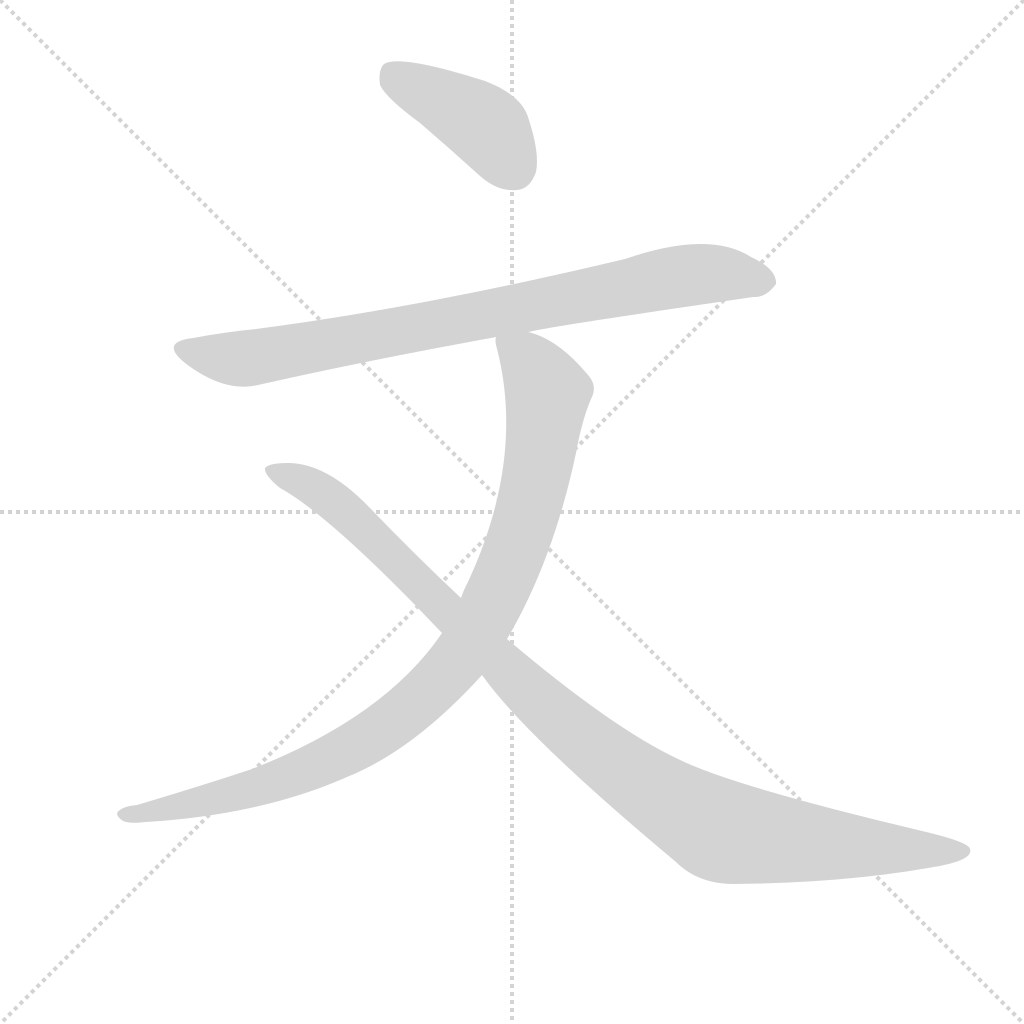
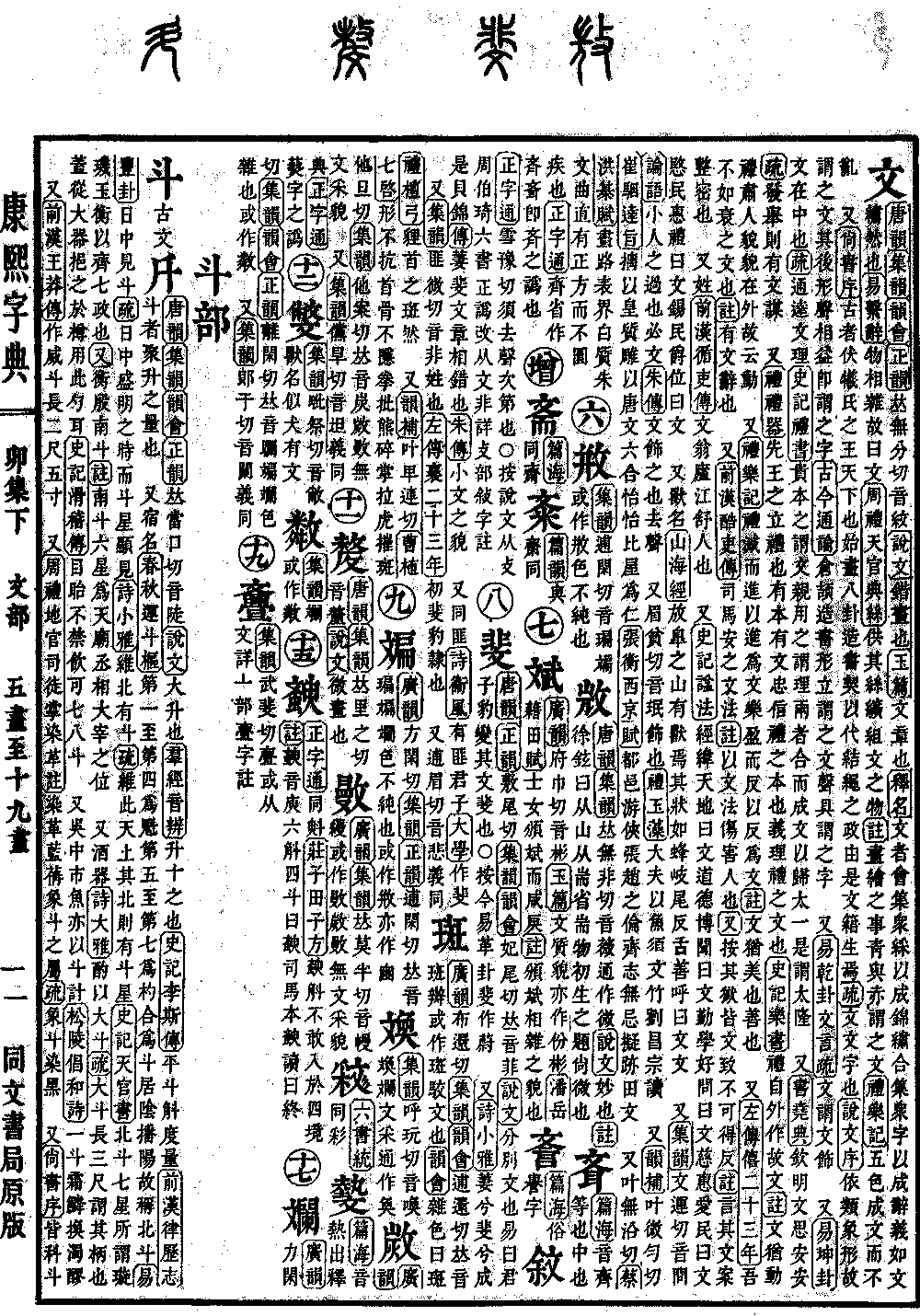
Mao Collection, Lower Volume; Radical: Script (wén); Kangxi stroke count: 4; Page 477, Entry 01
Tang Rhyme (Tangyun), Collection Rhyme (Jiyun), Rhyme Compilation (Yunhui), Correct Rhyme (Zhengyun): Pronounced wen.
Explanation of Graphs (Shuowen): Interwoven and depicted.
Jade Chapters (Yupian): Literary work.
Explanation of Names (Shiming): What is called wen means to collect various colors to weave into brocade. Collecting many written symbols to form literary meaning is like brocade.
Book of Changes (Yijing), Commentary on the Appended Statements: When things are interleaved, it is called wen.
Rites of Zhou (Zhouli), Offices of Heaven, Officials of Silk: Supplying silk, cotton, ribbons, and patterned goods. Commentary: In the matter of painting, matching blue with red is called wen.
Book of Rites (Liji), Record of Music (Yueji): The five colors form patterns without being chaotic.
Book of History (Shangshu) Preface: In ancient times when Fuxi ruled the world, he began to draw the Eight Trigrams and create writing to replace the method of tying knots, and thus books and documents were produced. Commentary: Wen refers to written characters.
Explanation of Graphs (Shuowen) Preface: To draw shapes according to the categories of objects is called wen. Later, when form and sound were combined, it was called a character (zi).
General Discourse of Past and Present (Gujin Tonglun): Cangjie created writing; depicting shapes is called wen, and matching them with sound is called a character (zi).
Book of Changes (Yijing), Qian Hexagram, Commentary on the Text: Wen refers to literary embellishment.
Book of Changes (Yijing), Kun Hexagram: Literary elegance is stored within. Commentary: To be well-versed in literary principles.
Records of the Grand Historian (Shiji), Book of Rites: To respect the source is called wen; to fit the practical is called li (principle). When both are combined it forms wen, returning to the Great Oneness; this is called the Great Prosperity.
Book of History (Shangshu), Canon of Yao: Respectful, discerning, refined, strategic, and gentle. Commentary: To initiate actions with refinement and strategy.
Book of Rites (Liji), Vessels of Rites (Liqi): The ancient kings established rituals, which have foundations and embellishments. Loyalty and trust are the foundation of ritual; righteous principles are the embellishments of ritual.
Records of the Grand Historian (Shiji), Book of Music: Ritual is manifested externally, therefore it is called wen. Commentary: Wen is like movement; ritual makes a person’s appearance solemn. Appearance is external, therefore it is called movement.
Book of Rites (Liji), Record of Music (Yueji): Ritual is simple and encourages people to advance, taking advancement as beauty. Music is abundant and causes people to return, taking returning as beauty. Commentary: Wen is like beauty and goodness.
Zuo Tradition (Zuozhuan), Year 23 of Duke Xi: I am not as refined (wen) as Zhao Cui. Commentary: Refers to having literary talent.
History of the Former Han (Qian Hanshu), Biographies of Harsh Officials: Sima An was well-versed in legal statutes (wen). Commentary: Refers to using legal statutes to harm others. Also: Examining those cases, the legal documents (wen) were so thorough that they could not be overturned. Commentary: Refers to the case files being strict and complete.
A surname. History of the Former Han (Qian Hanshu), Biographies of Upright Officials: Wen Weng was a native of Shu County in Lushan Commandery.
Records of the Grand Historian (Shiji), Treatise on Posthumous Titles: To measure heaven and earth is called wen; to have broad morality is called wen; to be diligent in learning and questioning is called wen; to be benevolent and love the people is called wen; to empathize with the people and distribute grace and rites is called wen; to bestow titles upon the people is called wen.
Name of a beast. Classic of Mountains and Seas (Shanhaijing): On Mount Fanggao there is a beast shaped like a bee with a bifurcated tail and an inverted tongue; it is good at calling, and its name is Wenwen.
Collection Rhyme (Jiyun): Pronounced wen (falling tone). Analects (Lunyu): A petty man who commits a wrong will surely cover it up (wen). Commentary by Zhu Xi: Wen means to cover up; read in the falling tone.
Pronounced min. To decorate. Book of Rites (Liji), Jade Precepts (Yuzao): A great officer uses fish whiskers to decorate bamboo implements. Liu Changzong reads it this way.
Rhyme Supplement (Yunbu): Rhymes with wei-yun. Cui Yin, Statement of Reaching (Dazhi): Holding onto the simplicity of the ancients, carving it with the refinement of Tang Yao. The world is harmonious, and every household consists of virtuous people.
Zhang Heng, Rhapsody on the Western Capital (Xijing Fu): The wandering knights in the city, such as Zhang Hui and Zhao Jun. Their ambitions are compared to Tian Wen of Lord Mengchang.
Rhymes with wu-yan. Cai Hong, Rhapsody on Chess (Qi Fu): Drawing the lines with white backgrounds and red patterns. Upright and with rules, square without being slippery.