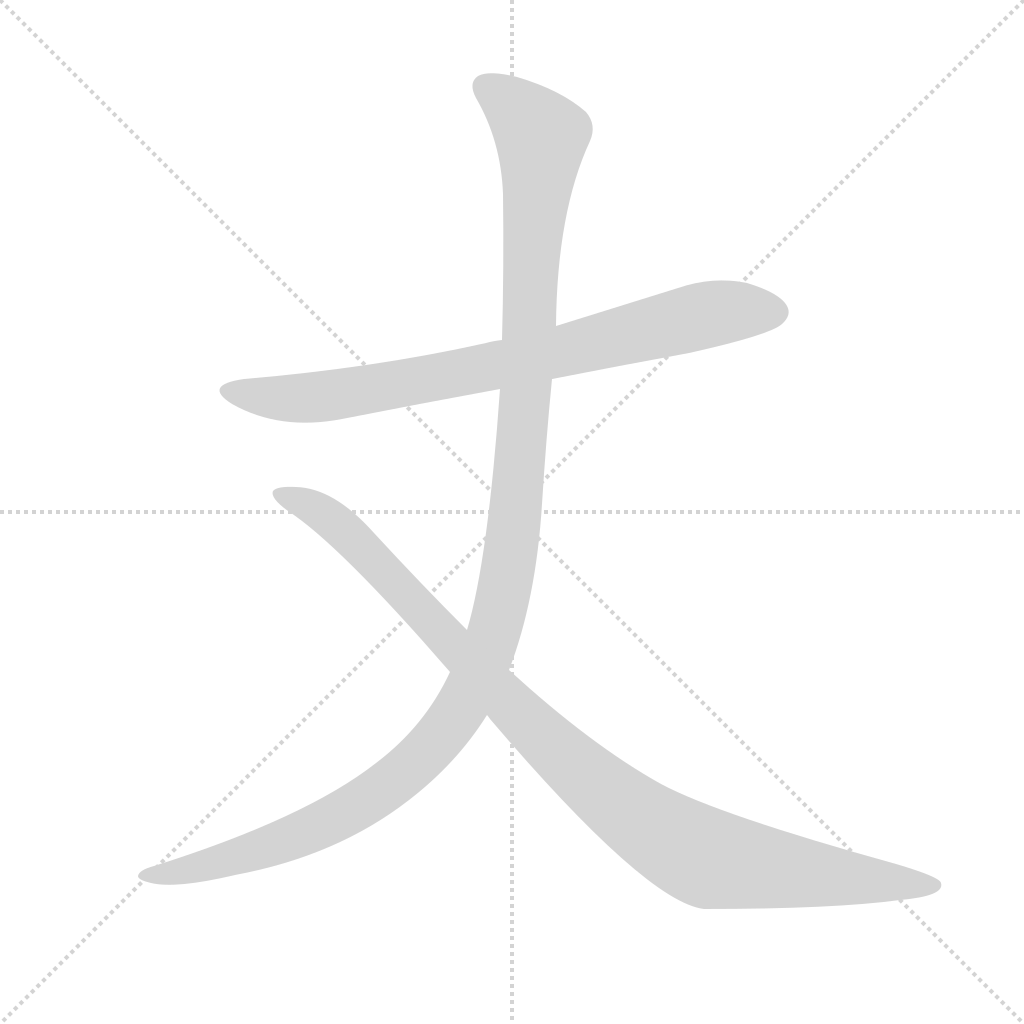
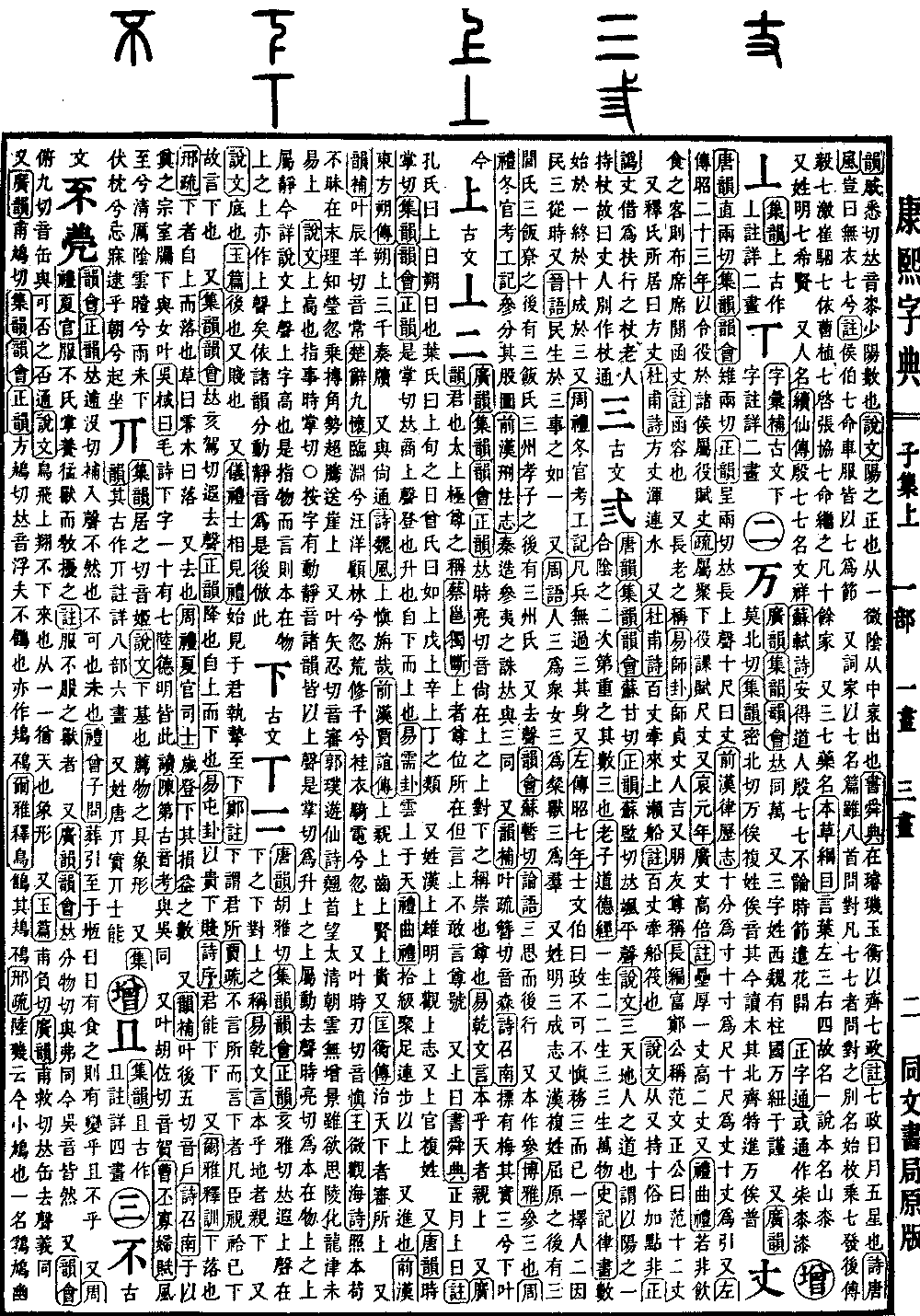
Zi Collection, Page Position: Upper. Radical: One (yī). Kangxi Strokes: 3. Page 76, Number 04. Tang Dynasty Rhymes (Tangyun) records the pronunciation as the fanqie of zhí and liǎng. Collected Rhymes (Jiyun) and Rhyme Assembly (Yunhui) record it as the fanqie of zhì and liǎng. Correct Rhymes (Zhengyun) records it as the fanqie of chéng and liǎng. It is pronounced as the rising tone of the word cháng. Ten feet (chi) constitute one zhang. According to the Treatise on Rhythms and the Calendar (Lulizhi) in the Book of Han (Hanshu), ten fen make one inch (cun), ten inches make one foot (chi), ten feet make one zhang, and ten zhang make one yin. It is also used in the Zuo Commentary (Zuozhuan) during the 32nd year of Duke Zhao regarding the ordering of feudal lords into service and the allocation of labor and engineering dimensions. The sub-commentary explains this as gathering subordinate laborers to assess and assign the dimensions of the engineering work. In the 1st year of Duke Ai, it describes a width of one zhang with the height doubled. The commentary notes that the rampart wall was one zhang thick and two zhang high. The Summary of Ceremonies (Quli) in the Book of Rites (Liji) states that if guests are not attending a meal, mats should be laid out with a distance of one zhang between them. The commentary explains that the term hán means to accommodate. It is also a term of address for elders. The Classic of Changes (Yijing) in the Army (Shi) hexagram states that if the army maintains the right path, it will be auspicious for the elders. It is also a respectful form of address between friends. In the Extended Compilation (Changbian), Duke Fu Zheng addressed Duke Fan Wenzheng as Fan the twelfth elder (Fan Shier Zhang). In Buddhism, the living quarters of a monk are called fāngzhàng. A poem by Du Fu mentions that the fāngzhàng seems to connect with the water's surface. Another poem by Du Fu mentions a bǎizhàng pulling a boat up the rapids. The commentary notes that bǎizhàng refers to a bamboo towrope used for pulling boats. The Explanation of Script and Elucidation of Characters (Shuowen Jiezi) states the character form represents a hand holding the number ten. The common form with an added dot is incorrect. The Correction of Errors (Zheng'e) notes that the character is borrowed to refer to a walking stick. Because elderly people hold walking sticks, they are called zhàngrén. It is also written as the character for staff (zhàng), and the two are used interchangeably. Textual Research: In the Zuo Commentary, the reference to the 23rd year of Duke Zhao should be corrected to the 32nd year. In the poem by Du Fu, the phrase "pulled here" should be corrected to "whose boat." In the commentary, the word for "raft" should be corrected to "bamboo towrope."