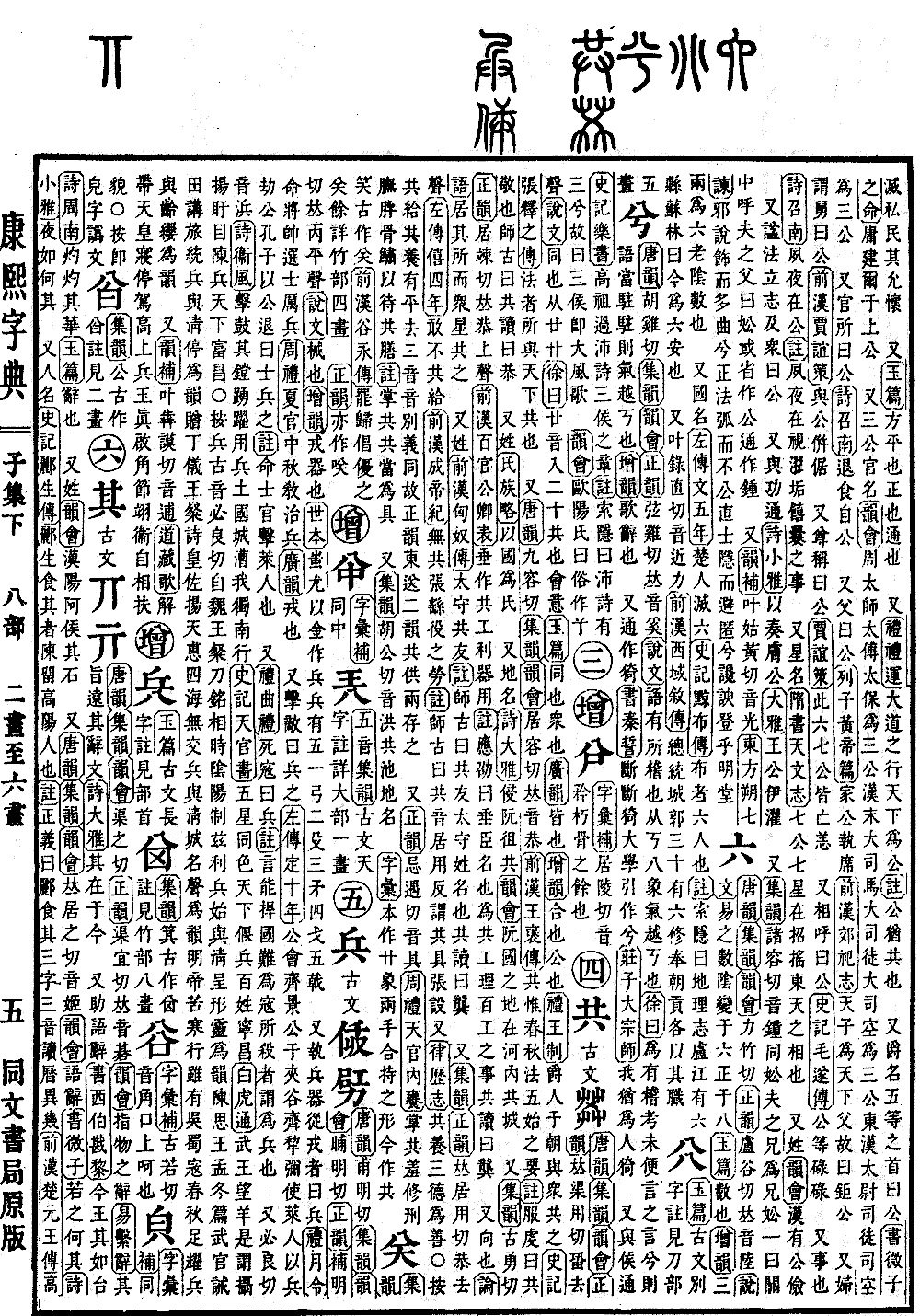
Zi Collection, Page Position: Lower. Radical: Eight (bā). Kangxi Dictionary strokes: 6. Page 127, Number 05.
Tang Yun (Tangyun), Ji Yun (Jiyun), Yun Hui (Yunhui), and Zheng Yun (Zhengyun) all record the fanqie as qú yòng qiè, pronounced like the departing tone of the word qióng.
Shuo Wen Jie Zi (Shuowen Jiezi) explains it as: together. The character form is composed of niàn and niàn.
Xu Xuan's note says: niàn is pronounced rù, representing twenty; the combination of two such parts forms gòng, making it an associative compound character.
Yu Pian (Yupian) explains it as: identical or numerous.
Guang Yun (Guangyun) explains it as: all or entirely.
Zeng Yun (Zengyun) explains it as: merged or publicly owned.
The Book of Rites (Liji) records: When conferring noble ranks at court, one must decide together with the scholars.
The Records of the Grand Historian (Shiji) records: The law is that which is observed in common by all under heaven.
Also read in Tang Yun as jiǔ róng qiè, and in Ji Yun and Yun Hui as jū róng qiè, with the same sound as gōng.
The Book of Han (Hanshu) contains the phrase: Respectfully considering the laws of autumn, the essentials of the five beginnings.
A note by Fu Qian says: Gòng means respectful. Yan Shigu says: Gòng is pronounced the same as gōng.
Also a surname.
The Compendium of Clans and Lineages (Shizu lüe) records: Taking the name of a state as a surname.
Also a place name.
The Book of Odes (Shijing) contains: Invaded Ruan and marched to Gong.
Yun Hui records: The territory of the state of Ruan was at Gong City in Heini.
Also read in Ji Yun as gǔ yǒng qiè, and in Zheng Yun as jū sǒng qiè, with the same sound as the rising tone of gōng.
The Book of Han records: Chui served as the Minister of Works (Gonggong), in charge of creating sharp tools.
A note by Ying Shao says: Chui is a person's name. Serving as the Minister of Works, he managed the affairs of the hundred artisans. Here gòng is pronounced the same as gōng.
Also means to face toward.
The Analects (Lunyu) contains: Remaining in its place while all the stars turn toward it.
Also a surname.
The Book of Han contains: The Grand Administrator Gong You.
A note by Yan Shigu says: Gong You is the name of the Grand Administrator. Here gòng is pronounced the same as gōng.
Also read in Ji Yun and Zheng Yun as jū yòng qiè, with the same sound as the departing tone of gōng.
The Zuo Zhuan (Zuozhuan) contains: How would I dare not provide supplies?
The Book of Han contains: Without the labor of providing and preparing for corvée service.
A note by Yan Shigu says: Gòng is pronounced jū yòng fǎn, meaning to supply or to set up.
The Treatise on Pitch-pipes and the Calendar (Lülizhi) contains: Providing for and nourishing the three virtues constitutes goodness.
Note: To provide (gòngjǐ) and to nourish (gòngyǎng) have both level and departing tone pronunciations; the sounds differ but the meanings are the same, which is why the Zheng Yun includes both the characters gòng and gōng under the dōng and sòng rhymes.
Also read in Zheng Yun as jì yù qiè, with the same sound as jù.
The Rites of Zhou (Zhouli) records: In charge of preparing the delicacies of dried meat, large cuts of meat, and dried fish, to await the preparation of meals.
A note says: The word gòng in the phrase in charge of preparing (zhǎnggòng) should be understood as jù.
Also read in Ji Yun as hú gōng qiè, with the same sound as hóng.
Gongchi is a place name.
Zihui (Zihui) explains: Originally written as niàn, resembling the shape of two hands holding something together. It is now written as gòng.