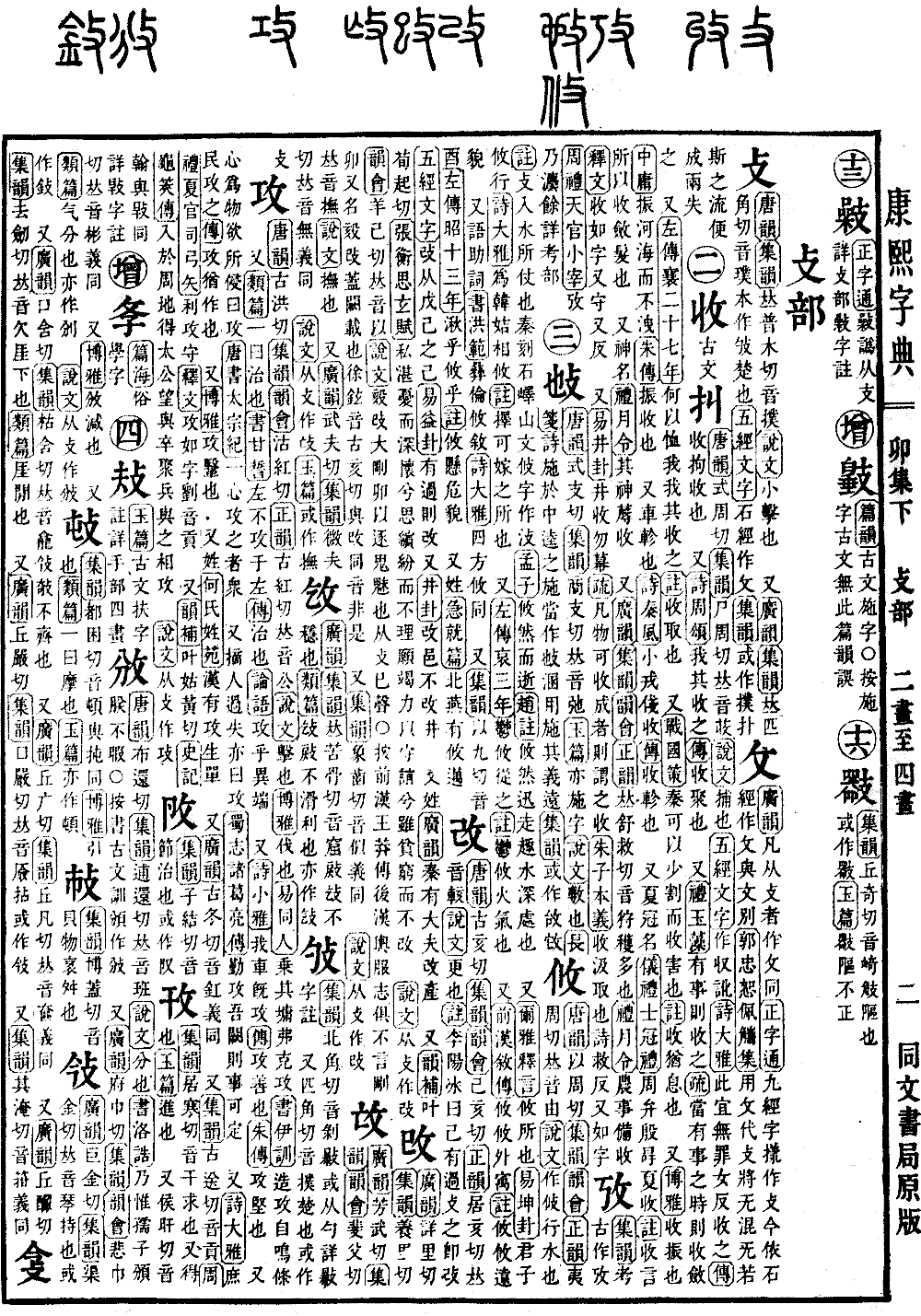
Mao Collection, Lower Volume
Radical: Tapping (pū)
Page 468, Entry 06
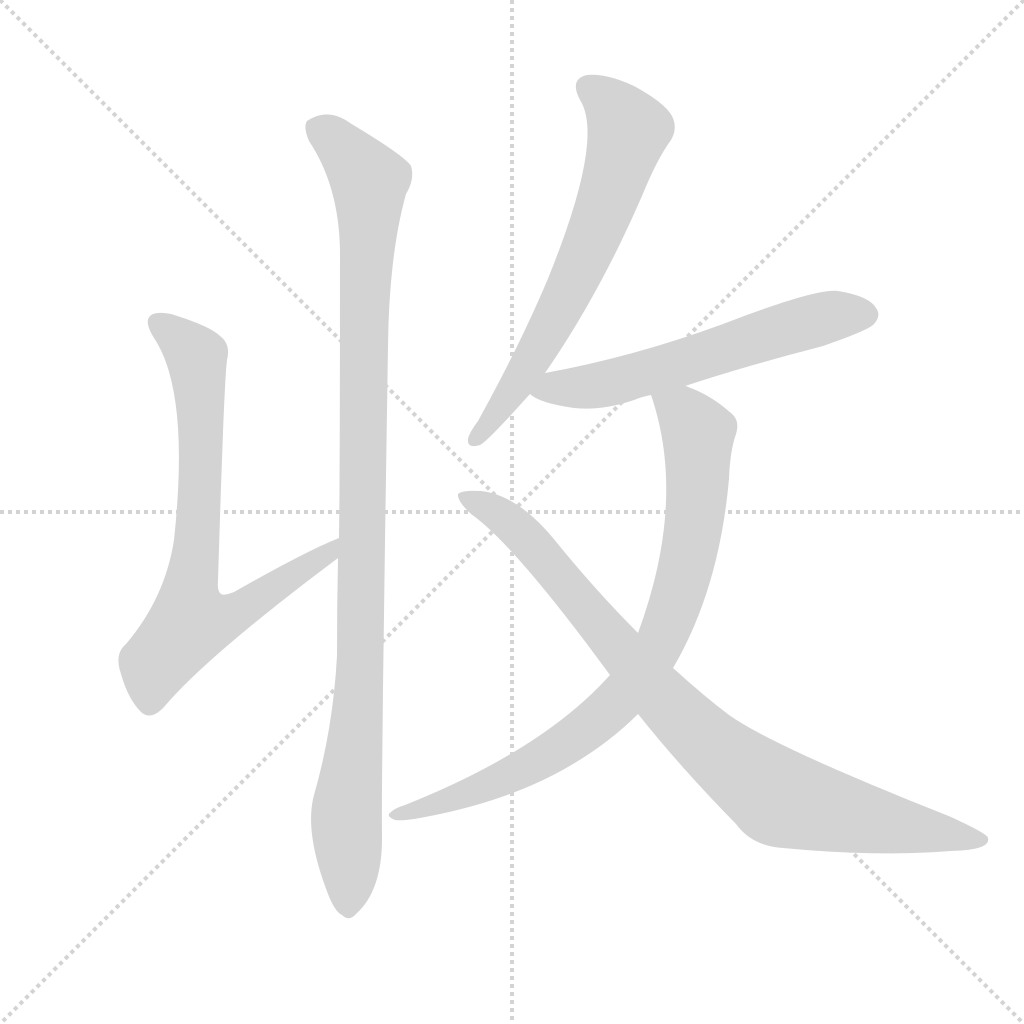
Ancient form. Pronounced shou. According to the Explaining Graphs and Analyzing Characters (Shuowen Jiezi), it means to arrest or capture. According to the Five Classics Script (Wujing Wenzi), it is written as a variant form, which is erroneous. In the Book of Odes (Shijing), Great Odes: This person should be innocent, yet you arrest him. The commentary states that shou means to arrest or capture. Also in the Book of Odes, Zhou Hymns: I have come to gather it. The commentary states that shou means to gather. Also in the Book of Rites (Liji), Jade Pattern: When there is an affair, one should restrain oneself. The sub-commentary states that when there is an affair, one should gather oneself together. Also in the Zuo Commentary (Zuo Zhuan), twenty-seventh year of Duke Xiang: With what shall I be comforted, I shall accept it. The note states that shou means to obtain or accept. Also in the Strategies of the Warring States (Zhanguo Ce): The State of Qin may yield a small amount of territory to cease the calamity. The note states that shou is like the meaning of to cease or stop. Also in the Explaining Elegant Words (Boya): Shou means to organize or put in order. In the Doctrine of the Mean (Zhongyong): To organize the rivers and seas without allowing them to leak. Zhu Xi's commentary states that the term zhen means to collect or organize. Also refers to the crossbar at the bottom of a carriage box. In the Book of Odes, Odes of Qin: The crossbar of the small war carriage is shallow. The commentary states that shou refers to the crossbar at the bottom of the carriage box. Also refers to the name of a cap from the Xia Dynasty. In the Ceremonial Rites (Yili), Capping Rites of Scholars: The Zhou called it bian, the Yin called it xu, and the Xia called it shou. The note states that shou means that which is used to gather or confine the hair. Also refers to the name of a deity. In the Book of Rites, Monthly Ordinances: That deity is called Rushou. Also according to the Guangyun, Jiyun, Yunhui, and Zhengyun, pronounced shou (falling tone): The meaning of a bountiful harvest. In the Book of Rites, Monthly Ordinances: Agricultural tasks are all completed and harvested. The explanation of the text states that shou is read in its original tone, and also read as shou (falling tone). Also in the Book of Changes (Yijing), Jing Hexagram: When well water is drawn, do not cover the well. The sub-commentary states that everything that can be harvested or matured is called shou. Zhu Xi's Original Meaning states that shou means to draw or extract. It can be read as shou (falling tone), or it can be read in its original tone.