Si Collection, Upper Volume
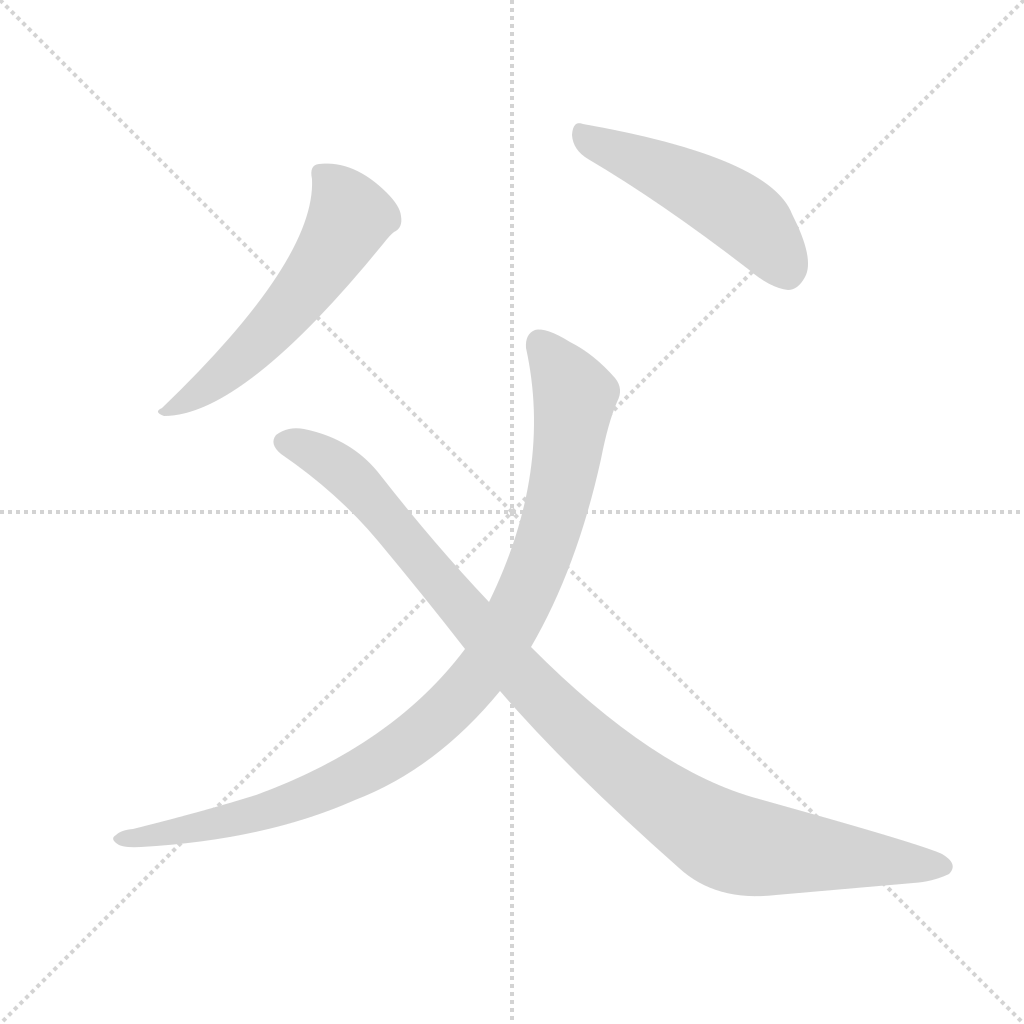
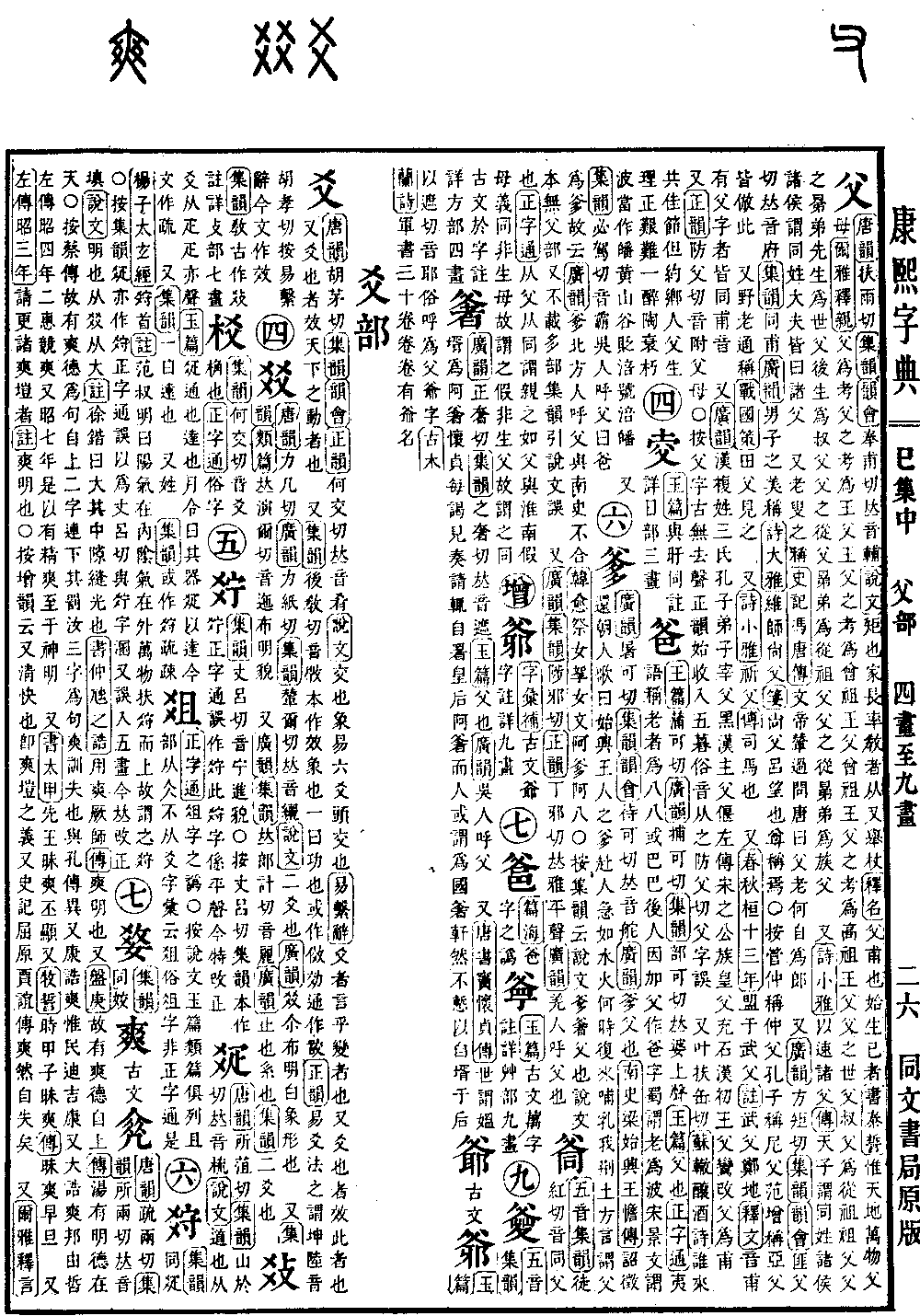
Radical: Father (fù)
Kangxi Strokes: 4
Page 690, Entry 01
Tang Rhymes (Tangyun): Pronounced fu. Collected Rhymes (Jiyun), Rhyme Meetings (Yunhui): Pronounced fu.
Explanation of Graphs (Shuowen): A rule or standard. One who leads and teaches the head of the household. Composed of the character for hand, representing the raising of a staff.
Explanation of Names (Shiming): Father means to begin. One who brings forth life.
Book of Documents (Shujing), Great Declaration (Taishi): Heaven, Earth, and the myriad things are the father and mother of all.
Erya, Explaining Kindred (Shiqin): A father is referred to as kao. The father of one's father is the grandfather (wangfu). The father of the grandfather is the great-grandfather (zengzu wangfu). The father of the great-grandfather is the ancestor (gaozu wangfu). The father's older brother is the uncle (shifu); the younger brother is the uncle (shufu). The father's cousin is referred to as the cousin-grandfather. The father's older brother born before the father is the uncle (shifu). The younger brother born after is the uncle (shufu). The father's father's cousin is the cousin-father. The father's cousins are the clan-fathers.
Also, Book of Odes (Shijing), Lesser Odes (Xiaoya): To summon the clan-fathers. Commentary: The Son of Heaven calls officials of the same surname fathers; feudal lords call officials of the same surname fathers.
Also, a term for an old man. Records of the Grand Historian (Shiji), Biography of Feng Tang: Emperor Wen passed in his carriage and asked Tang: Old father, why did you become a gentleman?
Also, Extensive Rhymes (Guangyun): Pronounced fu. Collected Rhymes (Jiyun), Rhyme Meetings (Yunhui): Pronounced fu. Collected Rhymes (Jiyun): Identical to the character for starting/beginning (fu). Extensive Rhymes (Guangyun): A beautiful title for a man.
Book of Odes (Shijing), Greater Odes (Daya): Only Teacher Shangfu. Commentary: Shangfu is Lu Wang, an honorable title. Note: Guan Zhong was called Zhongfu. Confucius was called Nifu. Fan Zeng was called Yafu. All are derived from this.
Also, a general term for a rustic old man. Strategies of the Warring States (Zhan Guo Ce): A field-father saw him.
Also, Book of Odes (Shijing), Lesser Odes (Xiaoya): Qi-fu. Commentary: The Minister of War.
Also, Spring and Autumn Annals (Chunqiu), Duke Huan, 13th Year: Alliance at Wufu. Note: Wufu is a location in Zheng. Explanations of Texts (Shiwen): Pronounced fu; all instances of this character are pronounced like the character for starting/beginning (fu).
Also, Extensive Rhymes (Guangyun): A Han dynasty double-surname. There are three families: Confucius's disciple Zaifu Hei, the Han official Zhufu Yan, and the Zuo Commentary (Zuo Zhuan) records the Song dynasty ducal clan member Huangfu Chongshi. In the early Han, Huangfu Luan changed his surname from Father (fu) to Beginning (fu).
Also, Orthography (Zhengyun): Pronounced fu. Mother and father. Note: In ancient times, the character for father did not have a departing tone. Orthography (Zhengyun) began including it in the five-mu rhyme group. Popular pronunciation followed this. The reading for fu is incorrect.
Also, rhymes with the sound fu. Su Zhe, Wine Brewing Poem: Who comes to share the holiday, just inviting the village fathers; livelihood is truly difficult, one drunkard bows to the decay of old age.
Textual Research: Extensive Rhymes (Guangyun): A Han dynasty double-surname. There are three families: Confucius's disciple Zaifu Hei, the Han official Zhufu Yan, and the Zuo Commentary (Zuo Zhuan) records the Song dynasty ducal clan member Huangfu Chongshi. In the early Han, Huangfu Luan changed his surname from Father (fu) to Beginning (fu). According to the original text of Extensive Rhymes (Guangyun), Wangfu is corrected to Huangfu.