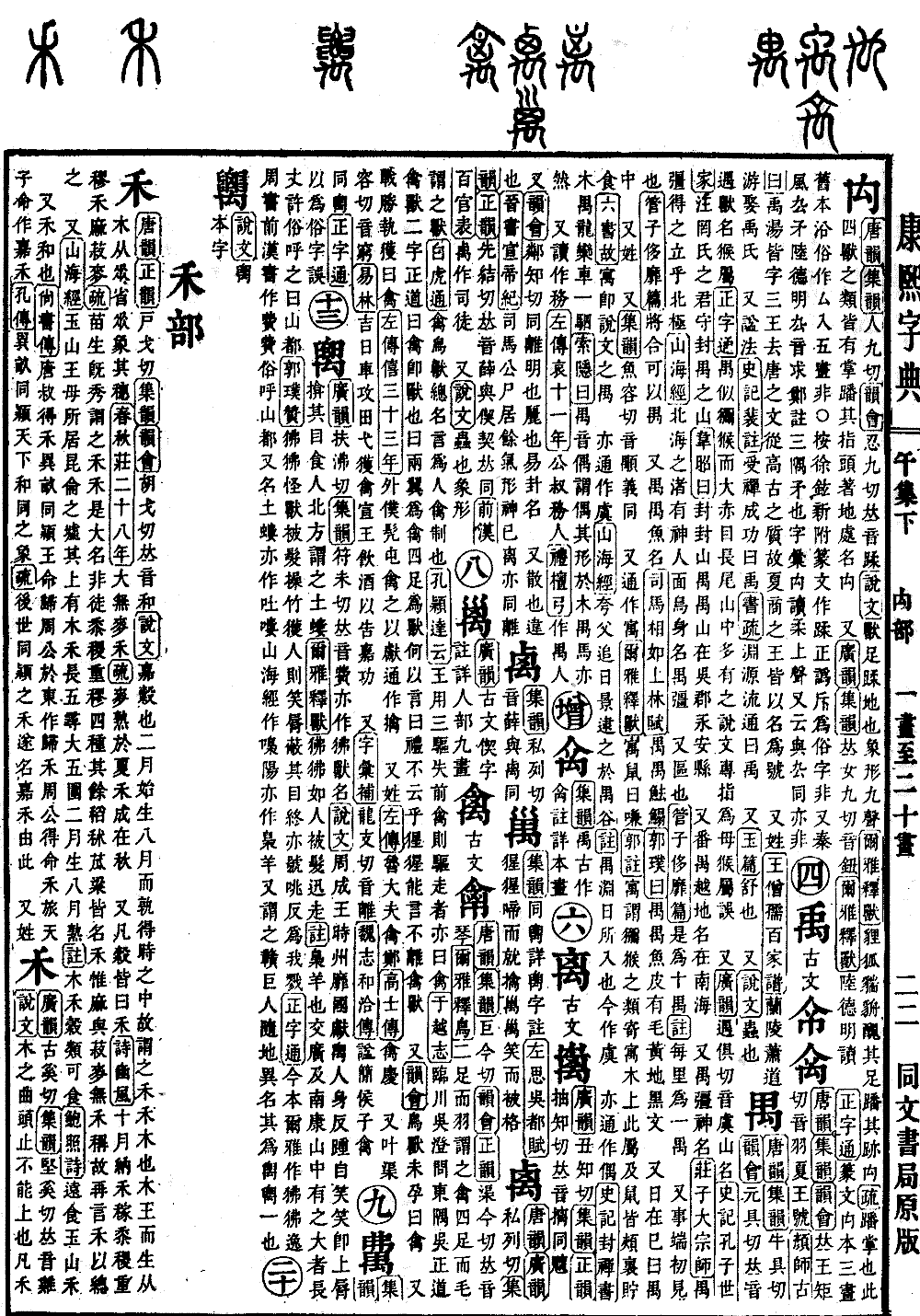
Wu Collection, Lower Volume
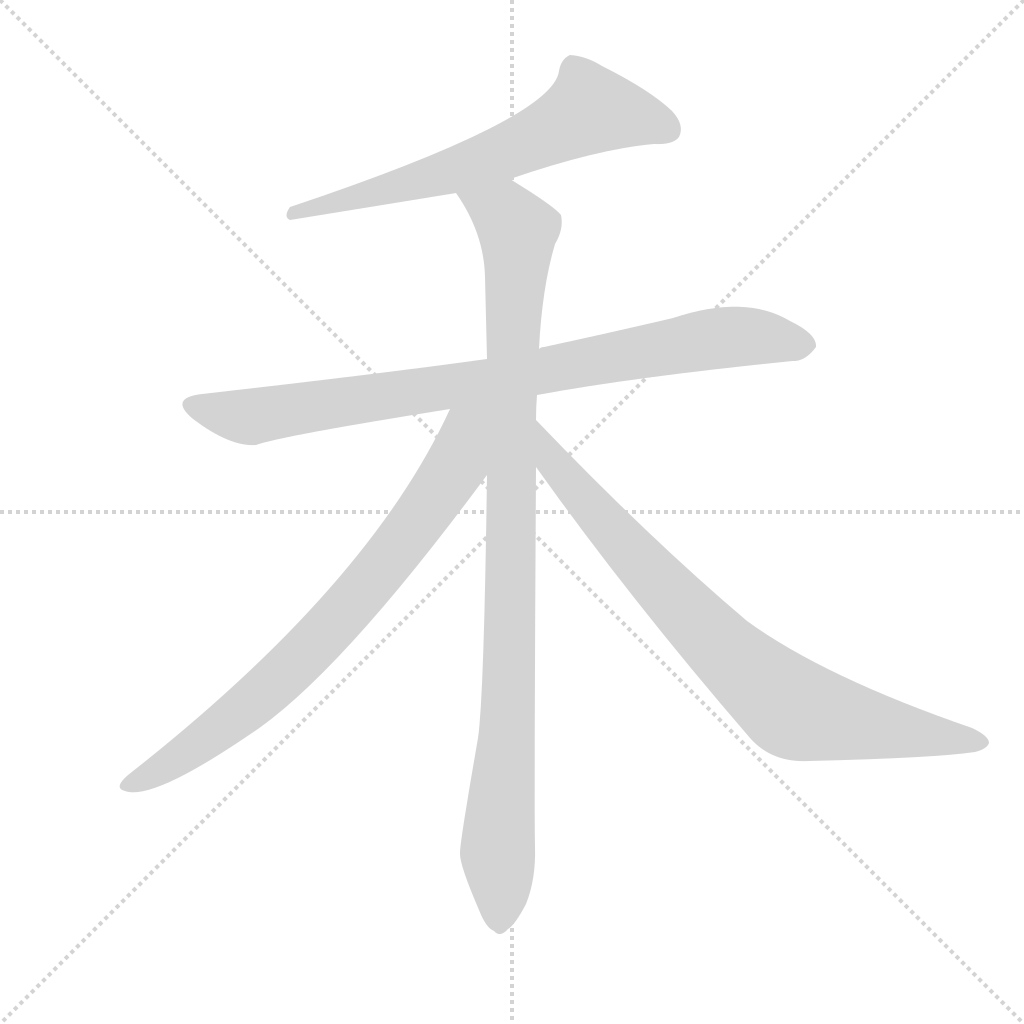
Radical: Grain (hé)
Kangxi stroke count: 5
Page 848, Entry 18
Pronounced he.
Shuowen Jiezi (Explanation of Simple and Compound Characters): Fine grain. It begins to grow in the second month and matures in the eighth month, having attained the suitability of the seasons, which is why it is called he. It belongs to the element of wood. It grows when the wood element is in its prime. The character form consists of wood and an abbreviated wood element, resembling its head of grain.
Spring and Autumn Annals (Chunqiu), 28th Year of Duke Zhuang: There was a great shortage of wheat and grain. Commentary: Wheat matures in summer; grain matures in autumn.
Also, all grains may be referred to as grain.
Book of Odes (Shijing), Odes of Bin: In the tenth month we gather the grain crops, millet, broomcorn millet, early-sown and late-ripened grains, grain, hemp, beans, and wheat. Commentary: When grain seedlings grow and develop heads, they are called grain. Grain is a general term; it does not refer only to millet, broomcorn millet, early-sown, and late-ripened grains. The others such as rice, glutinous rice, water wild rice, and sorghum are all called grain. Only hemp, beans, and wheat do not carry the name grain; therefore, grain is mentioned again to summarize them all.
Also, Classic of Mountains and Seas (Shanhaijing): Jade Mountain is the place where the Queen Mother of the West resides. On the mound of Mount Kunlun, there is the wooden grain, five fathoms long and five spans thick; it grows in the second month and matures in the eighth month. Commentary: The wooden grain is a type of edible cereal. Bao Zhao's poems: Partaking of the grain from Jade Mountain from afar.
Also, grain implies harmony.
Preface to the Book of Documents (Shangshu): Tang Shu obtained grain, from different plots but growing as a single stalk. The King of Zhou ordered it sent to the Duke of Zhou in the east, and wrote Returning the Grain. The Duke of Zhou received the grain bestowed by the Son of Heaven, and set forth the orders of the Son of Heaven, writing Excellent Grain. Commentary by Kong: Different plots growing as a single stalk is a symbol of the world being in harmony and unified. Commentary: Later generations called grain with a single stalk Excellent Grain; this is where it originated.
Also, a surname.
Textual Research: Book of Documents (Shangshu) Commentary: Tang Shu obtained grain, from different plots but sharing a single spike. Note: The citation provided is from the Preface to the book; the commentary was changed to the preface.