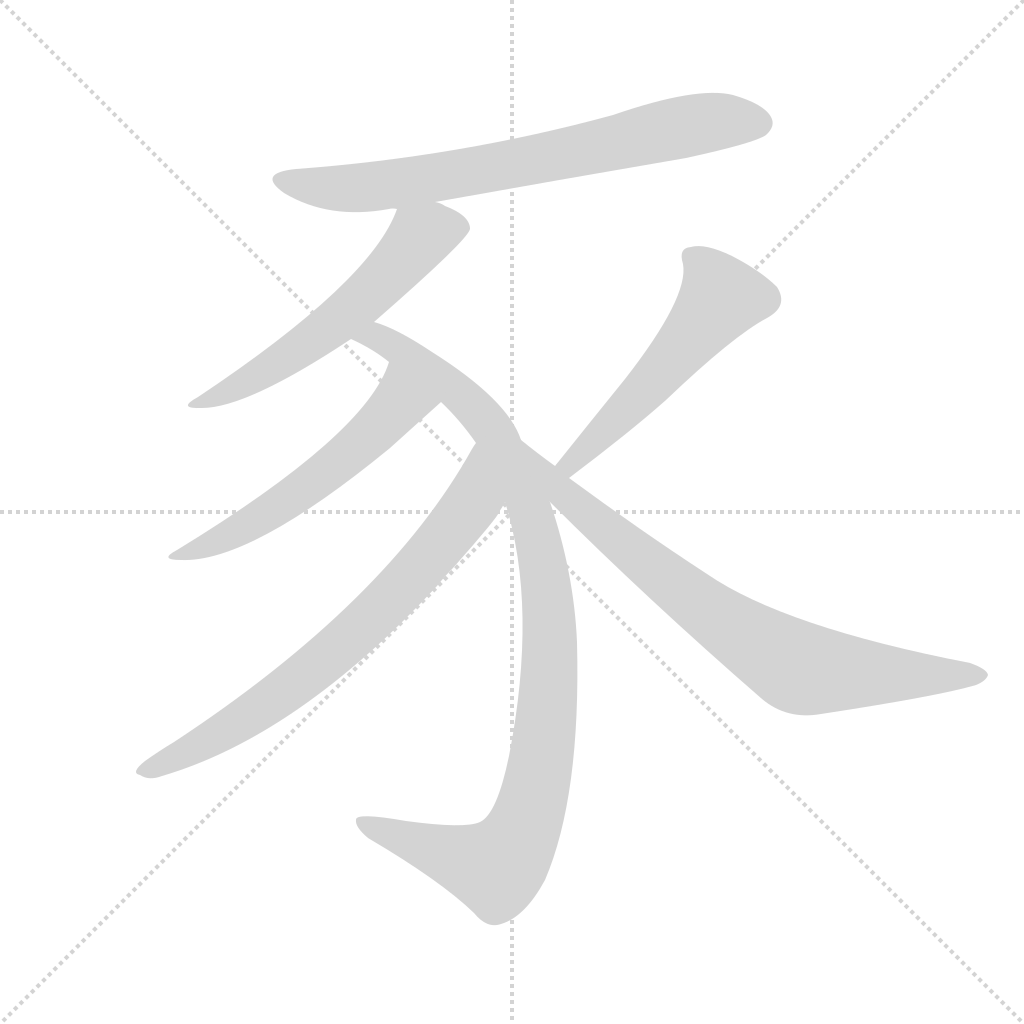
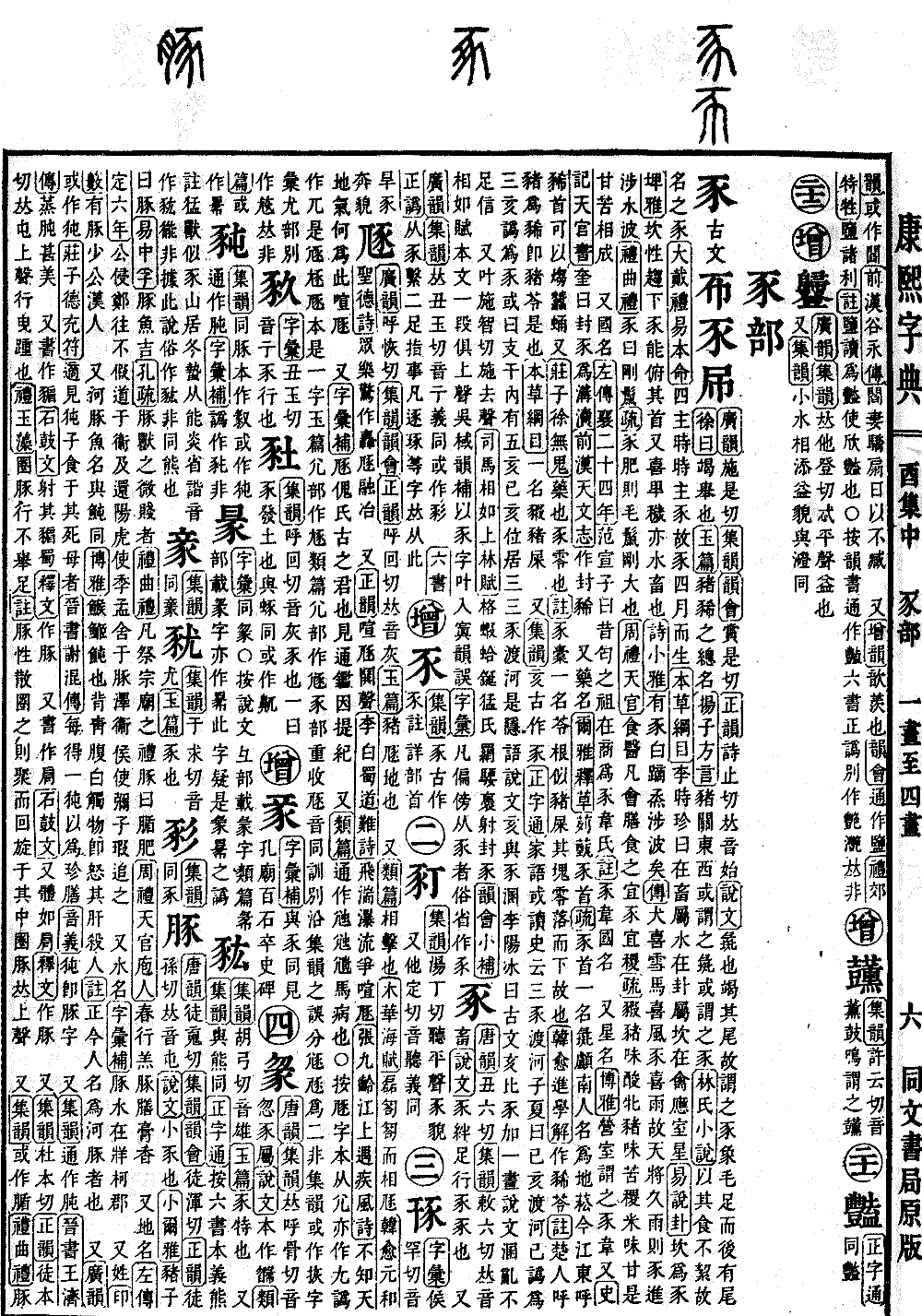
You Collection, Middle Volume. Radical: Pig (shǐ). Page 1194, Entry 04.
Ancient character. Pronounced shǐ. According to the Explaining Graphs and Analysis of Characters (Shuowen Jiezi), it refers to a pig. It lifts its tail, hence it is called a pig; it depicts the fur, feet, and the tail behind. Xu Shen says that to lift means to raise. According to the Jade Chapters (Yupian), it is the general term for pigs and swine. According to the Regional Speech (Fangyan) by Yang Xiong, in regions east and west of the pass, pigs are sometimes called zhi or sometimes shi. According to the Fiction of the Lin Family (Linshi Xiaoshuo), because it eats unclean things, it is called shi. According to the Book of Dai (Dai Dai Liji), the fourth month governs the seasons, and the seasons govern the pig, which is why pigs give birth in the fourth month. According to the Compendium of Materia Medica (Bencao Gangmu), Li Shizhen states: Among domestic animals, it belongs to water; among the trigrams, it belongs to Kan; among the constellations, it corresponds to the Encampment Mansion. According to the Book of Changes (Yijing), the trigram Kan represents the pig. According to the Pi Ya, the nature of Kan is to tend downward, and the pig is capable of bowing its head and enjoys filth; it is also a water animal. According to the Book of Odes (Shijing), there are pigs with white hooves wading across the waves. The commentary states: Dogs enjoy snow, horses enjoy wind, and pigs enjoy rain, so when heaven is about to have prolonged rain, the pigs will wade into the water waves. According to the Book of Rites (Liji), a pig is called a rigid-bristled one. The commentary states: When a pig is fat, its hair and bristles are rigid and large. According to the Rites of Zhou (Zhouli), regarding the officials of the heavenly court and food physicians: In coordinating the appropriateness of provisions and food, pork is appropriate with broomcorn millet. The commentary states: The meat of a male pig is sour, and the meat of a female pig is bitter; the taste of broomcorn millet is sweet, so the sweet and bitter complement each other. Also, a state name. According to the Zuo Commentary (Zuozhuan), Fan Xuanzi said: In the past, the ancestors of Gai were the Shiwei clan during the Shang Dynasty. The commentary states: Shiwei is the name of a state. Also, a star name. According to the Bo Ya, the Encampment Mansion is called Shiwei. Also, according to the Records of the Grand Historian (Shiji), the constellation Kui is called the Great Pig, which represents moats and ditches. The History of the Former Han (Qianhan Shu) writes this as the Great Swine. Also, a medicinal name. According to the Er Ya, regarding the explanation of plants: The le-zhen plant is called pig-head. The commentary states: Pig-head, also known as swine-skull; southerners call it earth-cabbage; today in the Jiangdong region it is called swine-head, which can be used to fry silkworm pupae. Also, according to the Zhuangzi, it is medicinal, known as shi-ling. The commentary states: Shi-tuo, also known as ling-gen, resembles pig feces, and its lumps fall scattered, which is why it is so named. Han Yu in the Advance Learning Explanation (Jinxue Jie) writes it as swine-ling. The commentary states: People in Chu call a pig a swine, which is the pig-ling. According to the Compendium of Materia Medica (Bencao Gangmu), it is also known as male pig feces. Also, according to the Collection of Rhymes (Jiyun), the character for the twelfth earthly branch hai was anciently written as shi. According to the Dictionary of Correct Characters (Zhengzitong), the Family Sayings (Jia Yu) records a reading of historical texts stating: Three pigs crossed the river. Zixia said: It was actually the character hai that crossed the river. The character ji was mistaken for three, and the character hai was mistaken for shi. Others say that among the stems and branches there are five types of hai, and the ji-hai position ranks third; the three pigs crossing the river is a riddle. The Explaining Graphs and Analysis of Characters (Shuowen Jiezi) confuses hai with shi. Li Yangbing says: The ancient character for hai has one extra stroke compared to shi, and the Explaining Graphs (Shuowen) is confused and unreliable. Also rhymes with the pronunciation shi. In Sima Xiangru’s Rhapsody on the Shanglin Park (Shanglin Fu), it is used to capture shrimp and clams, and to shoot the great swine. The Supplement to the Collection of Rhymes (Yunhui Xiaobu) suggests that in the original text of Xiangru’s Rhapsody, all are in the upper tone; Wu Yu’s Rhyme Supplement (Yunbu) incorrectly rhymes the character shi with the zhi rhyme group. According to the Compendium of Characters (Zihui), whenever a radical uses shi, it is often abbreviated to the character shi.