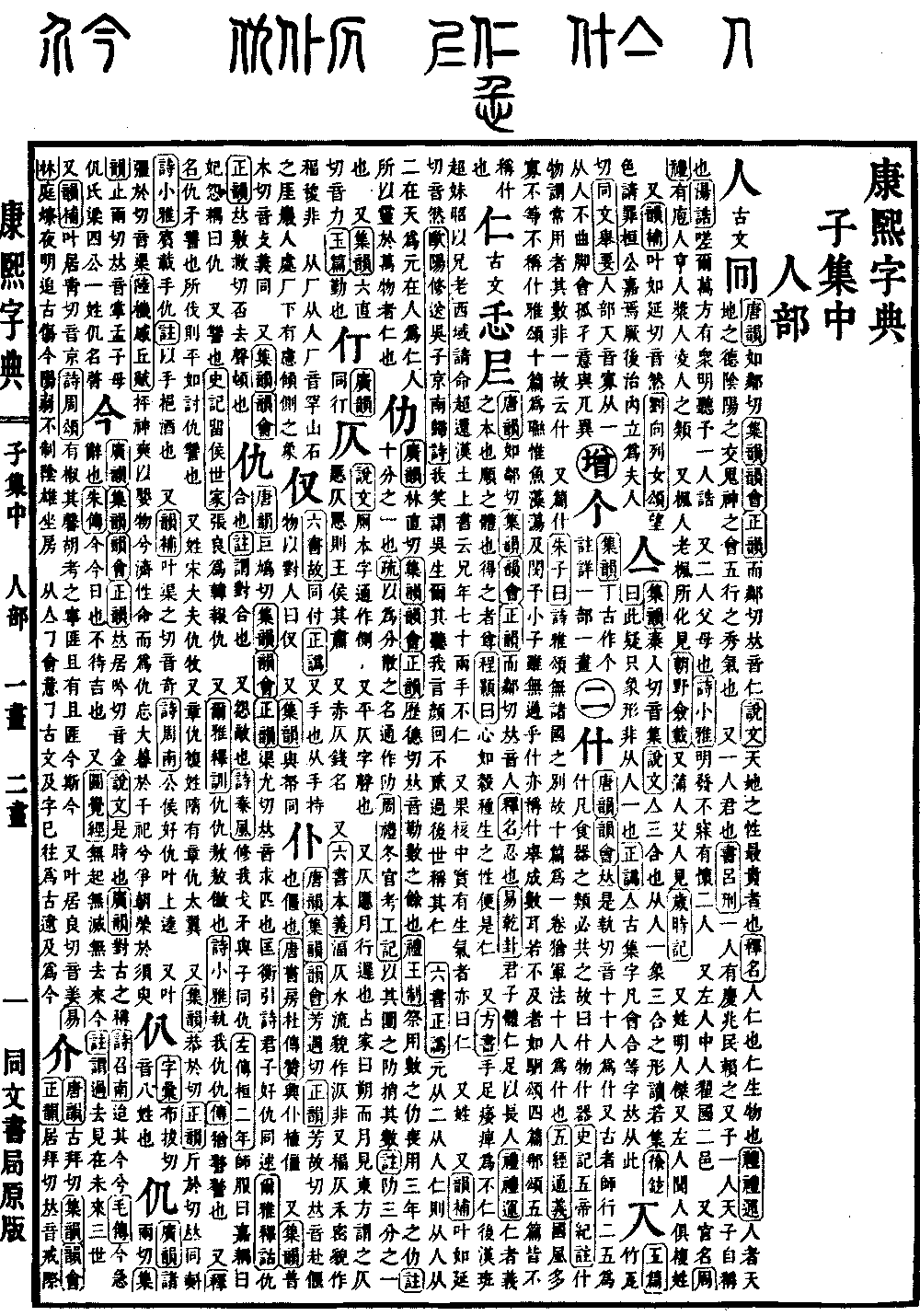
Zi Collection, Middle Volume. Radical: Person (rén). Kangxi stroke count: 4. Page 91, entry 19.
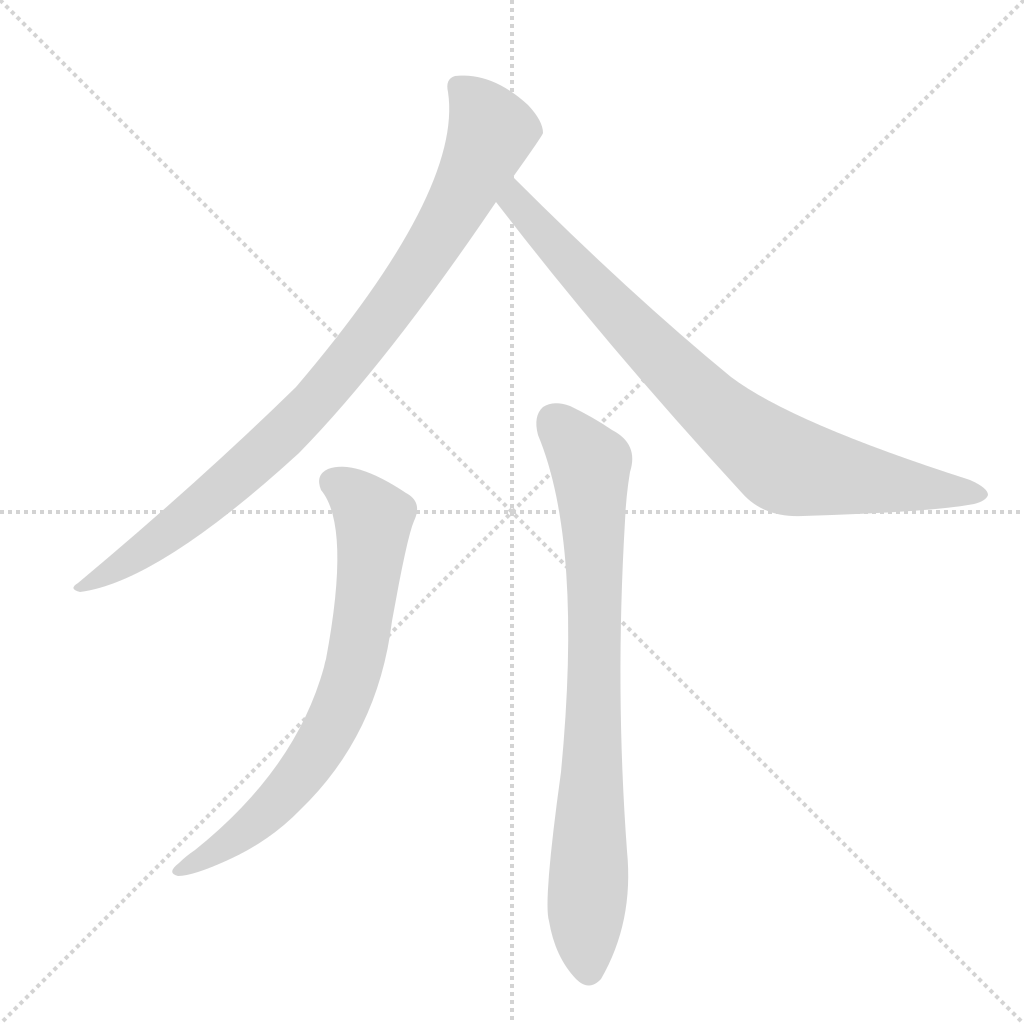
Guangyun: Pronounced jie. Jiyun, Yunhui, Zhengyun: Pronounced jie. Meaning: To border or meet. Book of Changes (Yijing), Treatise on the Appended Statements: The existence of worry, regret, and shame lies in this borderline. Commentary: This refers to the edge of discernment. Zuo Tradition (Zuo Zhuan), Ninth Year of Duke Xiang: Residing in the border between two great states. Also: To assist. Book of Odes (Shijing), Binfeng: Preparing this spring wine to assist in longevity. Also: Great. Book of Odes (Shijing), Xiaoya: May the spirits hear you and confer upon you great good fortune. Also: Er ya (Erya), Explanation of Ancient Words: Jie means good. Also: To rely upon. Zuo Tradition (Zuo Zhuan), Seventh Year of Duke Xi: To seek reliance from a great state. Also: Sixth Year of Duke Wen: To rely on another's favor is not courage. Records of the Grand Historian (Shiji), Biography of Lu Zhonglian: Lord Pingyuan said: I request to act as your introducer. Kongzi Jiaoyu (Kongcongzi), Difficult Teachings: Zi Shang said: A gentleman does not meet others without an introducer. Also: Yangzi, Dialect (Fangyan): Jie means solitary. Things without a pair are called solitary (te); beasts without a pair are called solitary (jie). Also: Small. Yangzi, Model Sayings (Fayan): Ascending Mount Tai and knowing the insignificance of the surrounding hills, how much more so for the small mounds? Also: To be situated in between. In ancient times, the host had a representative, and the guest had a representative. Book of Rites (Liji), Meaning of Audiences: A high duke has seven representatives; a marquis or count has five; a viscount or baron has three. Also: To separate. Zuo Tradition (Zuo Zhuan), Twentieth Year of Duke Zhao: Yanzi said: The pass that is a narrow barrier, violently exacting its private dues. Commentary: Jie means a barrier; a pass closely adjacent to the capital. Also: Noble representative. Zuo Tradition (Zuo Zhuan), Twenty-sixth Year of Duke Xiang: Prince Wei, the noble representative brother of our humble ruler. Also: Baojie, assistant to the agricultural official. Book of Odes (Shijing), Zhou Songs (Zhousong): Alas, the assistant to the agricultural officer. Also: Firm and unyielding is also called jie. Book of Changes (Yijing), Yu Hexagram: Firm as a rock. Mencius: Duke Liu Xia Hui would not change his integrity even for the position of a high official. Also: Jie-jie, similar to being anxious or distressed. Book of the Later Han (Hou Hanshu), Biography of Ma Yuan: I am merely troubled by this alone. Also: Side or bank. Chu Ci (Chuci), Nine Chapters (Jiuzhang): Saddened by the legacy of the river bank. Also: One person is called one jie. Zuo Tradition (Zuo Zhuan), Eighth Year of Duke Xiang: Nor shall I send a single messenger to inform our humble ruler. Also: Armor and weapons. Book of Rites (Liji), Qu Li: When wearing armor and helmet, one should have an appearance that cannot be violated. Also: Aquatic animals with scales are also called scaled-jie. Book of Rites (Liji), Monthly Ordinances (Yueling): In the month of early winter, its insects are those with shells. Also: History of the Former Han (Qian Hanshu), Treatises on the Five Elements: In the sixteenth year of Duke Cheng of the Spring and Autumn period, there was freezing rain on trees. Some say that today's elders call tree-ice 'tree-jie'; 'jie' represents armor and weapons. Also: Name of a state. Spring and Autumn Annals (Chunqiu), Twenty-ninth Year of Duke Xi: Jie Gelu came to pay a court visit. Commentary: Jie is the name of an Eastern Yi state; Gelu is his personal name. Also: A surname. Jie Zhitui of the Jin state. Also: Same as mustard (jie). History of the Former Han (Qian Hanshu), Biography of Empress Yuan: She treated the Prince Gong very generously and did not take past matters as a small offense. Also: Harmonizes with the rhyme of jeri, pronounced ji. Ma Rong, Rhapsody on the Long Flute (Changdi fu): Clear and sharp, like the boundary of light. Fierce and overbearing, the spirit of various heroes. Shuowen Jiezi (Shuowen): Written as claw, composed of person placed in the middle of eight. Zheng E: Claw means to divide or draw a line, a limit. Composed of person and eight, it signifies the meaning of distinguishing. Separately written as ge. See the note on the character ge in the Line radical.