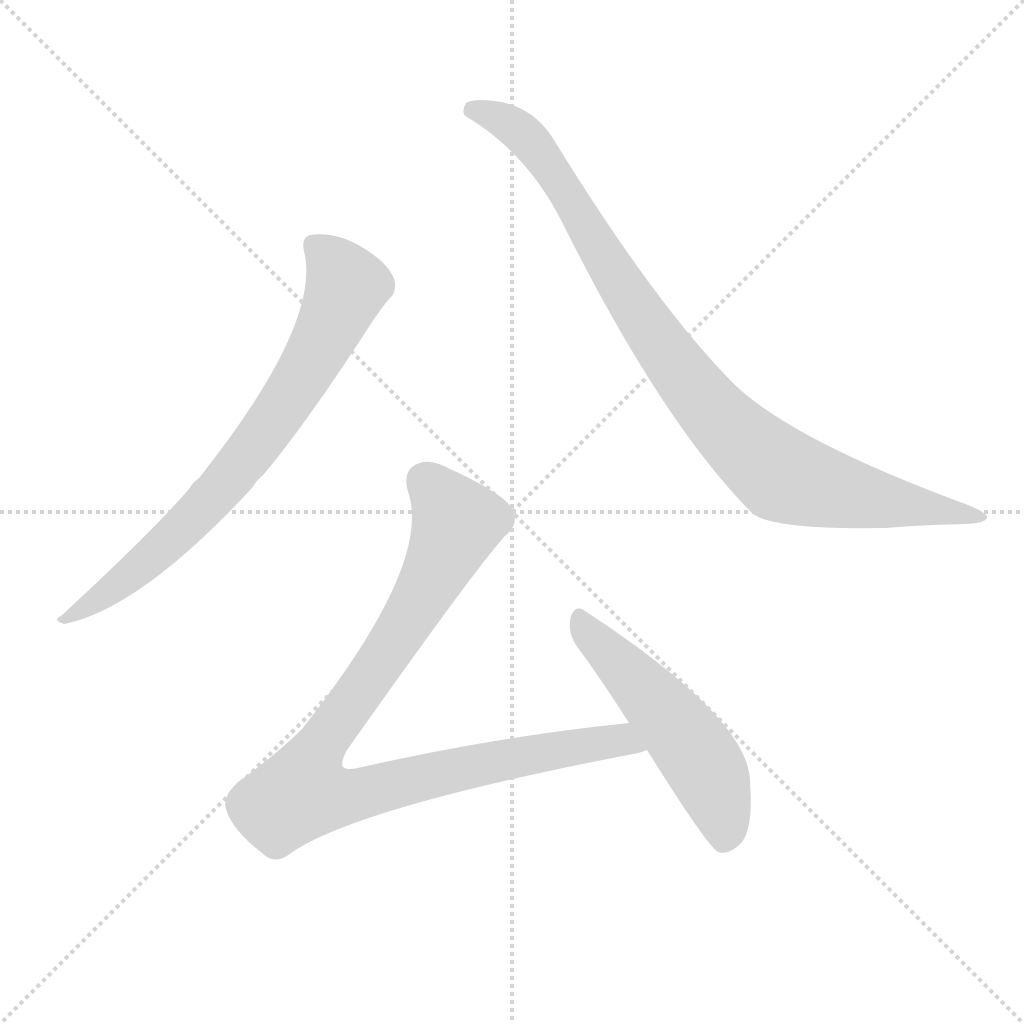
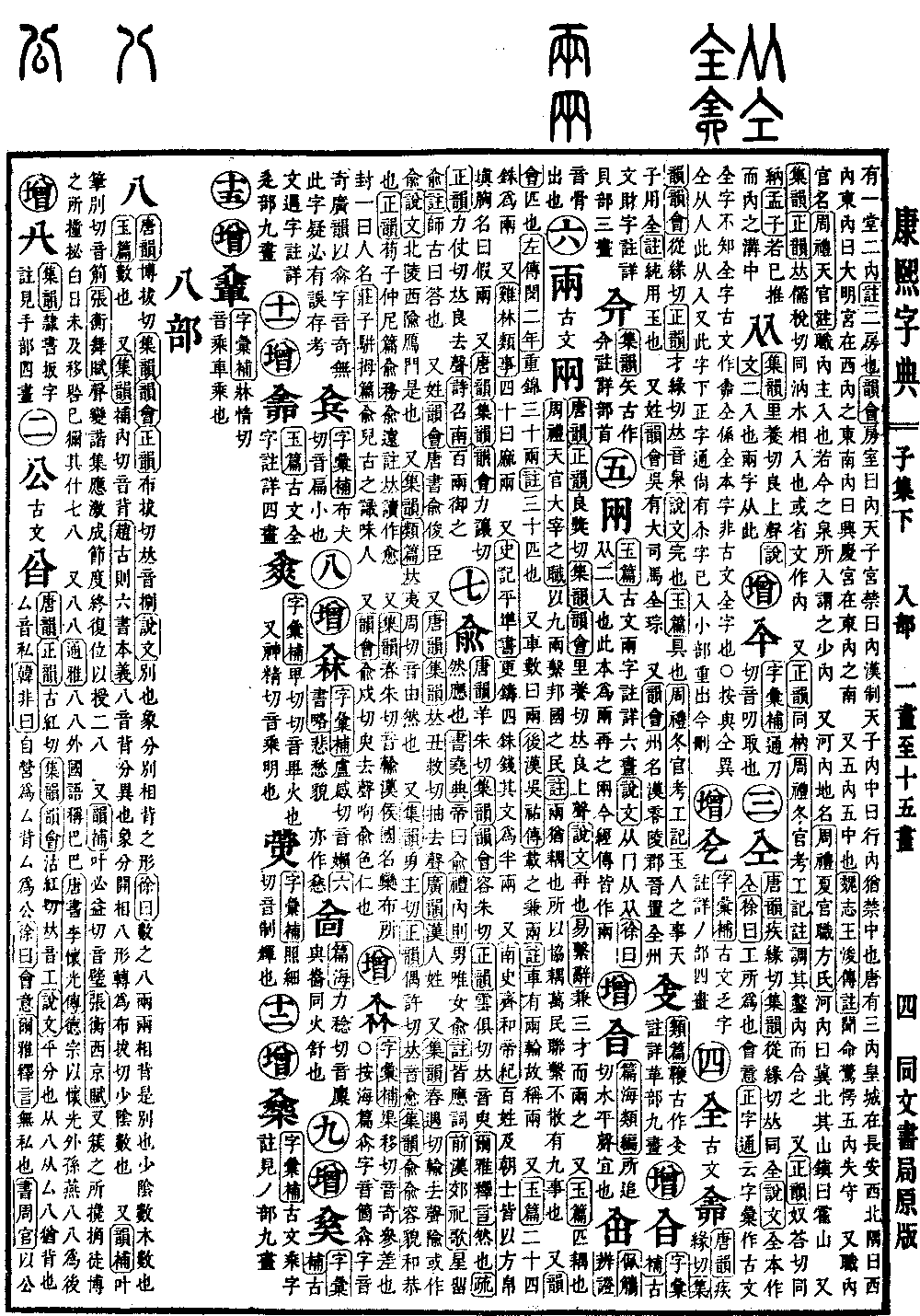
Zi Collection, Page Position: Lower
Radical: Eight (ba)
Kangxi Dictionary Stroke Count: 4
Page 126, Entry 28
Ancient Phonetics: According to the Tangyun and the Zhengyun, the pronunciation uses the initial g and final ong (gu hong qie). According to the Jiyun and the Yunhui, the pronunciation also uses the initial g and final ong (gu hong qie). It is pronounced the same as gong.
The Analytical Dictionary of Characters (Shuowen Jiezi) explains it as: Equal distribution. The character form is composed of the elements for eight (ba) and private (si). Eight represents turning one's back, and si is pronounced the same as the word for private.
Han Feizi says: Seeking profit for oneself is private (si); turning one's back on private interests is public (gong).
Xu Kai's commentary states: This is an ideogram.
The Erya (Erya), Shiyan section, explains it as: Having no private interests.
The Book of Documents (Shangshu), Zhouguan section, records: By using a public-minded heart to eliminate private desires, the common people will sincerely submit.
Also, the Jade Chapters (Yupian) explains it as: Upright and fair, honest, and impartial.
Also, the Book of Rites (Liji), Liyun section, says: When the Great Way is practiced, the world is shared by all. The commentary notes: Gong means communal or shared.
It is also a title of nobility; the first of the five ranks of nobility is called gong (Duke). The Book of Documents, Weizi zhi Ming section, records: Therefore, I enfeoff you as a High Duke.
It is also the title for the Three Ducal Ministers. The Yunhui records: During the Zhou Dynasty, the Grand Preceptor, Grand Tutor, and Grand Guardian were the Three Ducal Ministers. At the end of the Han Dynasty, the Grand Marshal, Grand Minister over the Masses, and Grand Minister of Works were the Three Ducal Ministers. During the Eastern Han, the Grand Commandant, Minister over the Masses, and Minister of Works were the Three Ducal Ministers.
It also refers to government offices or places of work. The Classic of Poetry (Shijing), Shaonan section, says: Returning home to eat after finishing public business.
It also refers to a father. The Liezi (Liezi), Huangdi section, records: The master of the house (father) brought the mats. The Book of Han (Hanshu), Jiaosi Zhi section, says: The Son of Heaven is the father of all under heaven, therefore he is called the Great Father (Jugong).
A daughter-in-law also calls her father-in-law (the husband's father) gong. The Book of Han, Jia Yi Zhuan section, says: The daughter-in-law sits as an equal with her father-in-law.
It is also used as an honorific when addressing others as gong. Jia Yi's Treatise on Maintaining Peace (Ce'an Ce) says: These six or seven gentlemen (gong) are all safe and sound.
It is also used for mutual address. The Records of the Grand Historian (Shiji), Mao Sui Zhuan section, says: You gentlemen (gong) are mediocre and incompetent.
It also refers to public affairs or general matters. The Classic of Poetry, Shaonan section, says: Busy with public duties from morning till night. The commentary notes: This refers to being busy from morning till night with tasks such as washing and cooking.
It is also a star name. The History of Sui (Suishu), Tianwen Zhi section, records: There are seven stars in the Seven Excellencies (Qigong) constellation, located to the east of the star Zhaoyao; they are the assistant stars of heaven.
It is also a surname. The Yunhui records: In the Han Dynasty, there was a person named Gong Jian.
It is also used in the system of posthumous names; setting one's will to benefit the public is called gong.
It is also interchangeable with the word for merit or achievement (gong). The Classic of Poetry, Xiaoya section, says: To achieve great merit. The Daya section says: The king's achievements are illustrious.
Also, according to the Jiyun, it has a pronunciation with the initial zh and final ong (zhu rong qie), pronounced the same as zhong. In this sense, it is the same as the word for a husband's elder brother (zhong). One theory states that in the Guanzhong region, a husband's father is called zhong. It is sometimes written in the abbreviated form gong. It is also interchangeable with the word for bell (zhong).
Also, according to the Rhyme Supplement (Yunbu), it has a leafing pronunciation with the initial g and final uang (gu huang qie), pronounced the same as guang. Dongfang Shuo's Seven Admonitions (Qi Jian) says: Falsehoods are embellished and full of distortions; the correct law is twisted and not impartial (gong). Upright men live in seclusion to avoid the world, while slanderous flatterers ascend to the court.