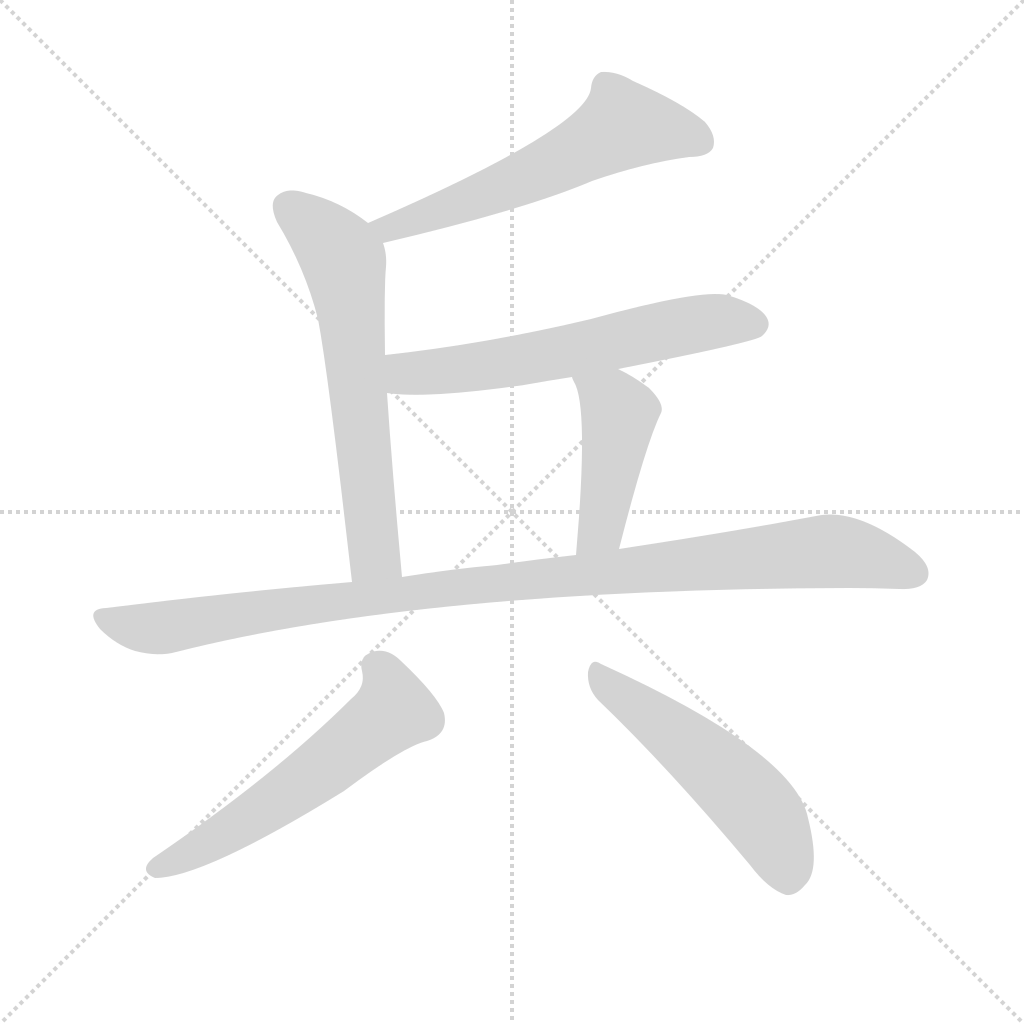
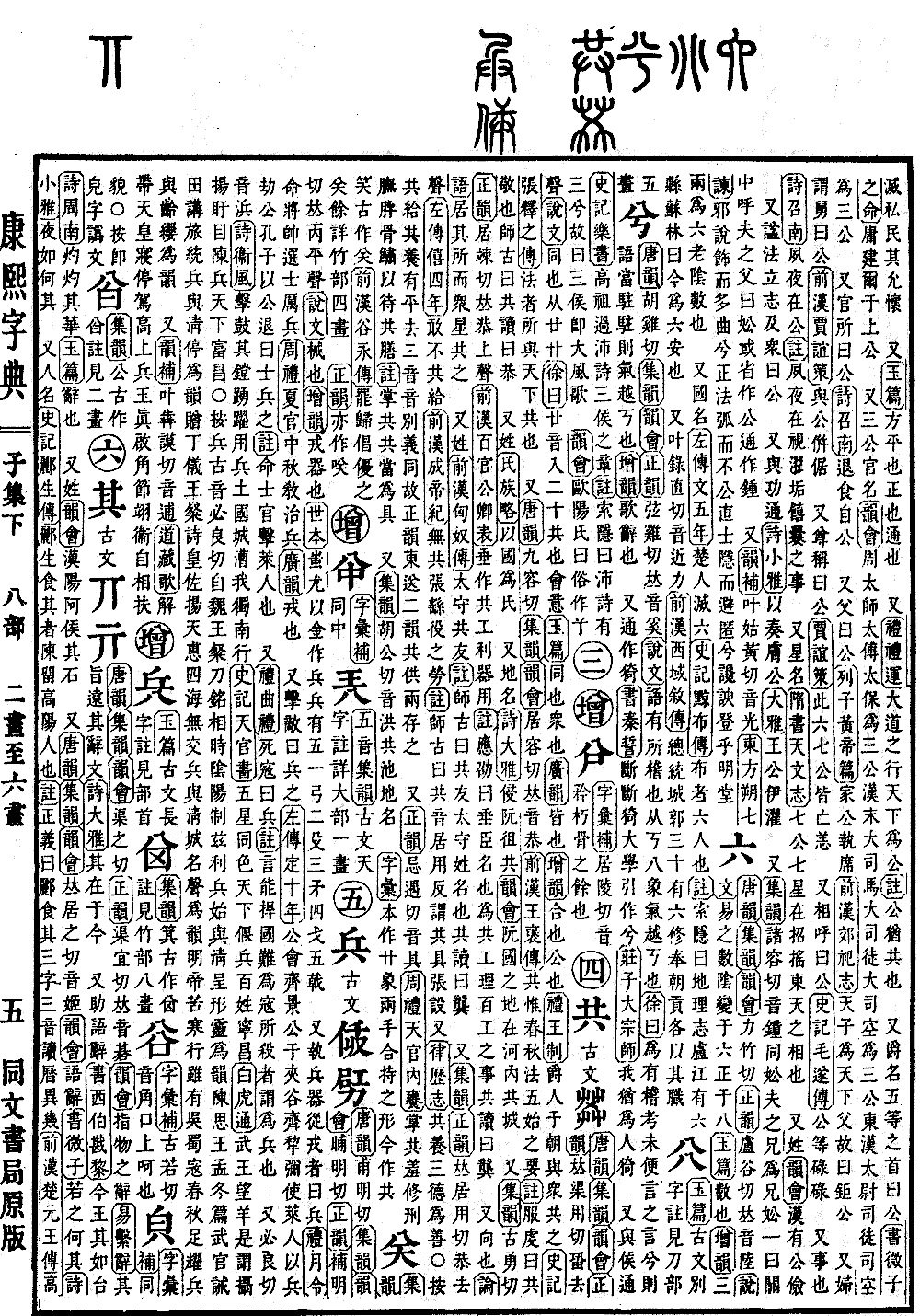
Zi Collection, Page Position: Lower
Radical: Eight (bā)
Stroke Count: 7
Page 127, Entry 10
Pronounced bīng (rising tone)
Pronounced bīng
Pronounced bīng (level tone), same pronunciation as the level tone of "bing".
Explained as "implements" (implements of war).
Explained as "military equipment" (weapons).
Recorded: Chi You used metal to make weapons. Weapons are divided into five types: first, bows; second, halberds; third, spears; fourth, swords; fifth, lances.
Also refers to a person who holds a weapon and serves in the army as "bing".
"The Rites (Liji)" - Commands generals to select soldiers and sharpen weapons.
"The Rites of Zhou (Zhouli)" - Training for warfare during the autumn season.
Explained as "military affairs".
Also refers to attacking the enemy as "bing zhi".
"Zuo Zhuan (Zuozhuan)" - Duke Ding of Lu met Duke Jing of Qi at Jiagu. Lai people, instigated by Li Mi of Qi, used weapons to threaten Duke Ding. Confucius protected Duke Ding as he withdrew and ordered, "Soldiers, attack them."
Note: The order was for soldiers to attack the Lai people.
Also, "The Rites (Liji)" refers to death as "bing".
Note: Refers to those who can be killed defending the nation as "bing".
Also pronounced bì liáng qiè, same pronunciation as "bāng".
"Book of Odes (Shijing)" - The sound of beating drums was loud; we leaped and used weapons. Others built cities and dug canals; I alone marched south to fight.
"Records of the Grand Historian (Shiji)" - When the five planets had the same color, there was peace in the world, and the people were prosperous and tranquil.
"Discourses of the White Tiger Hall (Baihu Tongyi)" - King Wu of Zhou had far-reaching vision, called "she yang". He opened his eyes to observe the military, and the world was rich and prosperous.
Note: The ancient pronunciation of "bing" was bì liáng qiè. Starting from Wang Can's "Dao Ming" from the Wei Dynasty, "bing" began to rhyme with characters like "qing," "cheng," and "xing."
Cao Zhi's "Meng Dong Pian": "Military officials admonish during training, and troops assemble and command soldiers," rhyming with "qing" and "ting."
Cao Zhi's poem "To Ding Yi and Wang Can": "The emperor assists and spreads heavenly grace; throughout the land, there are no wars," rhyming with "qing," "cheng," "ming," and "sheng."
Emperor Ming of Wei's "Ku Han Xing": "Although there are Wu and Shu, spring and autumn are sufficient to display military might," rhyming with "ling" and "ying."
Also, rhyming with "bēn mó qiè," pronunciation close to "bū."
"Dao Zang Ge" - Loosened his belt, the Heavenly Emperor slept, stopped his carriage on the high battlefield. Jade truth opened the horn's rhythm, guards supported each other.