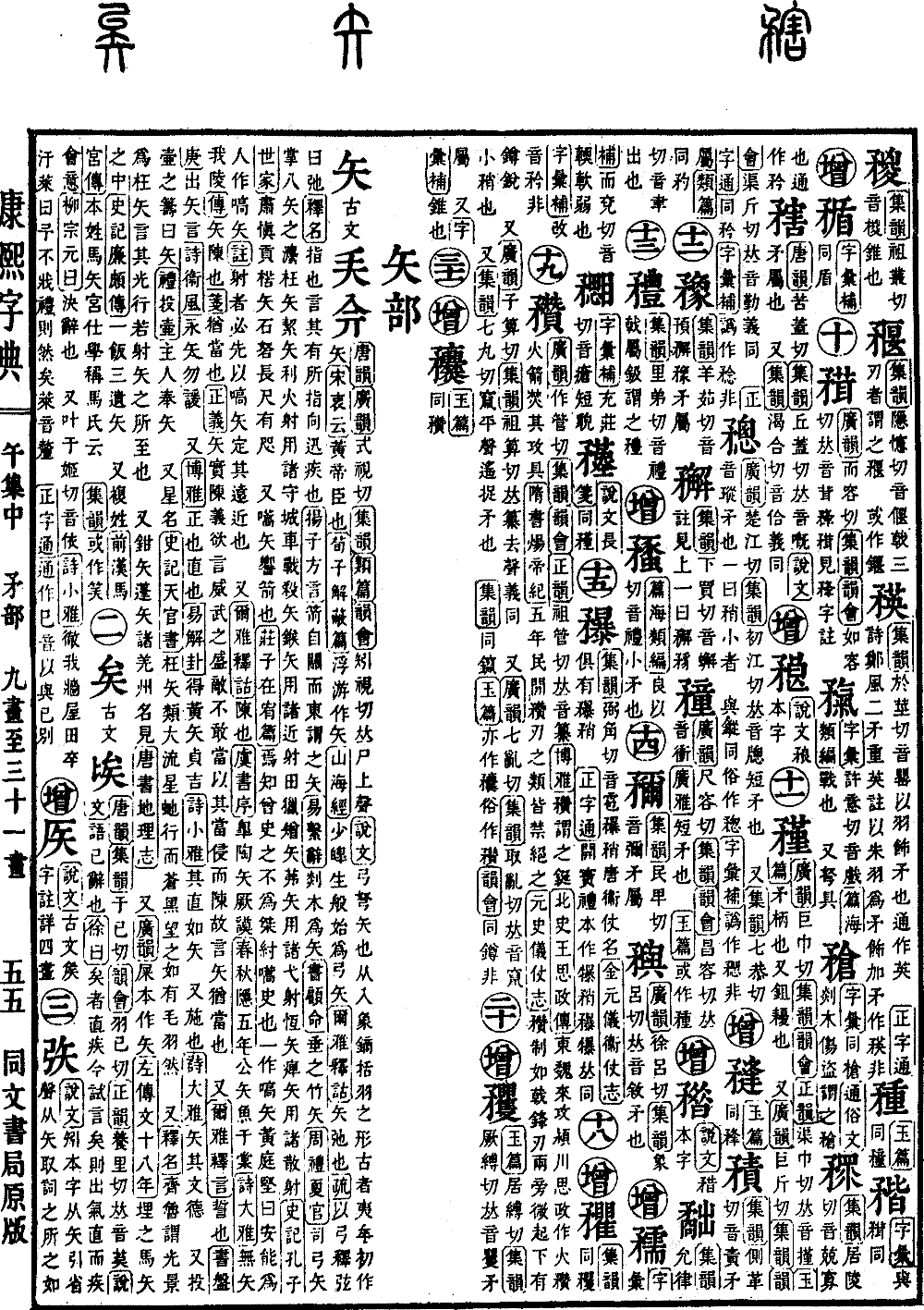
Wu Collection, Middle Volume
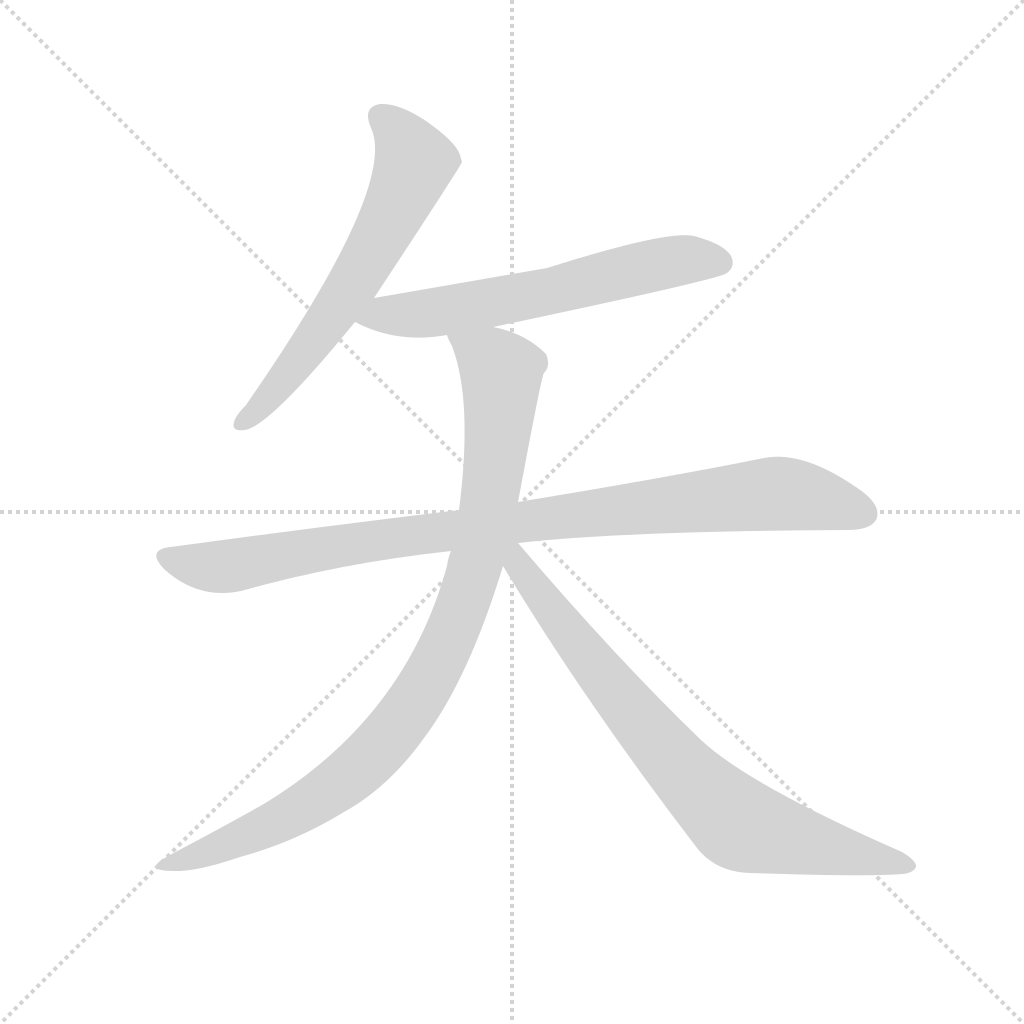
Radical: Arrow (shǐ)
Kangxi Dictionary strokes: 5
Page 823, Entry 34
Pronounced shi (rising tone).
Explaining the meaning as provided in the Analytical Dictionary of Characters (Shuowen Jiezi): The arrow used with a bow or crossbow. The character form adopts the shape of a notch, resembling the arrowhead, the nock that hooks onto the string, and the fletching. According to ancient lore, Yimou was the first to create arrows. Song Zhong states that Yimou was a minister of the Yellow Emperor. The Xunzi (Xunzi), Chapter on Dispelling Blindness (Jiebi Pian), records that Fouyou created arrows. The Classic of Mountains and Seas (Shanhaijing) records that Shaohao fathered Ban, and Ban began to create bows and arrows.
The Erya (Erya), Interpretation of Ancient Words (Shigu), explains the character as meaning to relax. The commentary notes that untying the bowstring from the bow is called chi (to relax). The Shiming (Shiming) explains it as "to point," meaning that the arrow has a direction and is swift and rapid. Yang Xiong's Dialects (Fangyan) records that east of Hangu Pass, the arrow is called shi. The Book of Changes (Yijing), Appended Remarks (Xici), records sharpening wood to make arrows. The Book of Documents (Shujing), Testament of King Kang (Guming), records the display of bamboo arrows presented as tribute. The Rites of Zhou (Zhouli), Ministry of Summer (Xiaguan), records the official in charge of bows and arrows, managing the usage of eight types of arrows. The wangshi and jieshi are useful for incendiary projectiles, used in city defense and chariot warfare. The shashi and houshi are used for short-range shooting and hunting. The zengshi and fushi are used to shoot birds. The hengshi and the [missing character] shi are used for archery practice.
The Records of the Grand Historian (Shiji), Hereditary House of Confucius (Kongzi Shijia), records that the Sushen people presented arrows with shafts of spindle tree wood and stone arrowheads, measuring one foot and eight inches long. There is also the haoshi, which is a whistling arrow. The Zhuangzi (Zhuangzi), Chapter on Abiding in Governance (Zaiyou Pian), asks how one knows that Zeng Shen or Shi Qiu were not the whistling arrows (precursors) of Jie of Xia or Zhou of Shang. It is also written as a variant form (hao). Huang Tingjian said: How can one act as a whistling arrow (forerunner) for others? Commentary: A person shooting an arrow must first use a whistling arrow to determine the distance.
Also, the Erya, Interpretation of Ancient Words, explains it as chen (to state/arrange). The Preface to the Book of Yu (Yu Shu Xu) records Gao Yao stating his strategies. The Spring and Autumn Annals (Chunqiu), Duke Yin's Fifth Year, records Duke Yin of Lu arranging fishing equipment to catch fish in Tang. The Book of Odes (Shijing), Greater Odes (Daya), says do not arrange troops on my mountain slopes. The Commentary (Zhuan) explains it as chen. The Annotation (Jian) explains it as meaning to match or to correspond. The Standard Meaning (Zhengyi) states that the primary meaning is to arrange; here it expresses military might and power so strong that the enemy cannot resist, and because one can arrange troops to resist an invasion, it is said to have the meaning of being matched or equal.
Also, the Erya, Interpretation of Words, explains it as shi (to swear/vow). The Book of Documents, Pan Geng, records the making of a vow. The Book of Odes, Odes of Wei (Weifeng), records vowing never to forget.
Also, the Guangya (Guangya) explains it as zheng (correct) or zhi (straight). The Book of Changes, Relief Hexagram (Jie Gua), records receiving a yellow arrow, a propitious omen. The Book of Odes, Lesser Odes (Xiaoya), says it is as straight as an arrow.
Also explained as shi (to perform/enact). The Book of Odes, Greater Odes, records performing his refined virtue.
Also, the counters used in the game of pitch-pot are called shi. The Book of Rites (Liji), Pitch-pot (Touhu), records the host holding the counters.
It is also the name of a star. The Records of the Grand Historian, Treatise on the Celestial Offices (Tianguan Shu), records the Wangshi star, which resembles a large shooting star, moving like a snake, with a blue-black color, and appearing to have hair or feathers.
Also, the Shiming records that in the regions of Qi and Lu, light and shadow are called wangshi, meaning its light travels like an arrow reaching a destination.
There are also Qian-shi and Peng-shi, names of locations in the Qiang tribal regions. Seen in the Old Book of Tang (Tangshu), Treatise on Geography (Dilizhi).
Also, the Guangyun (Guangyun) states the character for feces was originally written as this character. The Zuo Tradition (Zuo Zhuan), Duke Wen's Eighteenth Year, records burying him in horse manure. The Records of the Grand Historian, Biography of Lian Po (Lian Po Liezhuan), records visiting the restroom three times during the time it takes to eat a meal.
It is also a compound surname. The Book of the Former Han (Qian Hanshu), Biography of Ma Gong (Ma Gong Zhuan), records the original surname as Mashizhi; after Ma Gong attained office and studied, he changed it to the Ma surname. The Jiyun (Jiyun) also records it written in a variant form.