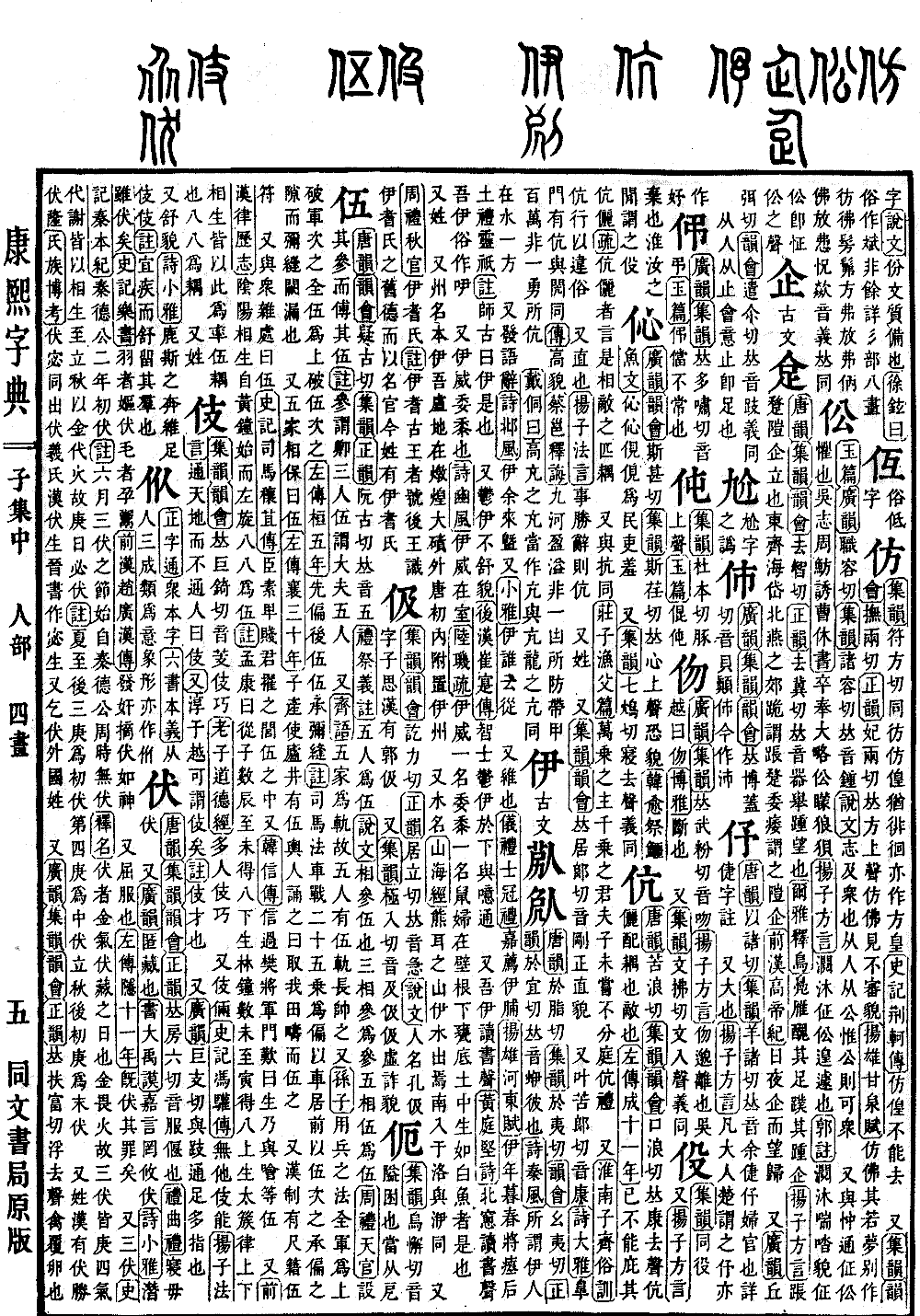
Zi Collection, Middle Volume
Radical: Person (rén)
企
Kangxi strokes: 6
Page: 95, entry 04
Ancient form
The rhyme dictionaries Tangyun, Jiyun, Yunhui, and Zhengyun give the pronunciation as qùzhì qiē and qùjì qiē, yielding the sound qì. To stand on tiptoe and gaze into the distance.
“Ducks and geese have webbed feet, and they stand on their heels (tiptoe).” — Erya (Shibiao)
“Gaiqi means to stand. In Eastern Qi, Haidai, and the northern outskirts of Yan, kneeling is called 'gui', and 'weiwei' is called 'gaiqi'.” — Fangyan (Yangzi)
“Day and night he stood on tiptoe, hoping to return.” — Records of Emperor Gao of Han (Qian Han Gaodi Ji)
Also, Guangyun and Yunhui give the pronunciation as qiūmǐ qiē and qiǎněr qiē, yielding the sound qǐ. The meaning is the same.
Formed from 'person' and 'foot' (zhǐ) as a compound ideograph. 'Foot' (zhǐ) here refers to the actual foot.
Textual Research: In the citation from Fangyan (Yangzi): “Gaiqi means to stand. In Eastern Qi, Haidai, and the northern outskirts of Yan, kneeling is called 'gui', and 'weiwei' is called 'gaiqi'.” The character '之' has been added after '跪谓' in accordance with the original text.