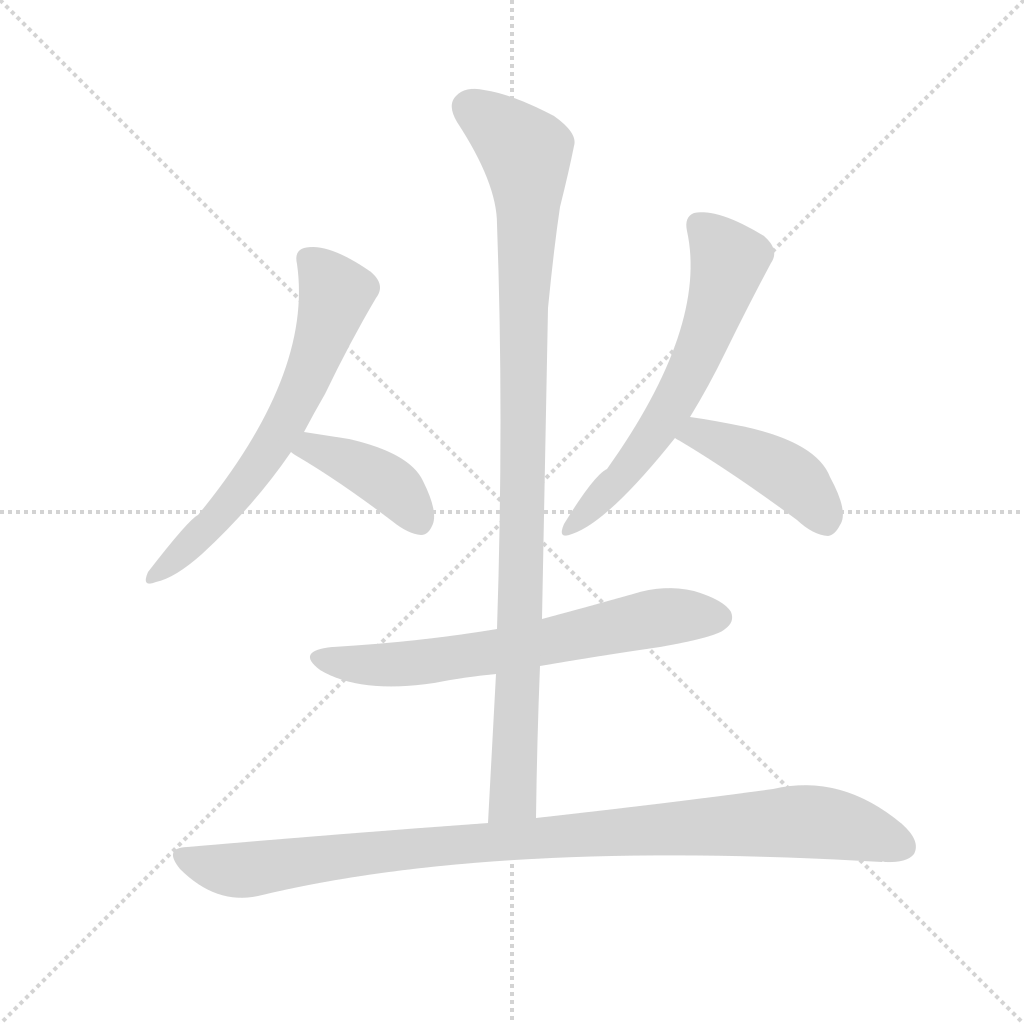
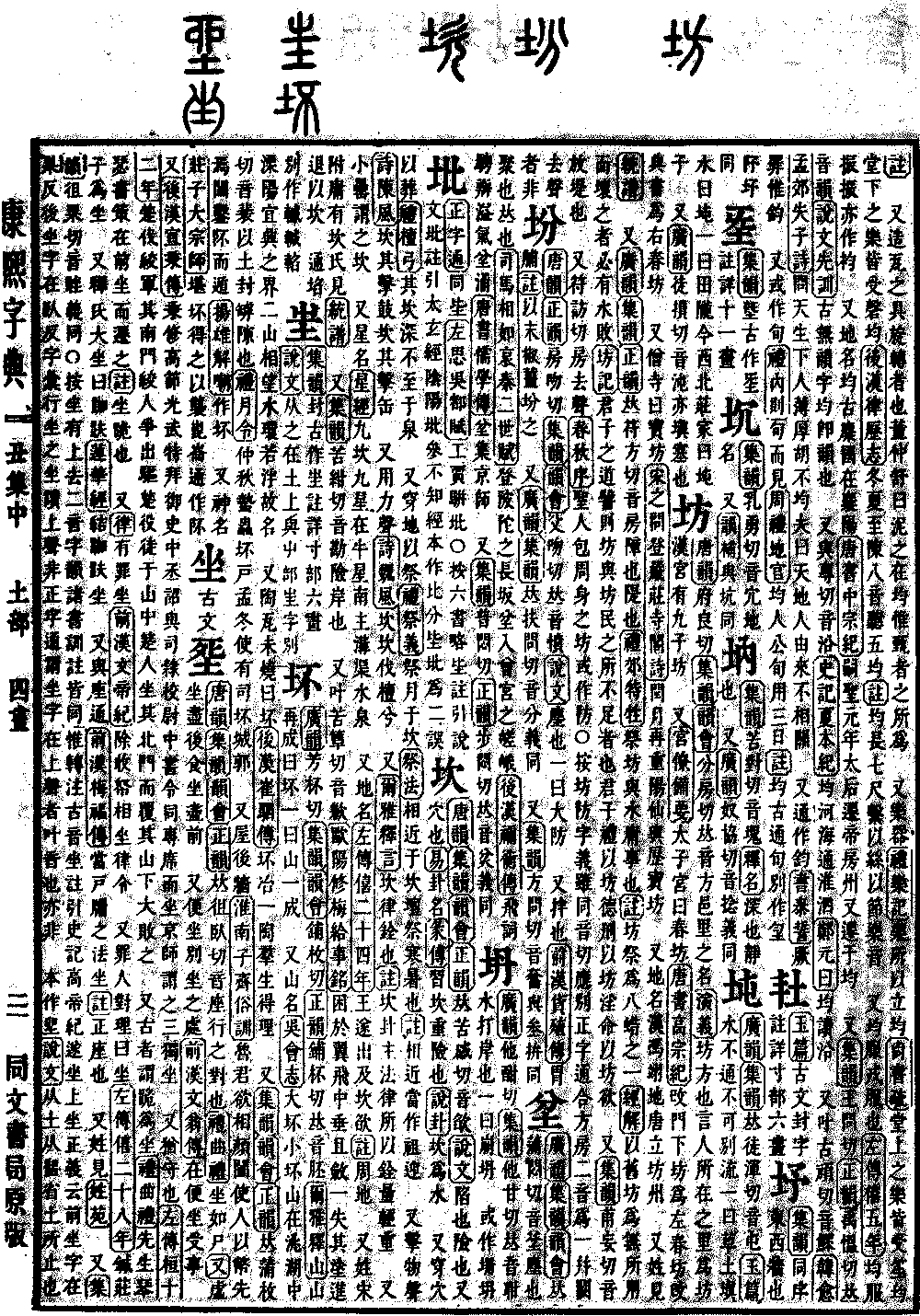
Chou Collection, Middle Volume. Radical: Earth (tǔ). 7 strokes. Page 225, Entry 15.
Ancient script. According to Tang Rhymes (Tang Yun), Collected Rhymes (Jiyun), Rhyme Compendium (Yunhui), and Correct Rhymes (Zhengyun), it is pronounced zuo (falling tone). It is the opposite of walk. Book of Rites (Liji), Songs of Propriety (Quli): When sitting, one should be as upright as the ritual impersonator of the ancestors. Also: When resting, sit toward the back; when dining, sit toward the front. There is also the term pianzuo (secondary seat), referring to an auxiliary seating area. History of the Former Han (Qianhan Shu), Biography of Wenweng: Handled official business in the secondary seat. Also, Book of the Later Han (Houhan Shu), Biography of Xuan Bing: Xuan Bing cultivated noble integrity. Emperor Guangwu specifically appointed him as Censor-in-chief and issued an edict allowing him to share a private seat with the Colonel Director of Retainers and the Secretariat Director. The people of the capital called them the Three Independent Seats.
It also carries the meaning of guarding. Zuo Zhuan, 12th Year of Duke Huan: The State of Chu attacked the State of Jiao, with troops stationed at the South Gate. The people of Jiao vied to exit the city and drove the laborers of Chu into the mountains. The people of Chu stood guard at the North Gate while simultaneously setting an ambush at the foot of the mountain, severely defeating the Jiao forces.
In ancient times, kneeling was referred to as sitting. Book of Rites (Liji), Songs of Propriety (Quli): When the teacher’s zither, lutes, books, and bamboo slips are placed in front, the student should kneel to move them aside. Commentary: Sitting here means kneeling.
Also, in the legal code, there is the law of collective punishment (liansuo), where one is implicated by the crimes of others. History of the Former Han (Qianhan Shu), Annals of Emperor Wen: Abolished the law regarding the confiscation of family members as slaves and the laws of collective punishment.
When a criminal is interrogated and confronted, this is also called sitting. Zuo Zhuan, 28th Year of Duke Xi: Zhen Zhuangzi served as the person being interrogated.
There is a form of sitting in Buddhism called the lotus position (jiafuzuo). Lotus Sutra (Lianhua Jing): Sitting in the lotus position.
It is also interchangeable with the character for seat (zuo). History of the Former Han (Qianhan Shu), Biography of Mei Fu: The dharma seat facing the door and window. Commentary: This refers to the main seat.
It is also a surname. See Genealogy of Surnames (Xingyuan).
According to Collected Rhymes (Jiyun), it is pronounced cuo (rising tone). The meaning is the same. Note: The character has two pronunciations, one in the rising tone and one in the falling tone. The explanations in dictionaries and rhyme books are the same. Only in Zhuanzhu Guyin is a passage from the Records of the Grand Historian (Shiji), Annals of Emperor Gao, cited: "Then sat in the high seat." The Correct Meaning (Zhengyi) states: The first occurrence is pronounced in the rising tone, the second in the falling tone. Dictionary of Characters (Zihui) claims the pronunciation for sitting down is in the rising tone, which is incorrect. Comprehensive Dictionary of Characters (Zhengzitong) claims the rising tone is merely for rhyming purposes, which is also incorrect. The original form of the character is written as [character omitted].
Explaining Simple and Analyzing Compound Characters (Shuowen Jiezi): Formed from Earth and a simplified form of remain, indicating that earth is a place where one rests. In clerical script, it is written as sitting.
Textual research: Zuo Zhuan, 12th Year of Duke Huan: The men of Chu sat at the North Gate and placed an ambush at the foot of the mountain, severely defeating them. Following the original text, "placed at the foot of the mountain" has been corrected to "placed among the mountain's foot." The original form of the character is written as [character omitted]. Explaining Simple and Analyzing Compound Characters (Shuowen Jiezi): Formed from Earth and a simplified form of remain, where earth is what remains. Corrected according to the Shuowen; "remain" has been corrected to the specific variant [character omitted].