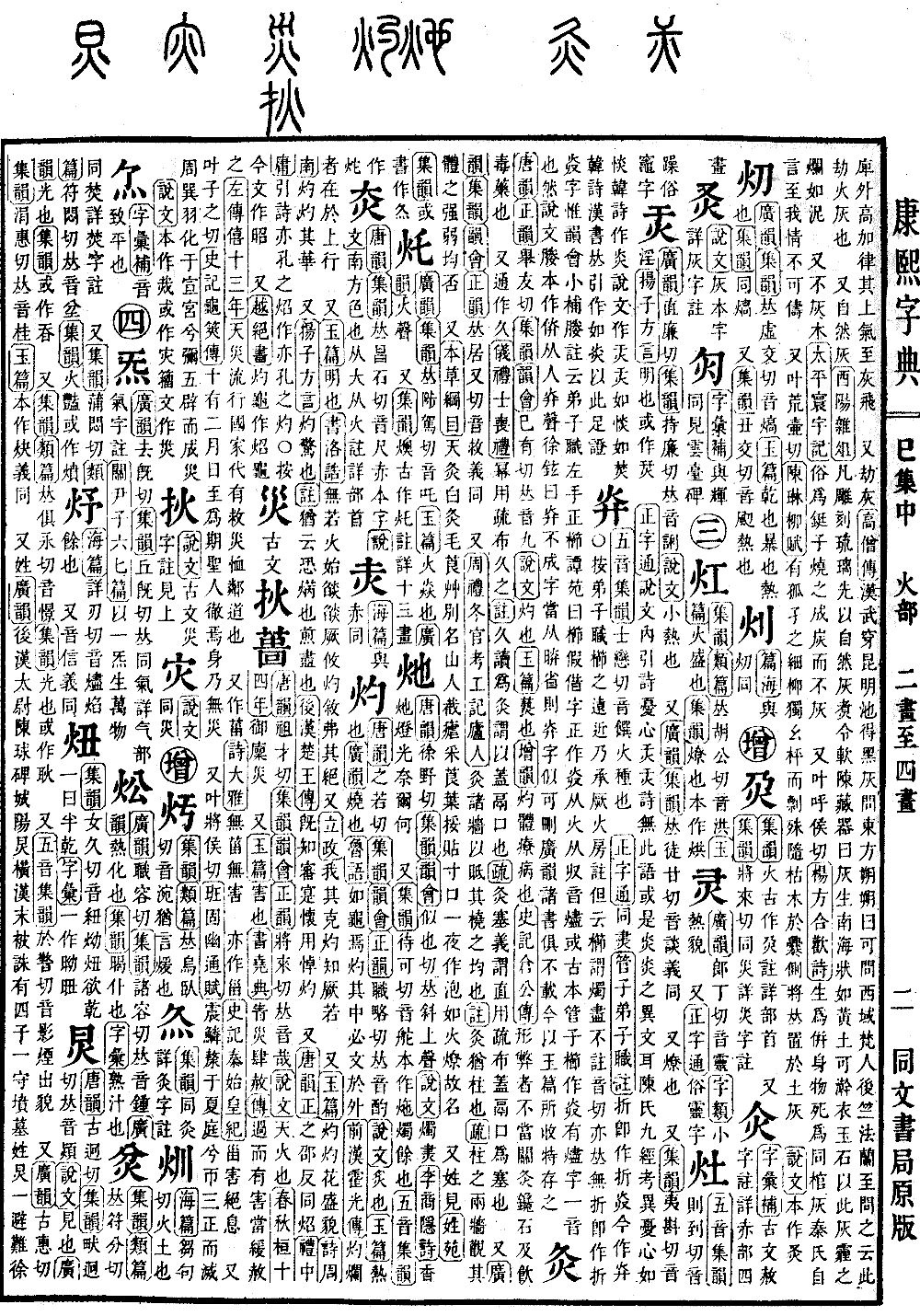
Si Collection, Middle Volume. Radical: Fire (huǒ). Kangxi stroke count: 7. Page 666, Entry 18. Ancient text.
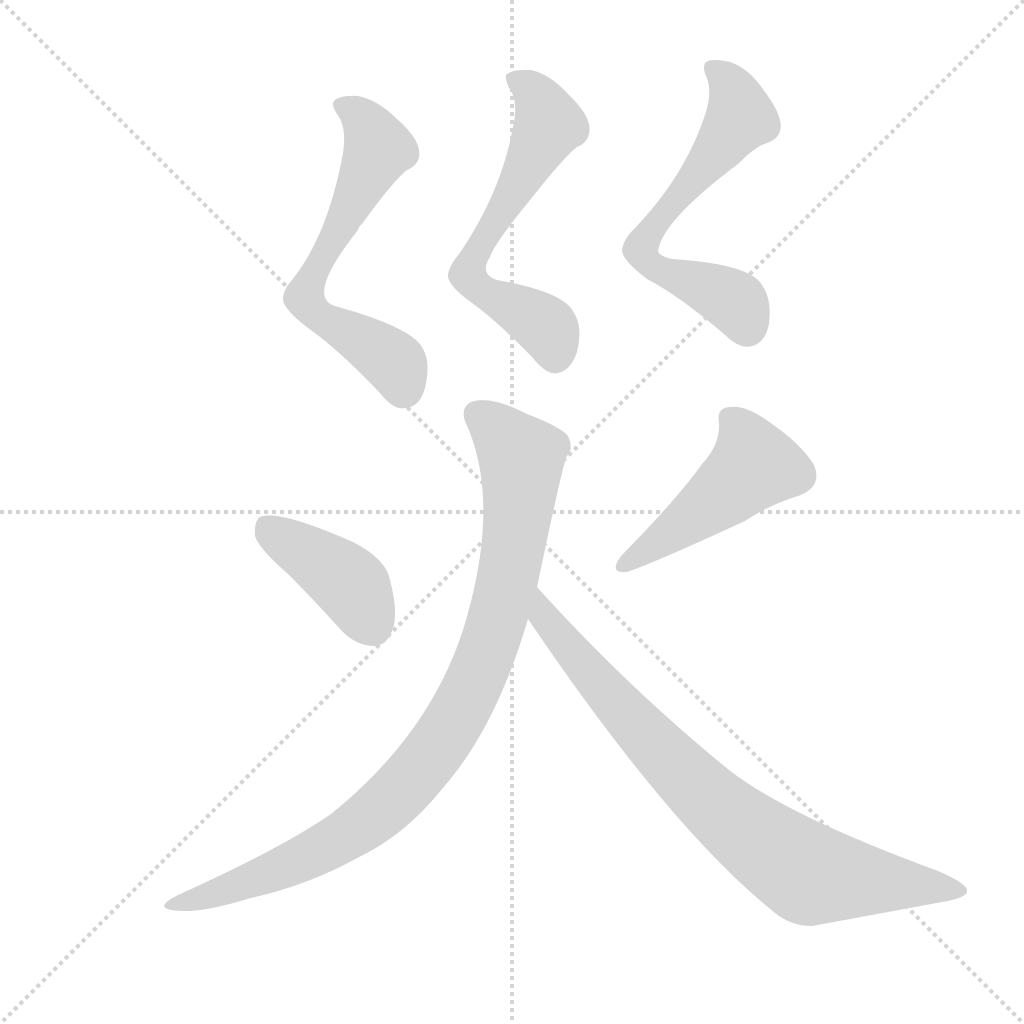
Pronounced zai. According to the Analytical Dictionary of Characters (Shuowen Jiezi), it refers to fire from heaven. In the Spring and Autumn Annals (Chunqiu), in the fourteenth year of Duke Huan, it is recorded that the imperial granary caught fire.
Also defined in the Jade Chapters (Yupian) as harm. In the Book of Documents (Shangshu), in the Canon of Shun, it states that unintentional faults and disasters are to be pardoned. The commentary explains that if an error occurs resulting in harm, the punishment should be mitigated. In the Zuo Tradition (Zuo Zhuan), in the thirteenth year of Duke Xi, it is noted that heavenly disasters spread, and that saving neighbors from disasters is the way of the state.
Also written as zai (variant form). In the Book of Odes (Shijing), in the Greater Odes (Daya), it is written as having no disaster and no harm. It is also written as zai (variant form). In the Records of the Grand Historian (Shiji), in the Annals of the First Emperor of Qin, it is written that harm and disaster are ended.
Also rhymes with zi. In the Records of the Grand Historian (Shiji), in the Biographies of Turtle and Yarrow Divination, it is written that the twelfth month is the limit, and the sage completes it, so that the person suffers no disaster.
Also rhymes with hou. In Ban Gu’s Rhapsody on Quiet Communion (Youtong Fu), it is written that the shaken scales appeared in the Xia court, spanning three dynasties before destroying Zhou; the feathers of the Xun trigram transformed in the Xuan Palace, filling five realms to become a disaster.
According to the Analytical Dictionary of Characters (Shuowen Jiezi), the original form was zai. Another variant form is zai. The seal script form is written as zai. According to the Analytical Dictionary of Characters (Shuowen Jiezi), this is the seal script form of the character.
Textual research: In the Book of Documents (Shangshu), in the Canon of Yao, it states that unintentional faults and disasters are to be pardoned. It is noted that the original text has been corrected from Canon of Yao to Canon of Shun.