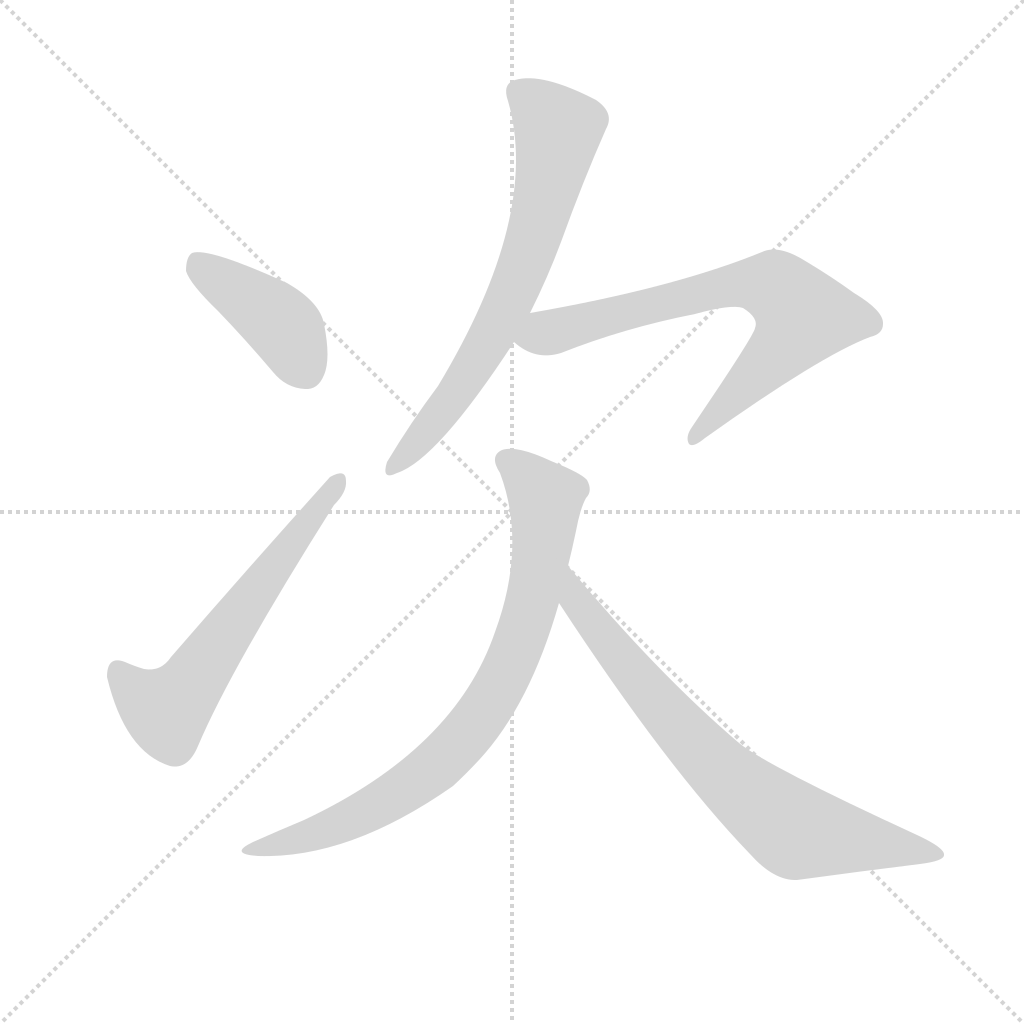
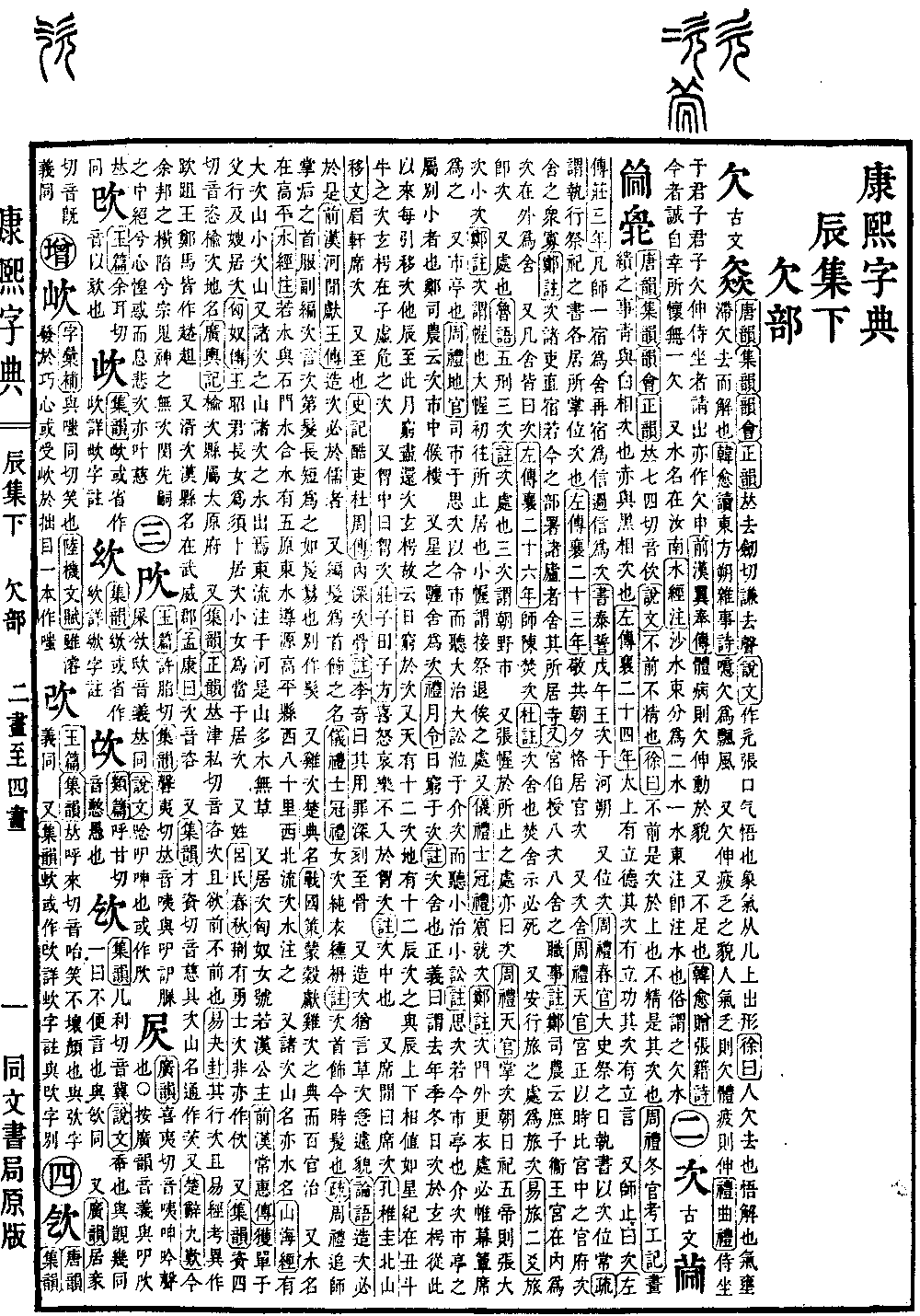
Chen Collection, Lower Volume, Radical: Debt (qiàn), Kangxi stroke count: 6, Page 565, Entry 03
Ancient form. From Tang Rhymes (Tangyun), Collection of Rhymes (Jiyun), Rhyme Compilation (Yunhui), and Orthodox Rhymes (Zhengyun), pronounced ci (falling tone).
From Explanation of Words and Phrases (Shuowen): Refers to a lack of advancement or a lack of refinement.
Xu states: To not advance is to be secondary in rank, and to be unrefined is the secondary level of quality.
Book of Rites (Liji), Section on the Artificers' Record (Kaogongji): In the work of painting and embroidery, blue and white are placed in sequence, and red and black are placed in sequence.
Zuo Commentary (Zuo Zhuan), 24th Year of Duke Xiang: The highest achievement is the establishment of virtue, the next is the establishment of merit, and the next is the establishment of words.
Also, when an army halts, it is called ci.
Zuo Commentary (Zuo Zhuan), 3rd Year of Duke Zhuang: An army staying one night is called a stop, two nights is called a garrison, and beyond that is called a encampment.
Classic of History (Shangshu), Oath of Tai (Taishi): On the day wuwu, the King encamped at the north of the Yellow River.
Also, official ranking.
Book of Rites (Liji), Section on the Spring Officials: On the day of the Great Sacrifice, the Grand Historian holds the register to arrange the official ranks.
Commentary: This refers to holding the ritual register to ensure everyone occupies their assigned place.
Zuo Commentary (Zuo Zhuan), 23rd Year of Duke Xiang: Respectfully maintain the morning and evening rituals, and steadfastly hold one's official position.
Also, official lodgings and residences.
Book of Rites (Liji), Section on the Heaven Officials: The Palace Administrator, according to the season, compares the numbers of the palace officials and their various lodgings.
Zheng's commentary: These are the lodging places for officials on duty, like the current guard houses, or the offices where they reside.
Also, the Palace Director manages the duties of the eight lodges and eight residences.
Note: Zheng Sinong stated that the sons of the nobility guard the palace; inside they are called lodges, outside they are called residences.
Also, any place of lodging is called ci.
Zuo Commentary (Zuo Zhuan), 26th Year of Duke Xiang: The army set up its encampment and burned it.
Du's commentary: Ci means to lodge. Burning the lodges shows a determination to die.
Also, a place where travelers rest is called a traveler's rest.
Book of Changes (Yijing), Journey hexagram: The journey reaches the resting place.
Also, to dwell.
Discourses of Lu (Luyu): The five, the three, and the resting places.
Commentary: Ci means to dwell. The three resting places refer to the court, the countryside, and the market.
Also, a tent erected at a stopping point is also called ci.
Book of Rites (Liji), Section on the Heaven Officials: The Master of Tents, when worshiping the five emperors at sunrise, erects large and small tents.
Zheng's commentary: Ci refers to a curtain or tent. The large tent is for the initial stop; the small tent is for the waiting period after the sacrifice.
Also, Ceremony of the Gentleman's Capping (Shiguanli): The guest goes to the resting place.
Zheng's commentary: The resting place is the area outside the gate for changing clothes. It must be prepared with curtains, mats, and cushions.
Also, a market pavilion.
Book of Rites (Liji), Section on the Earth Officials: The Market Supervisor uses the market pavilion to command the market, hear major cases, and settle major disputes. At the secondary pavilion, he hears minor cases and settles minor disputes.
Note: The market pavilion is like a modern market kiosk. The secondary pavilion is a branch of the market pavilion. Zheng Sinong stated: Ci refers to a tower within the market.
Also, the orbital path of stars is called ci.
Book of Rites (Liji), Section on the Monthly Commands: When the sun reaches the end of its orbital path.
Note: Ci means a house. The commentary explains: In the last month of the previous year, the sun was in the house of the empty asterism, and from then on, it moves to other houses until it reaches the end of the month and returns to the empty house; thus, it is called the sun exhausting its house.
Also, heaven has twelve houses, and the earth has twelve earthly branches. The houses and the branches correspond to each other. For example, Starry Era is in Chou, the house of Dipper and Ox. Empty asterism is in Zi, the house of Void and Danger.
Also, the heart or mind is called the chest's interior.
Zhuangzi, Tian Zifang: Joy, anger, sorrow, and pleasure do not enter the inner mind.
Note: Ci means middle.
Also, the space between seats is called the seating arrangement.
Kong Zhigui, Removal from the North Mountain: Brows raised in the seating arrangement.
Also, to arrive at.
Records of the Grand Historian, Biography of the Harsh Official Du Zhou: Inner severity reaches the bones.
Note: Li Qi said: In administering punishment, it is severe enough to reach the bone.
Also, "zaoci" (hasty) is the same as "caoci." It means in a rush or urgent.
Analects (Lunyu): In moments of haste, he must act in accordance with this.
History of the Former Han, Biography of King Xian of Hejian: In moments of haste, he must act in accordance with the scholars.
Also, a name for hair styling accessories.
Book of Rites (Liji), Section on the Gentleman's Marriage: The woman wears a hairpiece and a plain red-hemmed garment.
Note: Ci refers to headwear, what is now called a hairpiece.
Commentary: The Book of Rites, Section on the Hairdresser, records that the Queen's hair adornments are arranged and compiled. It refers to arranging hair of varying lengths to form these accessories.
Also, "Jici" is the name of a Chu state law.
Stratagems of the Warring States (Zhanguo Ce): Meng Gu presented the Jici law, and the hundred officials were governed.
Also, a river name in Gaoping.
Commentary on the Water Classic (Shuijingzhu): When the Ru River meets the Shimen River, the river has five sources. The eastern water originates eighty li west of Gaoping County, flowing northwest, where the Ci River pours into it.
Also, Zhusi is a mountain name, also a river name.
Classic of Mountains and Seas (Shanhaijing): There is Great Ci Mountain and Small Ci Mountain.
Also, the Zhusi Mountain, from which the Zhusi River flows, flows east into the Yellow River; this mountain has many trees but no grass.
Also, "Juci" is the title of Xiongnu noblewomen, similar to a Han princess.
History of the Former Han, Biography of Chang Hui: He captured the father-in-law and the sister-in-law (Juci) of the Chanyu.
History of the Xiongnu: Wang Zhaojun's eldest daughter was the Xubu Juci, and her youngest daughter was the Dangyu Juci.
Also, a surname.
Master Lu's Spring and Autumn Annals (Lüshi Chunqiu): In the state of Jing there was a brave warrior named Ci Fei, also written as Ci.
Also, from Collection of Rhymes (Jiyun), pronounced zi (falling tone). Yuci is a place name.
Universal Geography Record (Guangyuji): Yuci is a county belonging to Taiyuan Prefecture.
Also, from Collection of Rhymes (Jiyun) and Orthodox Rhymes (Zhengyun), pronounced zi (flat tone). "Cici" means wanting to advance but not doing so.
Book of Changes (Yijing), Guai Hexagram: His progress is hesitant. (In the Yijing textual variations, it is written as a character meaning to hesitate; Wang, Zheng, and Ma all write it as another term for hesitation).
Also, Xuci was a Han dynasty county in Wuwei Commandery.
Meng Kang states: Ci is pronounced zi.
Also, from Collection of Rhymes (Jiyun), pronounced ci (flat tone). Juci is a mountain name; also written as Ci.
Also, Songs of Chu (Chuci), Nine Laments: Now my country is in a state of chaos, and the ancestors and spirits have no place to dwell. I grieve that the first lineage is severed, and my heart is filled with confusion and lingering sorrow. (Here, ci is also rhymed with ci).