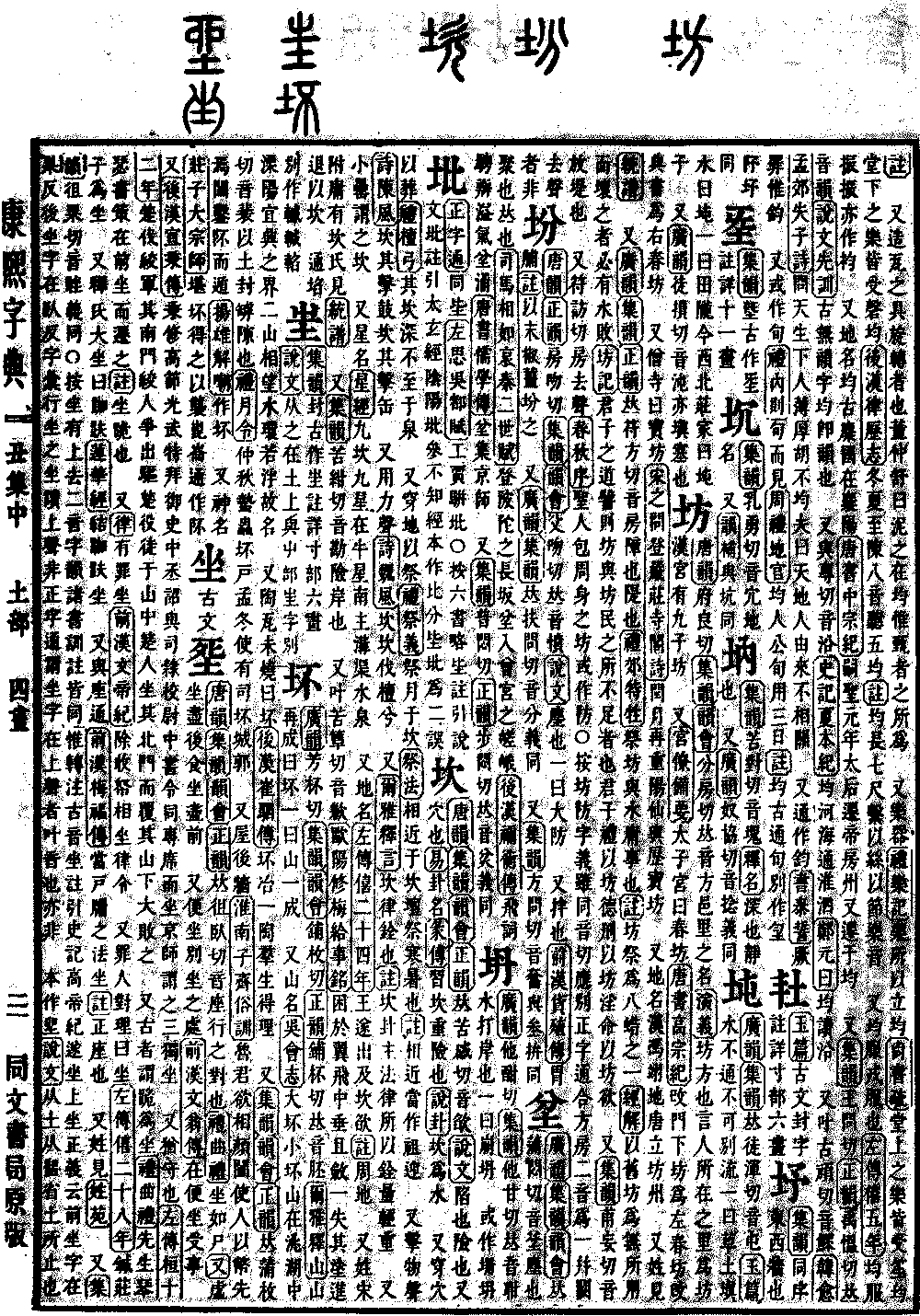
Chou Collection, Middle Volume. Radical: Earth (tǔ). Kangxi strokes: 7. Page 225, Entry 12.
Pronounced kan. Its pronunciation is identical to that of the character for dissatisfaction.
Shuowen Jiezi defines it as falling into a pit or an obstacle.
It also refers to a cave or pit.
It is the name of a trigram in the Book of Changes (Zhouyi).
The Tuan Zhuan commentary states: The repeated trigram Kan represents layered obstacles.
The Shuo Gua commentary states: Kan represents water.
It also refers to digging a pit for burial.
Book of Rites (Liji), Tan Gong records: The depth of a grave pit should not reach the level of groundwater.
It also refers to digging a pit for sacrificial purposes.
Book of Rites (Liji), Jiyi records: Sacrifices were made to the moon in a pit.
Book of Rites (Liji), Jifa records: Sacrifices were made beside pits and altars to honor the spirits of cold and heat. The commentary notes that the term appearing as similar should be read as to welcome the ancestors.
It also describes the sound of striking an object.
Book of Odes (Shijing), Guo Feng records: Sounding with a rhythmic thud, striking the drums and the earthen jars.
It also describes the sound of physical exertion.
Book of Odes (Shijing), Wei Feng records: With rhythmic thuds, the sandalwood trees are felled.
The Erya, Shiyan records: Kan serves as a standard for measuring law. The commentary notes that the Kan trigram governs law and is used to weigh gravity and lightness.
A small wine vessel is also called a kan.
It is the name of a constellation.
The Xing Jing records: There are nine stars named Nine Kan located south of the Ox constellation, which govern ditches and springs.
It is a place name.
Zuo Zhuan, 24th Year of Duke Xi records: The King of Zhou traveled to the place called Kan. The commentary notes this is a place name from the Zhou dynasty.
It is also a surname. There were people with the surname Kan in the vassal states of the Song dynasty. Reference found in the General Genealogy (Tongpu).
According to the Jiyun, it is pronounced kan. It refers to a precipitous riverbank.
It is also pronounced as qian, functioning as a rhyming variant.
Ouyang Xiu, Mei Jishi Ming writes: Constrained by the desire to soar, one drops and retracts halfway. Once the path is lost, both advance and retreat lead to dangerous pits.
It is interchangeable with the character meaning a pit. It is also written in variant forms (huan), (han), and (kan).