Chou Collection, Lower Volume
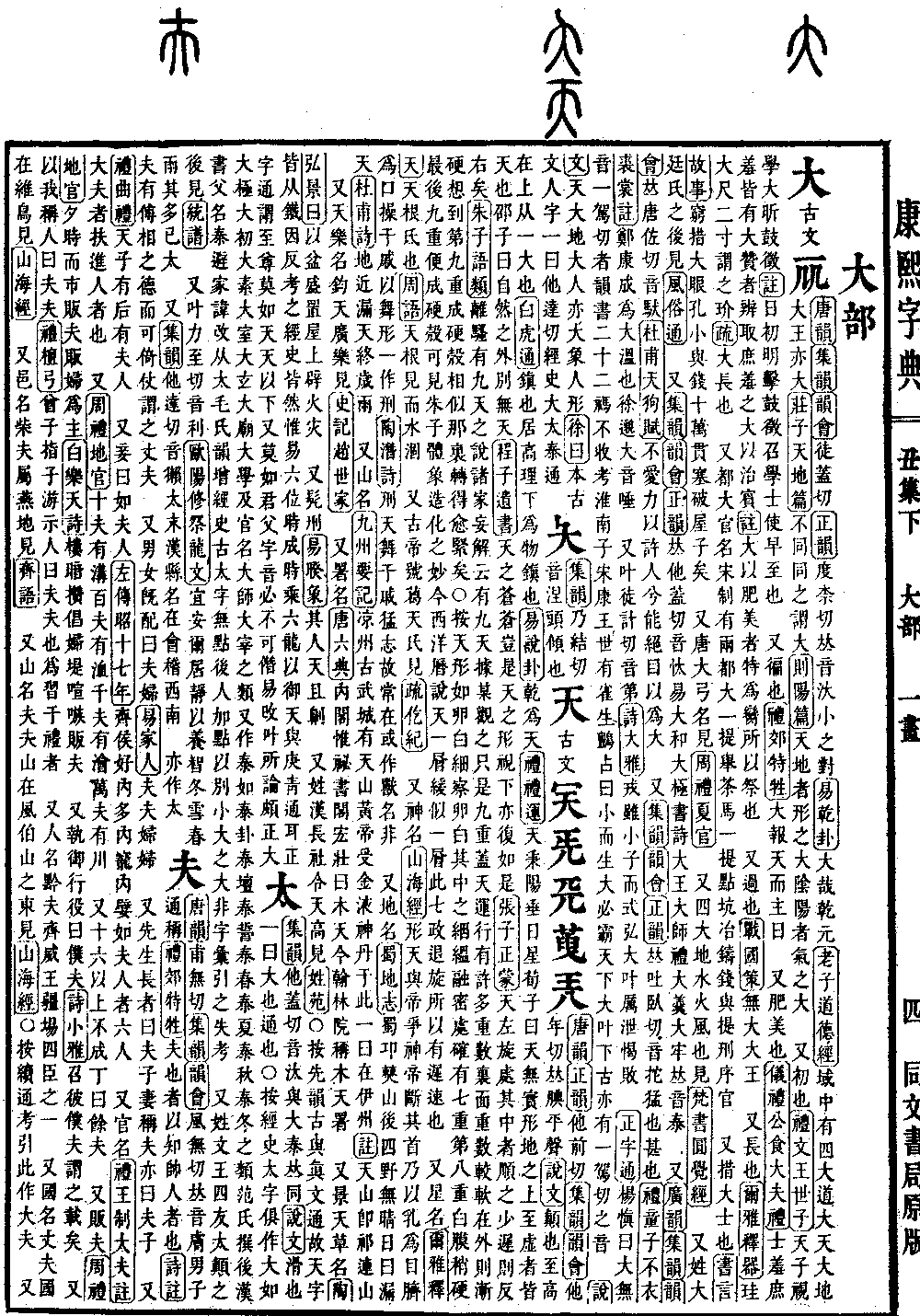
Radical: Large (dà)
Kangxi Strokes: 4
Page 248, Entry 11
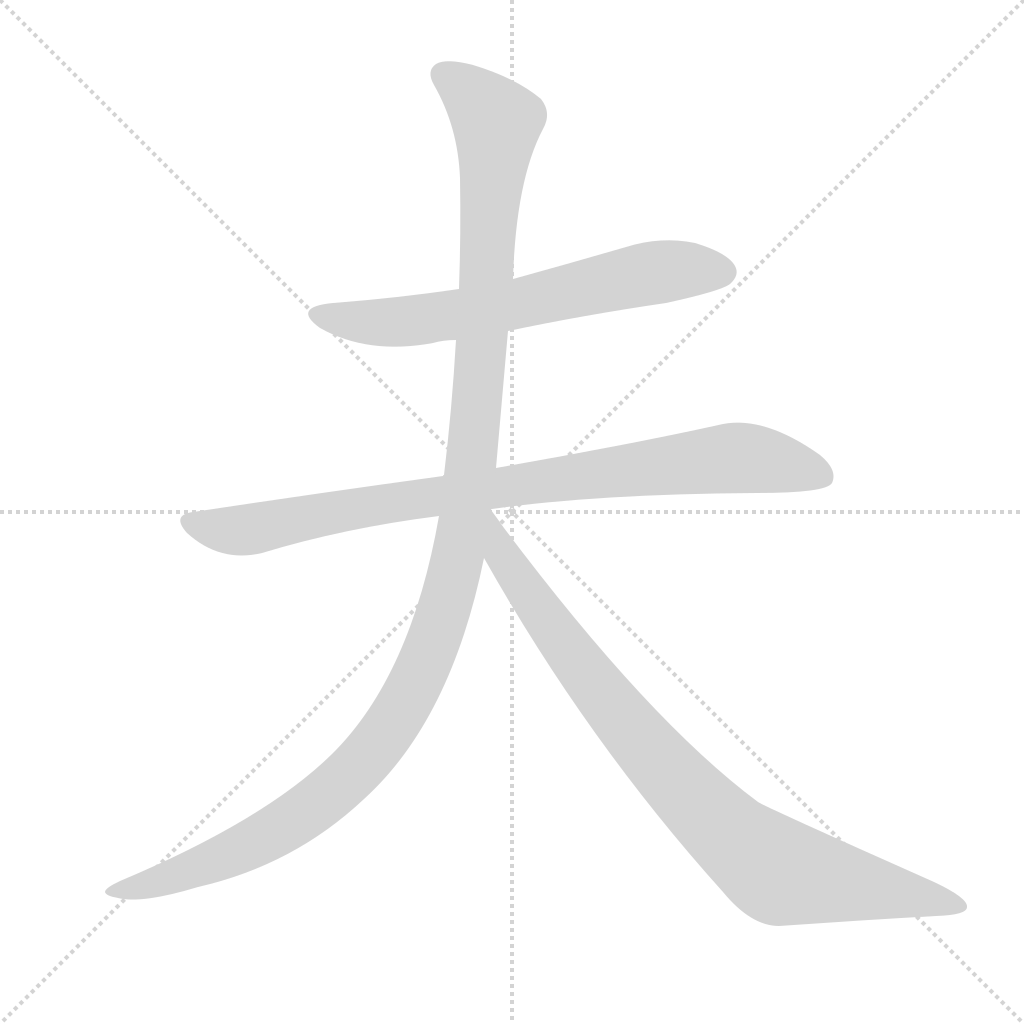
Pronounced fu. A general term for a man. Book of Rites (Liji): What is referred to as a husband is one who possesses wisdom and is capable of leading others. Commentary to the Book of Odes (Shijing): A husband possesses the virtue of assisting and is someone to be relied upon, hence he is called a gentleman (zhangfu). Furthermore, after a man and woman are married, they are called husband and wife. Book of Changes (Yijing): There is a husband and there is a wife, each observing their proper role. An older person of learning is respectfully called master (fuzi); a wife may also address her husband as master. Additionally, Book of Rites (Liji) records that the Son of Heaven has an empress and wives (furen). Concubines are also referred to as like a wife. Zuo Commentary (Zuo Zhuan): Duke Jing of Qi was fond of female beauty and had many favored women; there were six who were favored like wives. It is also an official title. Notes to the Book of Rites (Liji): A senior official (dafu) is one who supports and recommends talented people. Also, Rites of Zhou (Zhouli) records that between the fields of ten households (shi fu), there are ditches (gou); between one hundred households, there are channels (xu); between one thousand households, there are drains (hui); and between ten thousand households, there are rivers (chuan). Males over the age of sixteen who have not yet reached maturity are called additional men (yufu). There is also the term merchant (fanfu). Rites of Zhou (Zhouli): When the markets open for trade in the evening, they are primarily for male and female merchants. Poem by Bai Juyi: The pavilions are dimly lit and gathered with singing girls, the embankments are noisy with the shouts of merchants. Those who drive carriages and serve are called carriage drivers (pufu). Book of Odes (Shijing): Summon the carriage driver and tell him that we may set out. Also, the term fufu is used to refer to someone. Book of Rites (Liji): Zengzi pointed to Ziyou and said to others: This person is one who is well-versed in ritual. It is also a name. Qianfu was one of the four ministers guarding the border under King Wei of Qi. It is also a state name. The State of Zhangfu is located north of Weiniao, as seen in the Classic of Mountains and Seas (Shanhaijing). It is also the name of a town. Chaifu belonged to the state of Yan, as seen in the Discourses of the States (Guoyu). It is also the name of a mountain. Mount Fufu is located east of Mount Fengbo, as seen in the Classic of Mountains and Seas (Shanhaijing). According to the Continued Comprehensive Examination of Literature (Xu tongkao), it is written here as senior official (dafu). There is also wufu, a type of stone inferior to jade. History of the Former Han (Hanshu): Compared with the Three Kings, the Five Hegemons are like the wufu stone compared to beautiful jade. It is also written as fu or fu. It is also a unit of measurement. History of the Former Han (Hanshu): Six feet make one pace, one hundred paces make one acre, and one hundred acres make one unit of land (fu). It is also a surname. There is also the compound surname Xufu.
Pronounced fu. A particle at the beginning of a sentence. Analects (Lunyu): The benevolent person. It is also a modal particle at the end of a sentence. Analects (Lunyu): Such is it. It is also a demonstrative pronoun. Analects (Lunyu): These few disciples. It is also the name of a plant. Erya (Erya): The zhufu plant. Note: A creeping plant with small leaves and purple flowers that is edible, commonly known as qiaoyaoche.
Pronounced fu. Poem by Chen Lin: Confucius relied on his sacred virtue to travel through various states promoting his ideas. Encountering distress in the state of Cai, such is the arrangement of fate.