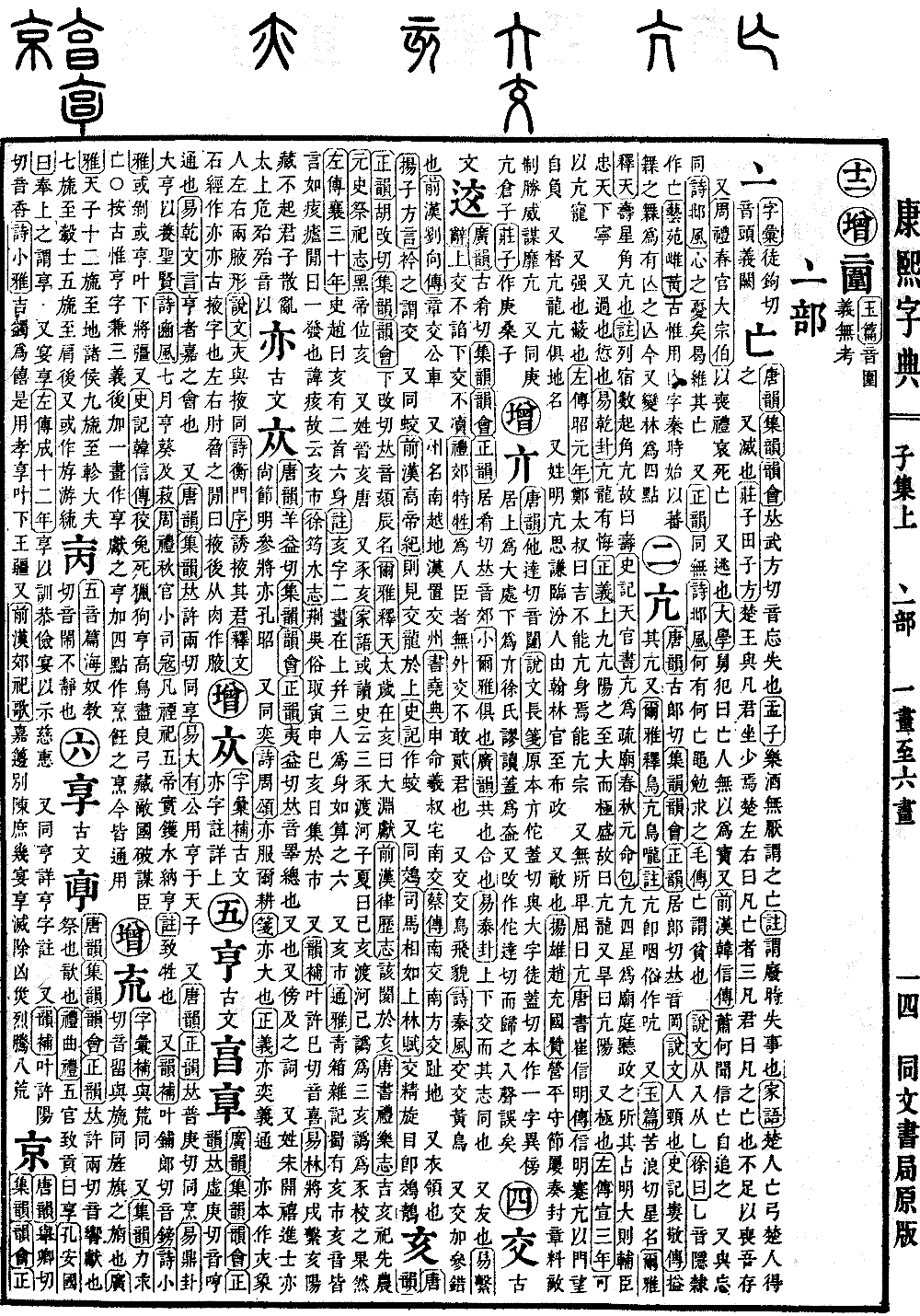
Zi Collection, Page Position: Upper
Radical: Lid (tóu)
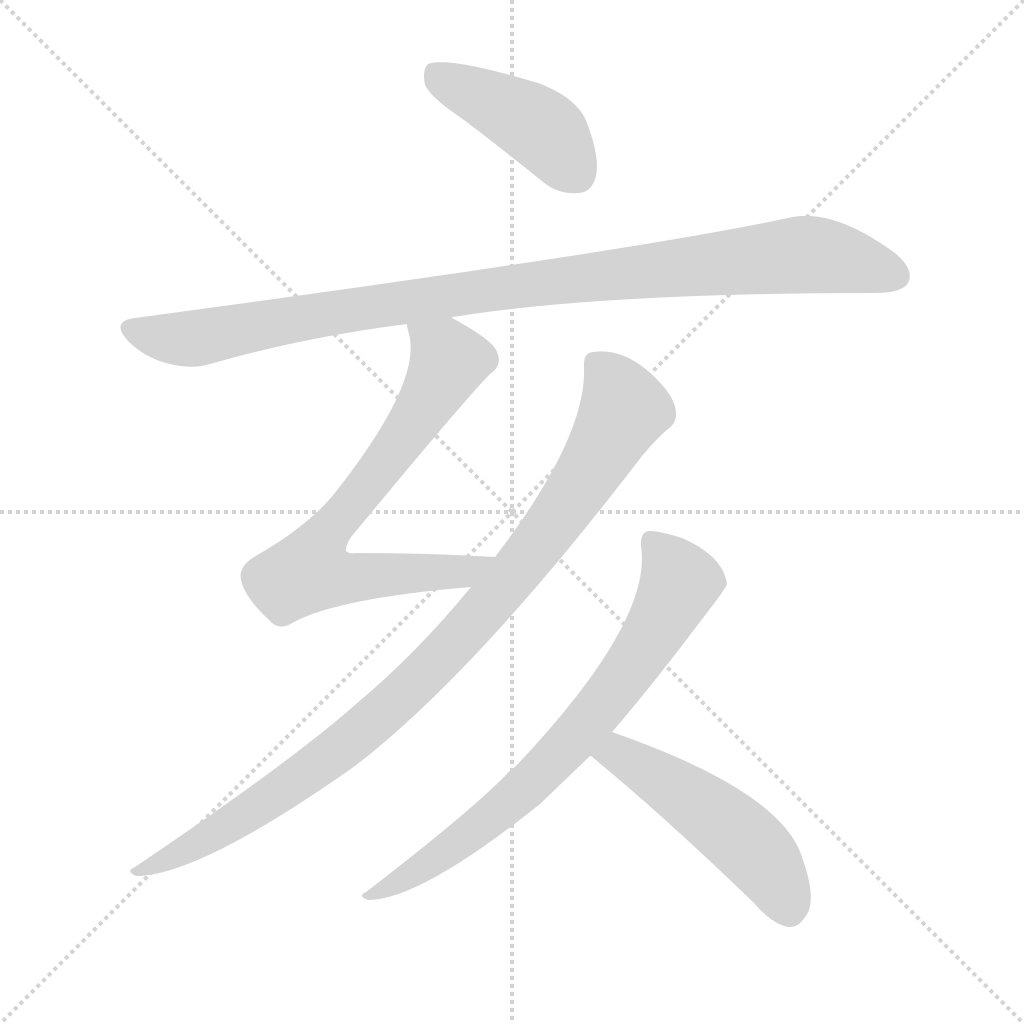
Entry: hai
Kangxi stroke count: 6
Page 88, Entry 08
Pronounced hai (rising tone).
It is the twelfth of the Earthly Branches.
Erya, Explanation of the Heavens (Erya): The years in which the Grand Year (Taisui) moves to the position of hai are called dayuanxian.
History of the Former Han, Treatise on Harmonics and Calendars (Qianhan Shu, Lvli Zhi): All things are contained and hidden during the hai hour.
Old Book of Tang, Treatise on Rites and Music (Tangshu, Liyue Zhi): Sacrifices to the First Farmer (Xiannong) are held on auspicious hai days.
History of Yuan, Treatise on Rituals (Yuanshi, Jishi Zhi): The direction for sacrificing to the Black Emperor is in the hai position.
Also used as a surname, for example, Haitang of the State of Jin.
There is the story of "shi-hai." School Sayings (Jiayu): Someone reading a history book said, "Three pigs crossed the river." Zixia pointed out, "It should be 'ji-hai crossed the river.' The character ji was mistakenly written as three, and the character hai was mistakenly written as pig." Upon checking, this was indeed the case.
Zuo Tradition (Zuo Zhuan), 30th Year of Duke Xiang: Shi Zhao said, "The character hai has two heads and six bodies." Commentary: The character hai has two strokes on top, and the three person-shaped elements below form the body, resembling the numeral six in counting rods.
Also refers to "hai markets." Extensive Refinements (Tongya): The Notes from the Green Chest (Qingxiang Zaji) record that in the Shu region, there were "hai markets." The character hai is pronounced jie (level tone), meaning an illness like malaria that recurs every other day. Because the character jie was a taboo name, it was called a hai market.
Record of Xu's Waters (Xu Yunshui Zhi): It is a custom in the Jing and Wu regions to select days corresponding to yin, shen, si, and hai for holding market trade.
Also, in the Supplement to the Rhymes (Yunbu), it is rhymed and pronounced xi (rising tone).
Forest of Changes (Yilin): From the xu hour to the hai hour, the yang energy remains hidden and does not flourish. The noble person is separated and in confusion, and those in the highest positions face danger. Here, it is pronounced yi (rising tone).