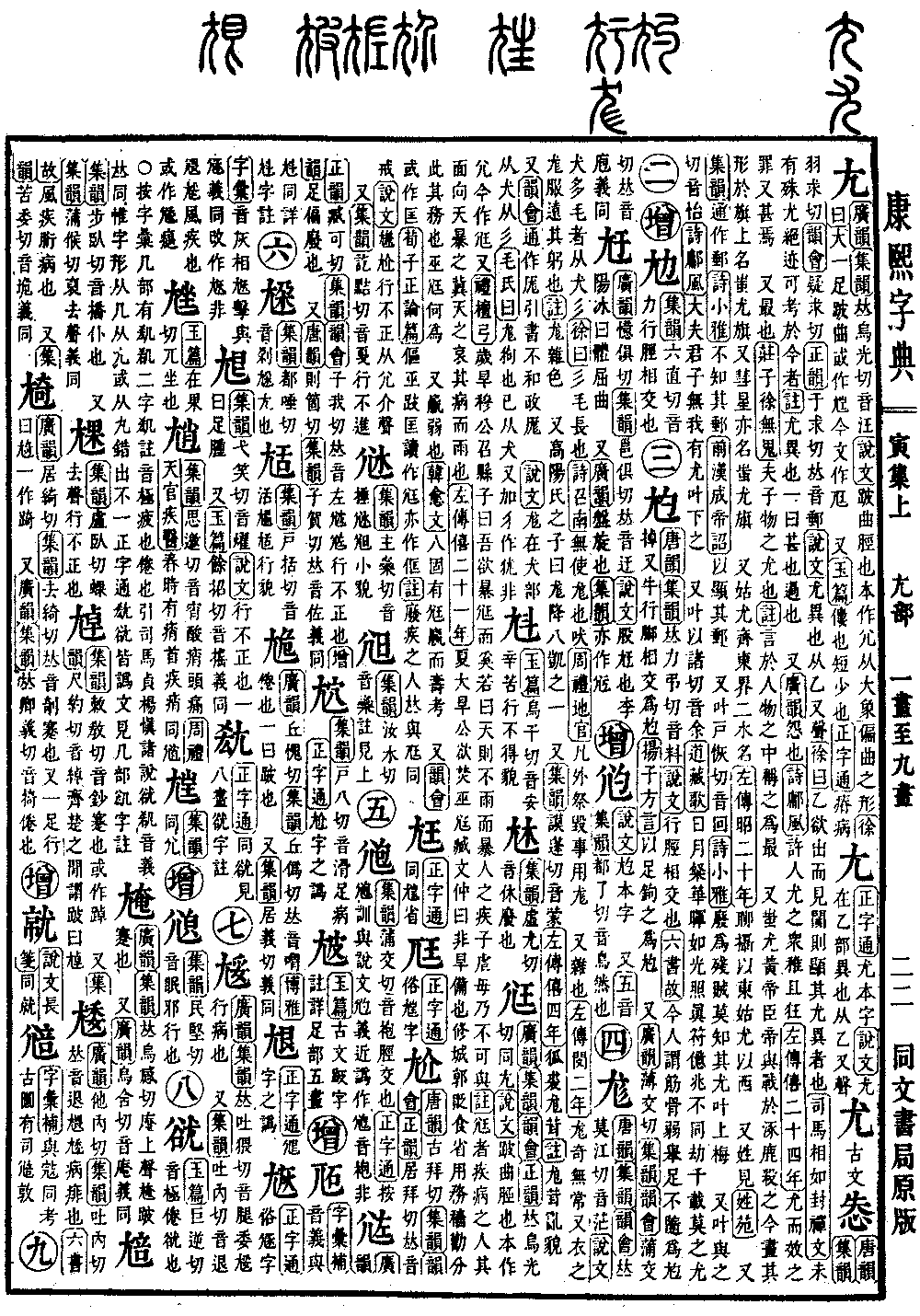
Yin Collection, Upper Volume
Radical: Lame (wāng)
Kangxi stroke count: 7
Page 298, Entry 12
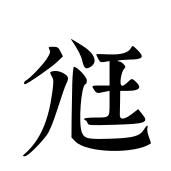
Pronounced wāng. Same as the variant form.
According to the Explaining Graphs and Analyzing Characters (Shuowen Jiezi), it refers to a curved or crippled shin. Originally written with the character for Lame (wāng), now written as this character.
Also, in the Book of Rites (Liji), specifically the Tan Gong section: In a year of drought, the Duke summoned Xianzi and said: I wish to expose a cripple to the sun to pray for rain; what do you think? He replied: If heaven does not rain, and you expose a sick person to the sun, it is like being cruel to one's own mother; this is not the way. The commentary notes: A cripple is a person suffering from illness; one exposes them to the sun facing heaven, hoping heaven will pity their sickness and bring rain.
In the Zuo Tradition (Zuo Zhuan), twenty-first year of Duke Xi: In the summer, there was a great drought, and the Duke wished to burn a shaman and a cripple. Zang Wenzhong said: This is not the proper preparation for drought; one should repair city walls, reduce food consumption, encourage agriculture, and distribute resources. These are the priorities. What can a shaman and a cripple do?
Also means frail or weak. In the writings of Han Yu: People inherently possess frailty and weakness yet may still live to an old age.
Also, according to the Collection of Rhymes (Yunhui), sometimes written as a variant form (kuāng). In the Xunzi, Rectifying Arguments section: Hunchbacks, shamans, and those with deformed feet are like this. It is read as the character for Lame (wāng). Also written in a variant form. The commentary notes: Persons with disabilities. Identical to the variant form (wāng).