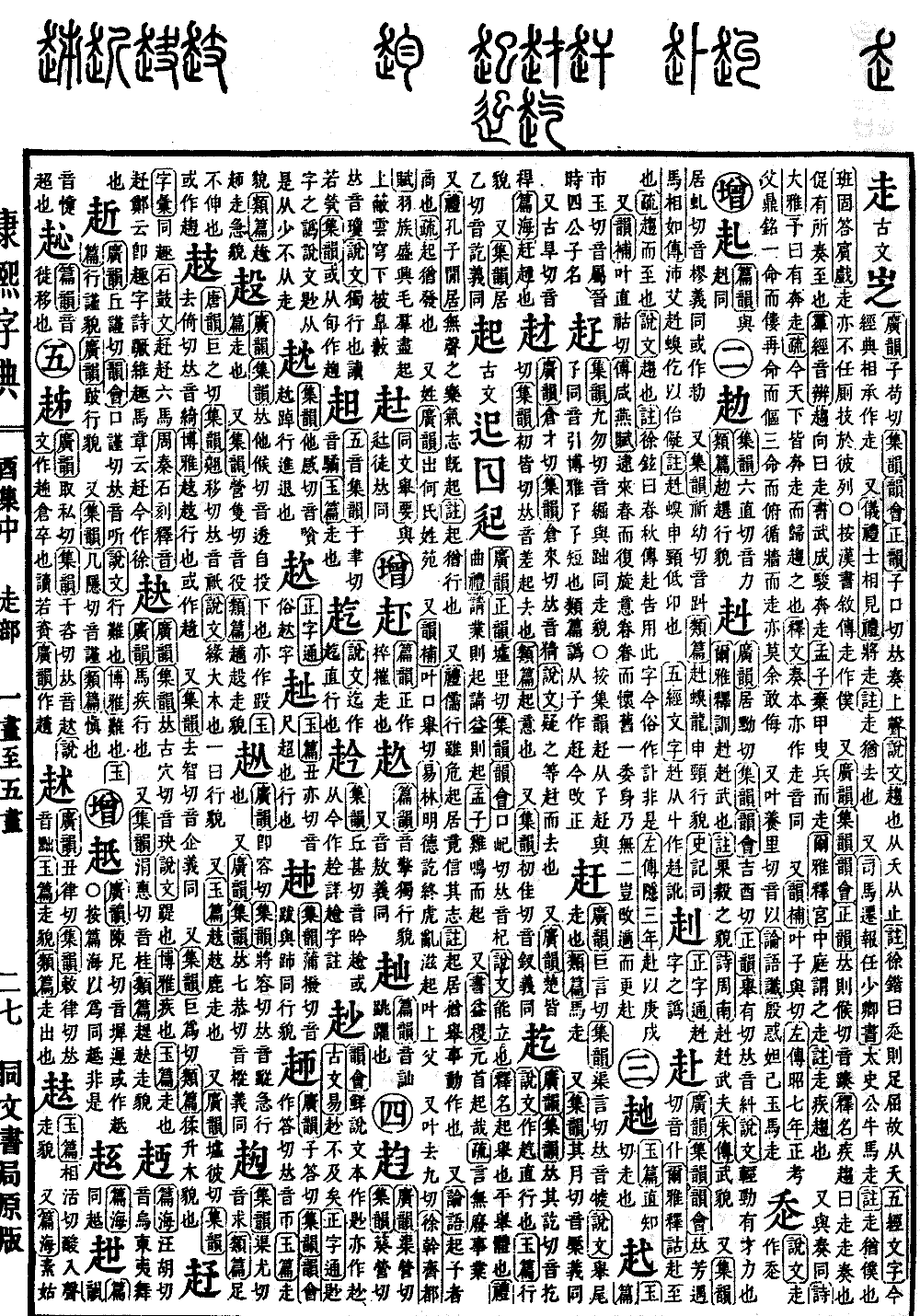
You Collection, Middle Volume
Radical: Walk (zǒu)
Kangxi Strokes: 7
Page 1215, Entry 01
Archaic script
According to the Expanded Rhymes (Guangyun), pronounced zǒu (rising tone)
According to the Collected Rhymes (Jiyun), the Rhyme Collection (Yunhui), and the Correct Rhymes (Zhengyun), pronounced zǒu (rising tone)
According to the Explanation of Writing (Shuowen Jiezi), it means to hurry. Formed from the components for bent and stop.
Annotation: Xu Kai says: The foot is bent, therefore it is formed from the component for bent.
According to the Five Classics Text (Wujing Wenzi), current classical texts conventionally use the form for walk.
Also, according to the Book of Etiquette and Ceremonial (Yili), in the chapter on officials meeting one another, it says: "About to walk."
Annotation: Walk here means to leave.
Also, according to Sima Qian's Letter to Ren Shaoqing (Bao Ren Shaoqing Shu), it says: "Grand Historian's cow and horse servant."
Annotation: Walk here means servant.
Also, according to Ban Gu's Response to the Guest's Ridicule (Da Bin Xi), it says: "I am also not capable of serving in their ranks." Note: In the Book of Han (Hanshu) Preface, walk is written as servant.
Also, according to the Expanded Rhymes (Guangyun), the Collected Rhymes (Jiyun), the Rhyme Collection (Yunhui), and the Correct Rhymes (Zhengyun), pronounced zòu.
According to the Explanation of Names (Shiming), to hurry quickly is called walking. To walk is to present. It means to be in a hurry to present something.
According to the Explanation of Sounds in the Classics (Qunjing Yinbian), to hasten toward is called walking.
According to the Book of Documents (Shujing), in the chapter on the completion of the martial enterprise, it says: "Steeds running and bustling."
According to Mencius (Mengzi), it says: "Dragging their weapons and fleeing."
According to the Literary Expositor (Erya), in the chapter on the explanation of palaces, it says: "The central courtyard is called a walk."
Annotation: Walk means to hurry quickly.
Also, same as the term for present.
According to the Book of Odes (Shijing), in the Great Odes (Daya), it says: "I said there is rushing to present."
Commentary: Now all under heaven are rushing and bustling to submit to him.
Explanation of Texts (Shiwen): Present was originally also written as walk. The pronunciation is the same.
Also, in the Rhyme Supplement (Yunbu), rhymed with the pronunciation zǐ.
According to the Zuo Commentary (Zuozhuan), in the seventh year of Duke Zhao, it says: "The inscription on the tripod of Zheng Kaofu says: At the first appointment I bowed; at the second I bent; at the third I stooped, walking along the wall, and yet no one dared to insult me."
Also rhymed with the pronunciation yǐ.
According to the Prophecy of the Analects (Lunyu Chen), it says: "The Shang dynasty was deluded by Daji and the jade horse walked."
Textual Research: According to the Book of Odes (Shijing), in the Great Odes (Daya), it says: "I said there is rushing to present." We have corrected "rushing and walking" to "rushing to present" in accordance with the original text.