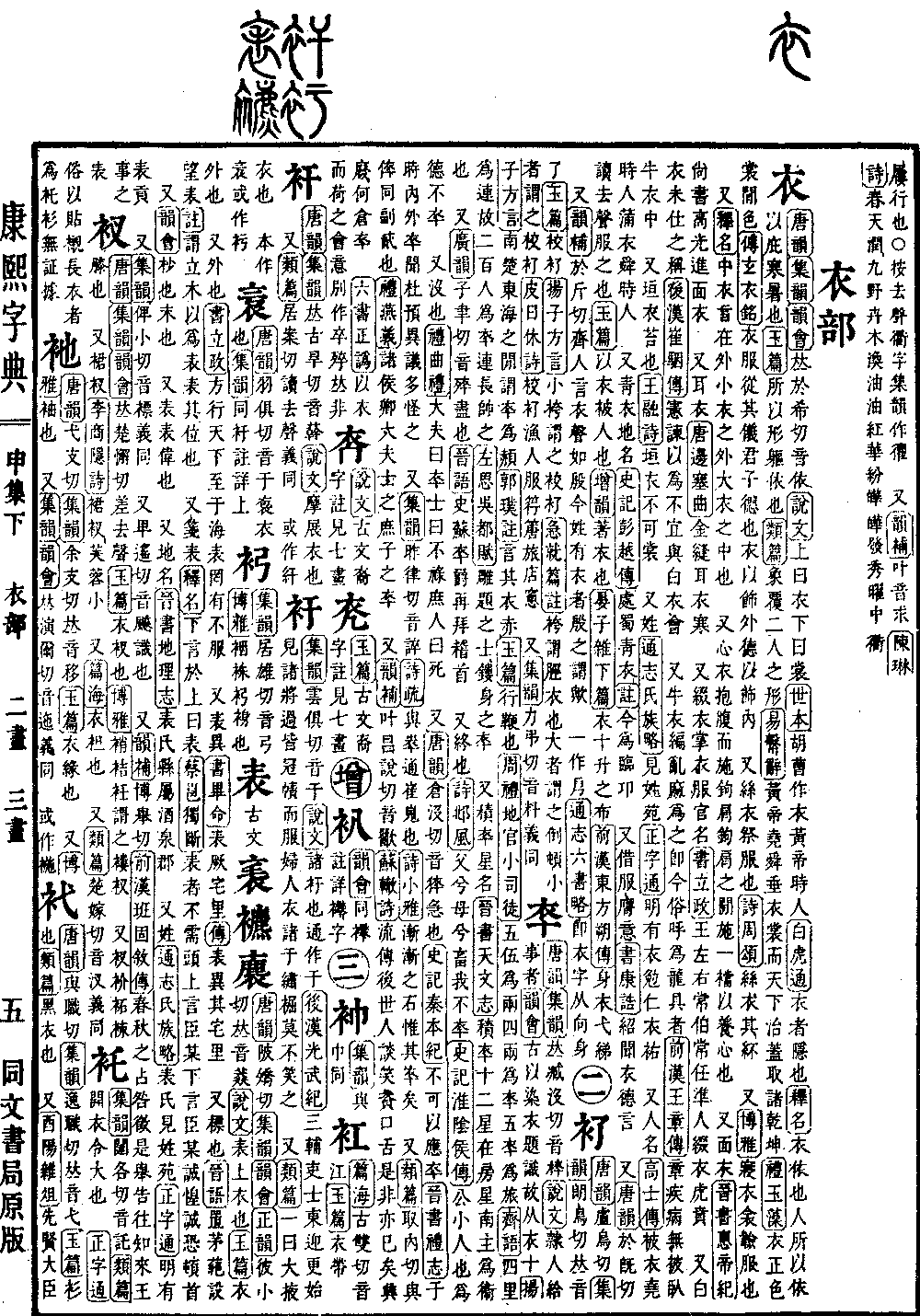
Shen Collection, Lower Volume
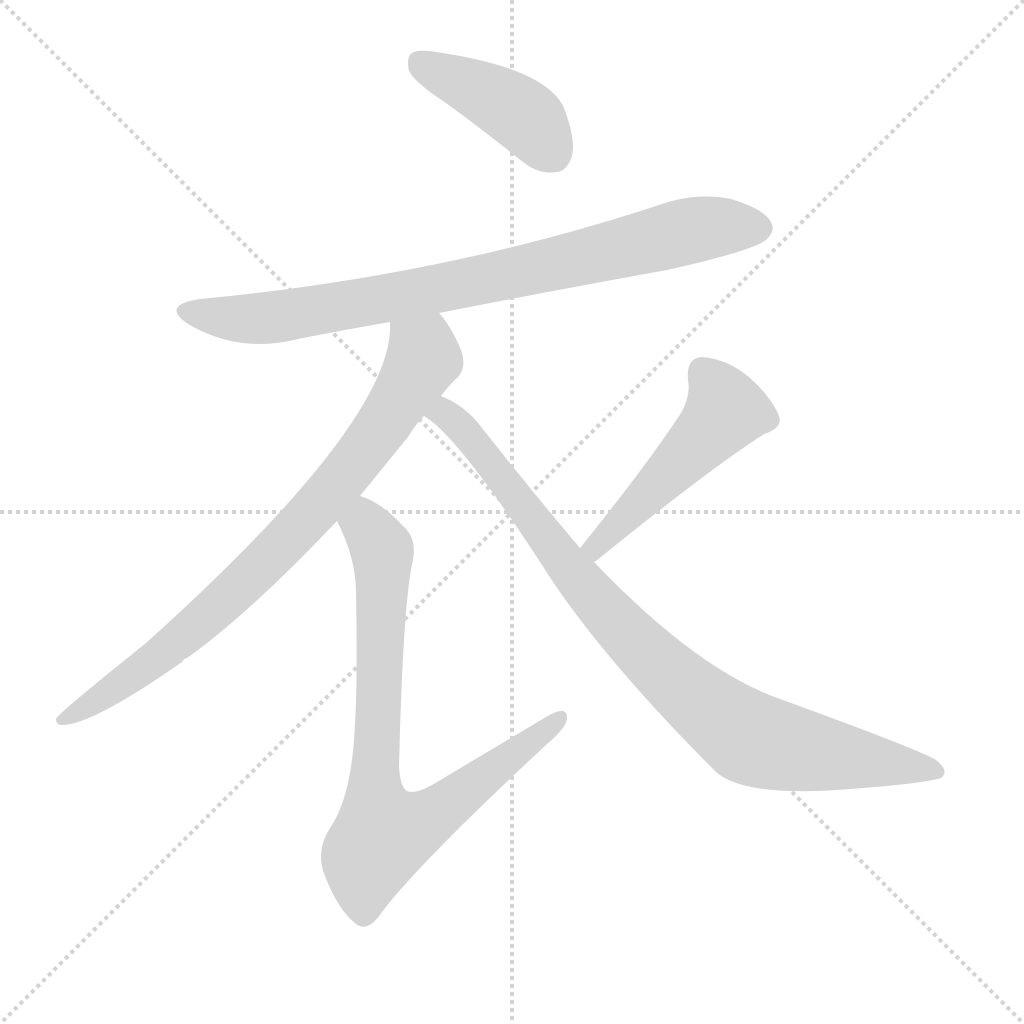
Radical: Clothing (yī)
Page 1111, Entry 01
Pronounced yi (level tone). According to the Shuowen Jiezi (Dictionary of Explaining Characters), garments worn on the upper body are called yi, and garments worn on the lower body are called shang. The Shiben (Genealogical Records) states that Hu Cao created clothing; he was a person from the era of the Yellow Emperor. The Baihu Tong (Comprehensive Discussions in the White Tiger Hall) states that clothing carries the meaning of concealment and covering. The Shiming (Explanation of Names) states that clothing carries the meaning of dependence; humans rely on it to shield themselves from cold and heat. The Yupian (Jade Chapters) states that it is something for the body to rely upon. The Leipian (Classified Chapters) states that the character shape resembles the form of covering two people. The Book of Changes (Yijing), in the Appended Remarks (Xici), says that the Yellow Emperor, Yao, and Shun wore long, dangling robes, and the world was well-governed; this was likely modeled after the order of Heaven and Earth. The Book of Rites (Liji), in the Jade Bead (Yuzao) section, states that garments should be of pure colors, while lower garments may be of mixed colors. The Fu Yi Ming (Inscription on Clothing) states that wearing clothes should follow rituals, which embodies the virtue of a gentleman. Clothing is used to adorn the exterior, while virtue is used to cultivate the inner self. Also, silk clothing refers to ceremonial attire worn during sacrificial rites. The Book of Odes (Shijing), in the Zhou Songs (Zhou Song), says the silk clothing is clean and bright. Also, the Boya (Broad Compendium) states that sleeping clothing refers to a quilt, which is used to cover the body. Also, the Shiming states that middle clothing refers to garments worn outside the inner undergarments but inside the outer robes. Also, heart clothing refers to a garment that wraps around the abdomen with straps hanging over the shoulders, with a piece of fabric added between the shoulder straps to protect the chest area. Also, face clothing; the Book of Jin (Jin Shu), in the Annals of Emperor Hui, records that the Minister Gao Guang presented face clothing. Also, ear clothing; Tang dynasty frontier songs mention using gold-threaded ear clothing to resist the cold. Also, Zhuiyi refers to the title of an official in charge of clothing. The Book of Documents (Shujing), in the Establishment of Government (Lizheng), mentions officials such as the Changbo, Changren, Zhuren, Zhuiyi, and Huben. Also, white clothing refers to people who do not hold official positions. The Book of the Later Han (Hou Han Shu), in the Biography of Cui Yin, mentions that Xian urged that one should not meet with those in white clothing. Also, ox clothing is made from tangled hemp; it is what is commonly known today as longju. The Book of the Former Han (Qian Han Shu), in the Biography of Wang Zhang, mentions that Wang Zhang was gravely ill and, lacking a quilt, slept inside ox clothing. Also, wall clothing refers to moss. In the poetry of Wang Rong, it is said that wall clothing cannot be worn as garments. Also, a surname. The Tongzhi (Comprehensive Treatises), in the Treatise on Clans (Shizu Lue), mentions it appearing in the Surname Garden (Xingyuan). The Zhengzitong (Correction of Characters) notes that in the Ming dynasty, there were people named Yi Mianren and Yi You. Also, a personal name. The Gaoshi Zhuan (Biographies of Eminent Gentlemen) mentions Bei Yi, a person from the time of Yao, and Pu Yi, a person from the time of Shun. Also, Qingyi, a place name. The Records of the Grand Historian (Shiji), in the Biography of Peng Yue, mentions being settled in Qingyi in the Shu region, which is identified in the notes as being the modern-day Linqiong. Also, borrowed to mean keeping something firmly in mind. The Book of Documents, in the Kang Gao section, says to inherit and remember those virtuous words.
Pronounced yi (departing tone). This refers to the act of putting on clothes. The Yupian states it means to clothe someone. The Zengyun (Expanded Rhymes) states it means to clothe oneself. The Yanzi Chunqiu (Master Yan's Spring and Autumn Annals) mentions wearing clothes made of ten-sheng fabric. The Book of the Former Han, in the Biography of Dongfang Shuo, mentions wearing black, coarse, thick silk clothing.
Also, pronounced yin. People in the Qi region pronounce yi as yin. There are people today with the surname Yi; could it be derived from the Yin surname? It is also written in a variant form (zhuan). The Tongzhi, in the Six Books (Liushu Lue), states that it is the character yi, composed of the elements for towards and body. Examination: The Zhengzitong records that in the Ming dynasty, there was a person named Yi Mianren, Yi You. Following the original text, corrected to You.