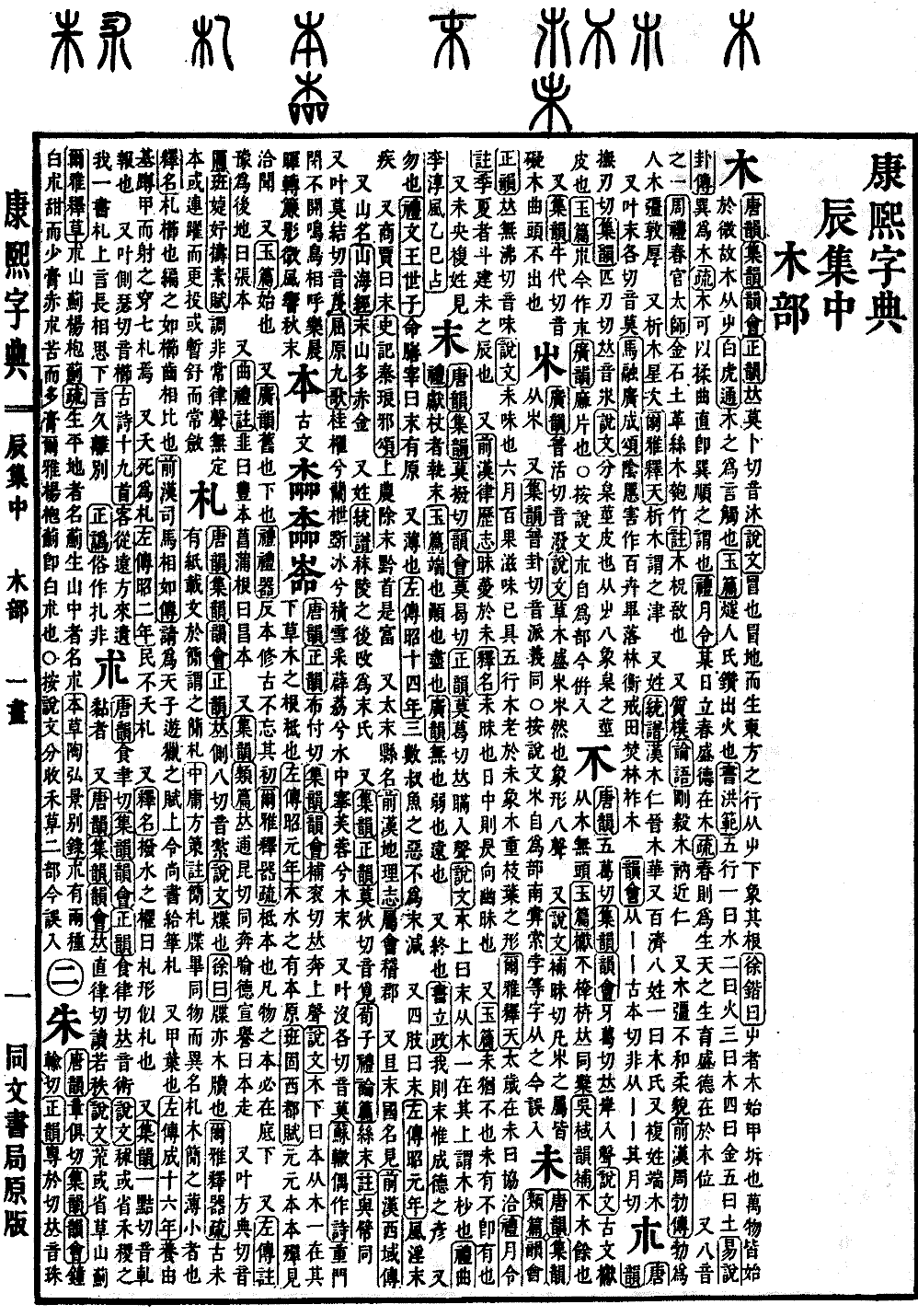
Chen Collection, Middle Volume
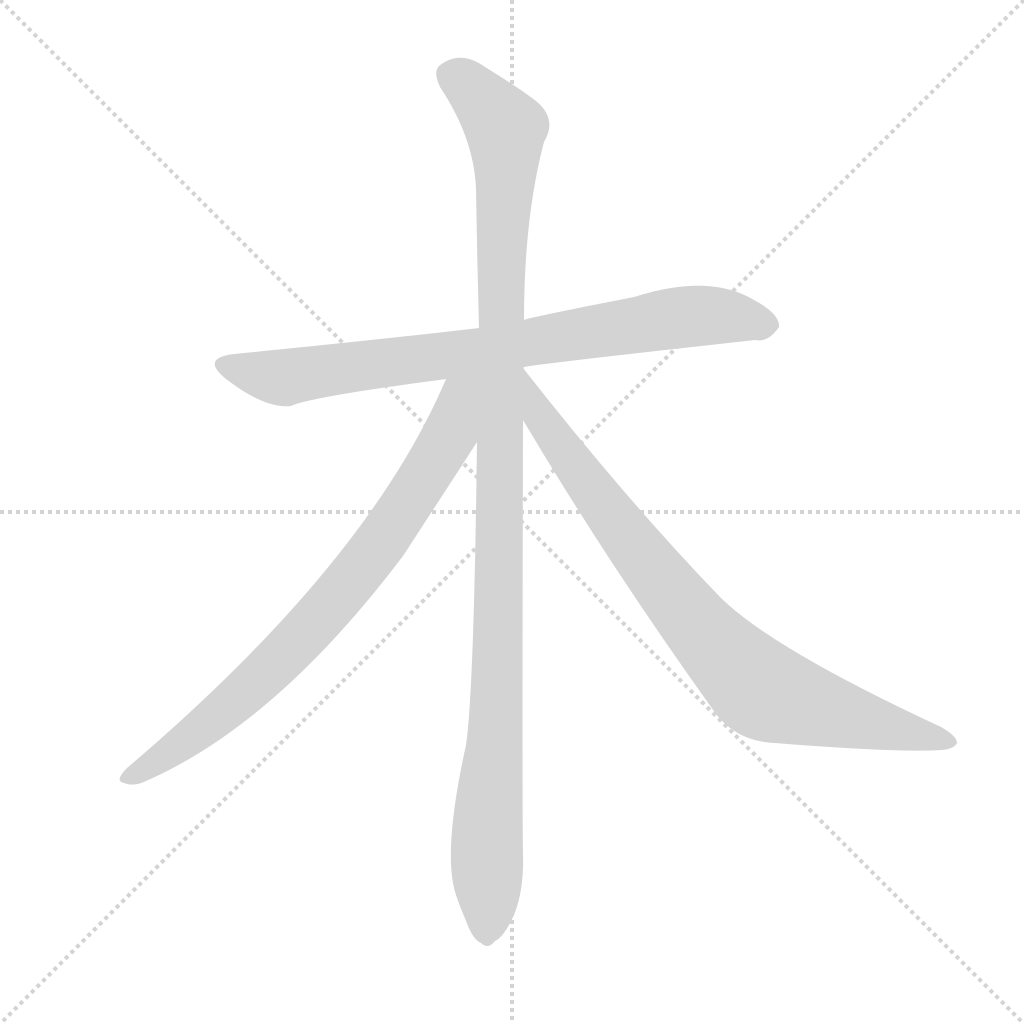
Radical: Tree (mù)
Page 509, Entry 01
Pronounced mu.
According to the Explaining Graphs and Analyzing Characters (Shuowen Jiezi), it signifies to emerge or cover. It refers to plants breaking through the soil and represents the elemental force of the East. The upper part of the character is derived from the radical for sprout, and the lower part resembles its roots. Xu Kai states that the sprout represents the beginning of growth, and since all things start small, the character is derived from this. According to the Comprehensive Discussions in the White Tiger Hall (Baihu Tong), the character carries the meaning of touching or contacting.
The Jade Chapters (Yupian) records that this refers to the wood used by the Suiren clan to drill for fire.
In the Book of Documents (Shangshu), section Great Plan (Hongfan), the five elements are: first is water, second is fire, third is wood, fourth is metal, fifth is earth. In the Book of Changes (Yijing), section Discussion of the Trigrams (Shuogua Zhuan), it represents wood. The sub-commentary notes that the nature of wood is to be either curved or straight, and it can be utilized by following its natural properties.
In the Book of Rites (Liji), section Monthly Ordinances (Yueling), it states that on a certain day of early spring, the flourishing vitality resides in wood. The sub-commentary explains that spring is the season of growth, and as heaven transforms and nourishes all things, its flourishing vitality is manifested in the direction associated with wood.
It is also one of the eight musical sounds. In the Rites of Zhou (Zhouli), section Spring Offices (Chunguan), the eight sounds are: metal, stone, earth, leather, silk, wood, gourd, and bamboo. The commentary explains that wood here refers to wooden instruments such as the zhu (a percussion instrument) and the yu (a tiger-shaped wooden percussion instrument).
It also conveys the meaning of simplicity or rusticity. In the Analects of Confucius (Lunyu), it states that firmness, resolution, simplicity, and caution in speech are qualities near to benevolence. It also appears in the term muqiang, which refers to a personality that is stiff and not supple. In the History of the Former Han (Qian Hanshu), biography of Zhou Bo, it is noted that Zhou Bo was rustic, upright, and sincere.
It further refers to Ximu, which is the name of a celestial stellar region. In the Erya, section Explaining Heaven (Shitian), it states that this stellar region is known as the ford.
It is also a surname. The Comprehensive Genealogies (Tongpu) records that there was a Mu Ren in the Han dynasty and a Mu Hua in the Jin dynasty. Additionally, it is one of the eight great surnames of the state of Baekje. There are also compound surnames, such as Duanmu.
In the variant phonetic usage, it is pronounced mo. In the Guangcheng Eulogy (Guangcheng Song) by Ma Rong, it states that when evil spirits arise, all grasses wither. The official in charge of mountains and forests issues warnings regarding agricultural affairs, burning mountain forests and felling trees.
The Rhyme Collection (Yunhui) notes that the character is derived from the vertical stroke. The vertical stroke in ancient pronunciation is read as ben. It is not derived from the hook stroke, which is read as the result of the combination of qi and yue.