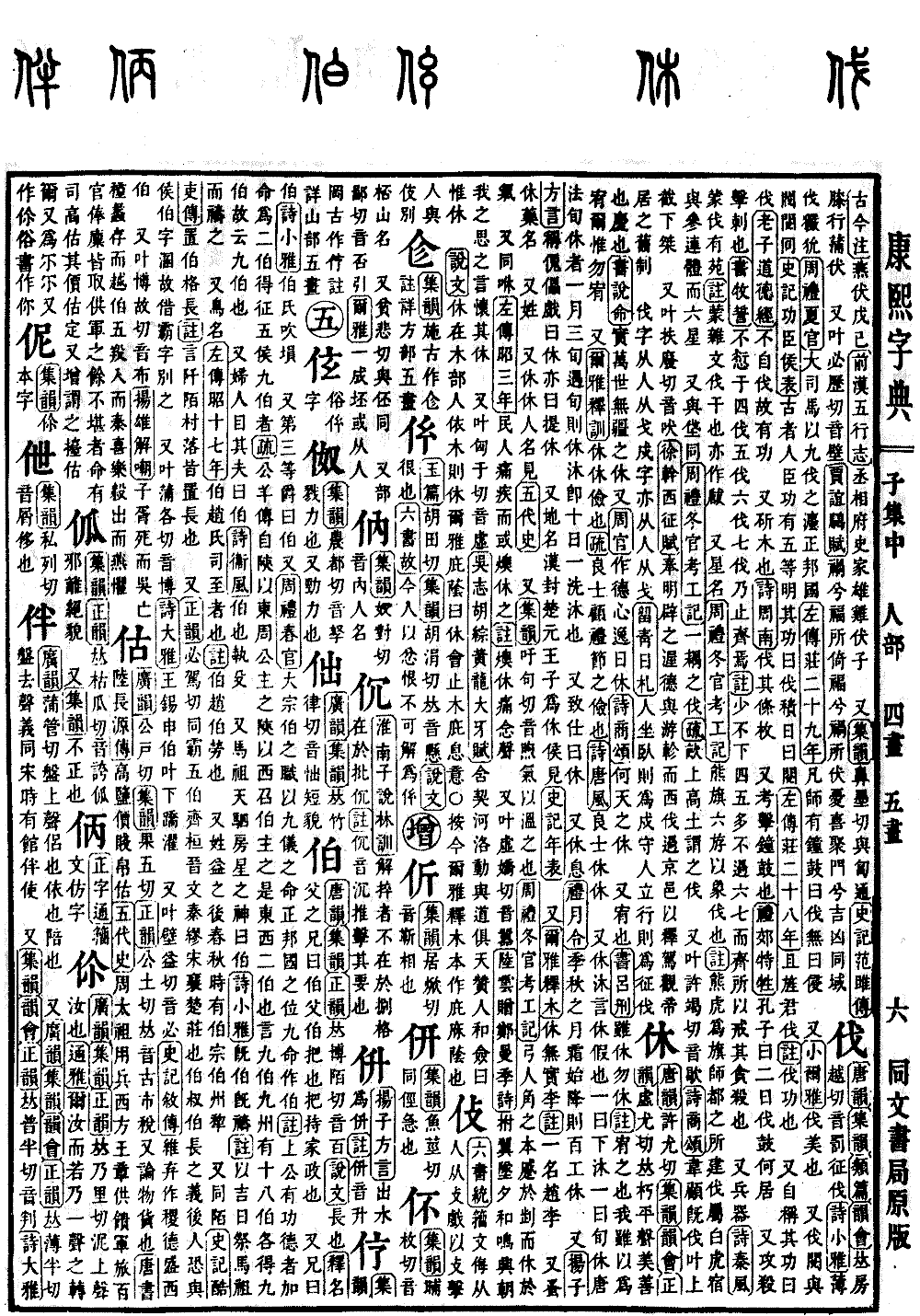
Zi Collection, Middle Volume
Radical: Person (rén)
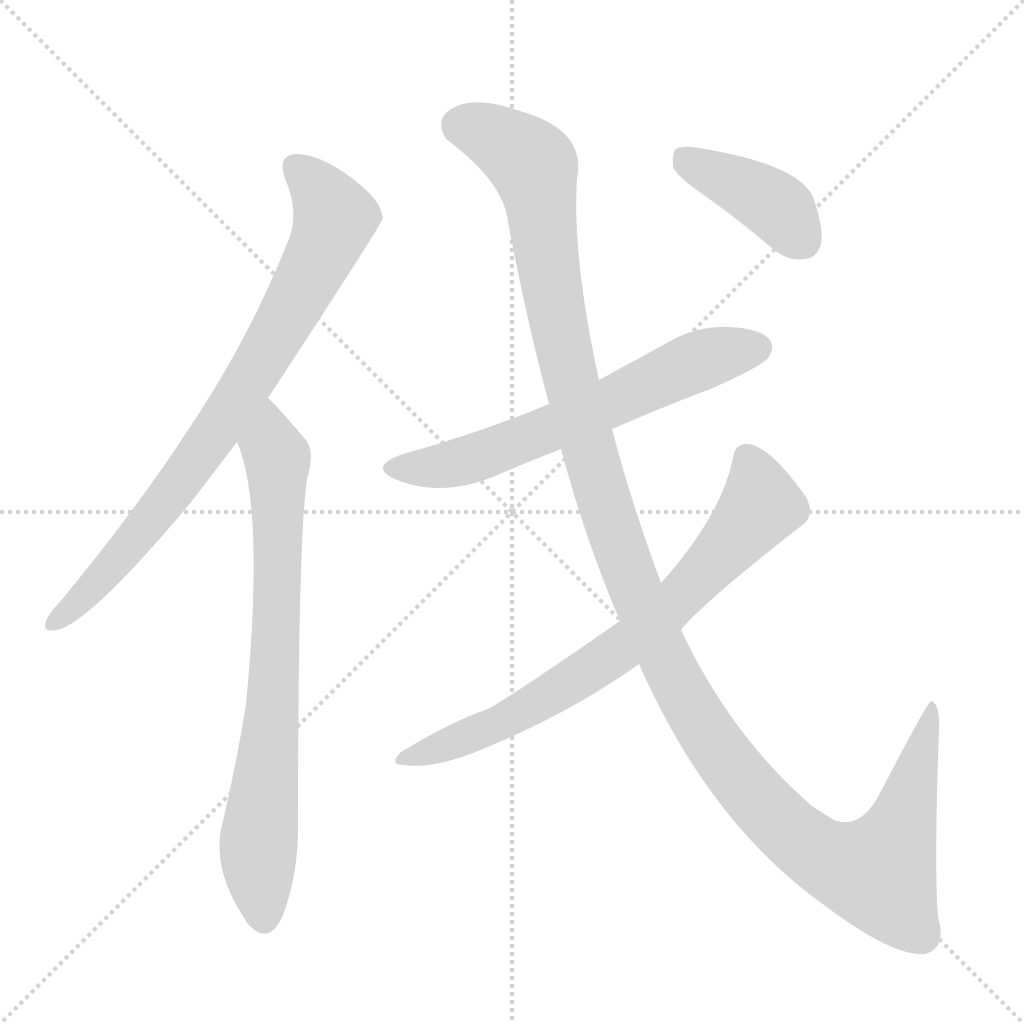
Character: fá
Kangxi stroke count: 6
Page 96, Number 01
Tangyun, Jiyun, Leipian, and Yunhui: initial fáng and final yuè cut, pronounced like fá.
To go on a military expedition or to strike.
We went on a military expedition against the Xianyun — Book of Odes (Shijing).
The Minister of War uses the nine methods of punishment to rectify the states — Rites of Zhou (Zhouli).
Whenever an army uses bells and drums, it is called a strike; without them, it is called an incursion — Zuo Commentary (Zuozhuan).
Also, according to the Little Erya (Xiao Erya), the word means beauty.
Also, fáyüè is the same as the term for merit and length of service.
In ancient times, the merits of ministers were divided into five grades: declaring one's merit is called fá, and accumulating time in service is called yuè — Records of the Grand Historian (Shiji).
And to commend your merit — Zuo Commentary.
Note: fá means merit or achievement.
Also, boasting of one's own merit is called fá.
He does not boast of himself, therefore he achieves success — Daodejing (Laozi).
Also, to fell trees.
Cutting down its branches and trunk — Book of Odes.
Also, to strike bells and drums.
Confucius said: Why beat the drums for two days? — Book of Rites (Liji).
Also, to attack or to slay.
After no more than four, five, six, or seven strikes, stop and reform the ranks — Book of Documents (Shangshu).
Note: Not fewer than four or five, and not more than six or seven before reforming, to caution against the greed for killing.
Also, a type of weapon.
On the shield there are colored patterns — Book of Odes.
Note: méng refers to multicolored patterns. fá refers to a shield. Sometimes also written in a variant form pronounced fá.
Also, the name of a star.
The bear flag has six streamers to symbolize the Fa star — Rites of Zhou.
Note: Flags with bear and tiger designs are established by the military commanders; the Fa star belongs to the White Tiger mansion and is connected to the Shen constellation, totaling six stars.
Also used interchangeably with the character pronounced fá.
A mound of earth from a pair of plows — Rites of Zhou.
Commentary: The raised earth above a ditch is called fá.
Also used as a rhyming word pronounced xiē.
The states of Wei and Gu have already been punished — Book of Odes.
Rhyming with the words pronounced jié and jié.
Also used as a rhyming word pronounced fèi.
Upholding the deep benevolence of the enlightened sovereign, I join the traveling chariots on an expedition to the west. Passing through the capital, I halt the carriage to observe the ancient layout of the imperial palace — Rhapsody on the Western Expedition (Xizheng fu).
The character fá is composed of the elements person and halberd, and the character shù is also composed of the elements person and halberd.
A person sitting or lying down represents guarding; a person standing and walking represents an expedition — Daily Notes of Liuqing (Liuqing rizha).
Verification: A mound from a pair of plows — Rites of Zhou.
Commentary: Raised earth on a field is called fá. Corrected from the original text: change on the field to on the ditch.