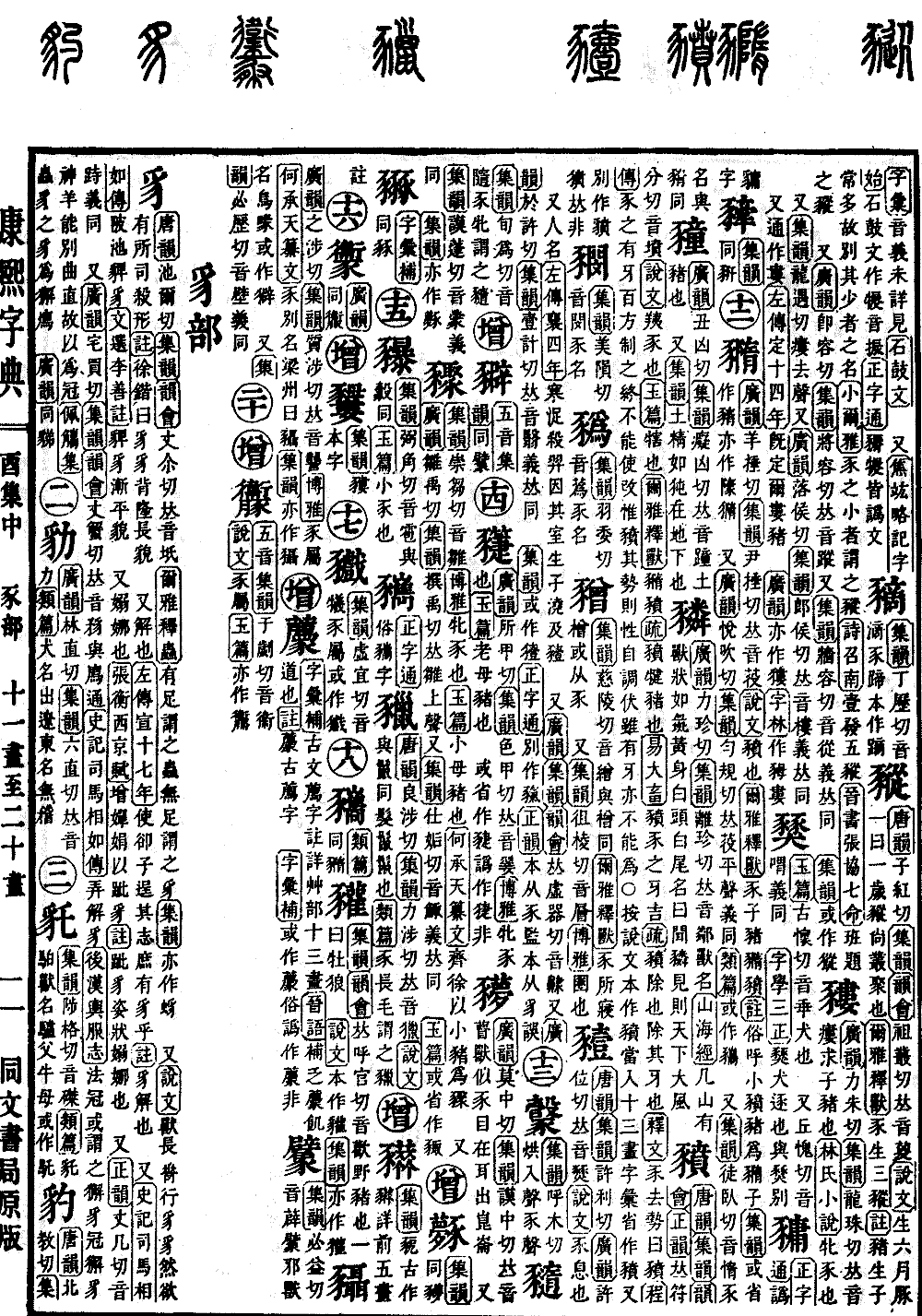
You Collection, Lower Volume
Radical: Badger (zhì)
Kangxi Strokes: 7
Page 1199, Entry 36
Pronounced zhi (rising tone).
Literary Expositor (Erya), Explanation of Insects: Those with feet are called insects, those without feet are called zhi.
Collected Rhymes (Jiyun): Also written as a variant form.
Additionally, from the Explanation of Simple and Compound Characters (Shuowen Jiezi): A long beast, moving in a zhi-zhi manner, with the appearance of wanting to oversee or kill.
Annotation: Xu Kai says: zhi-zhi means a high, long back.
Also means to resolve or loosen.
Zuo Commentary (Zuozhuan), 17th Year of Duke Xuan: Cause the son of Xi to satisfy his ambition, perhaps then there will be a loosening (zhi).
Annotation: Zhi means to loosen.
Also, Records of the Grand Historian (Shiji), Biography of Sima Xiangru: The slopes and pools were uneven (pizhi).
Anthology of Literature (Wenxuan), Li Shan's Annotation: Pizhi means gradually flattening.
Also means slender and graceful.
Zhang Heng, Western Metropolis Rhapsody (Xijing Fu): Increased the grace of the slender and swaying movements (cizhi).
Annotation: Cizhi refers to a slender and graceful posture.
Also, Correct Rhymes (Zhengyun): Pronounced zhi (rising tone). Meaning is the same.
Also, Broad Rhymes (Guangyun): Pronounced zhai. Same as zhi (the mythical beast).
Records of the Grand Historian (Shiji), Biography of Sima Xiangru: Toying with the Xie-zhi.
Book of the Later Han (Hou Hanshu), Treatise on Official Carriages and Attire: The law cap is sometimes called the Xie-zhi cap. The Xie-zhi is a divine sheep capable of distinguishing between right and wrong, hence it is used as a name for the cap.
Peixi Ji: The zhi in the term for small insects and animals is the same as the zhi in Xie-zhi.
Broad Rhymes (Guangyun): Same as the variant form.