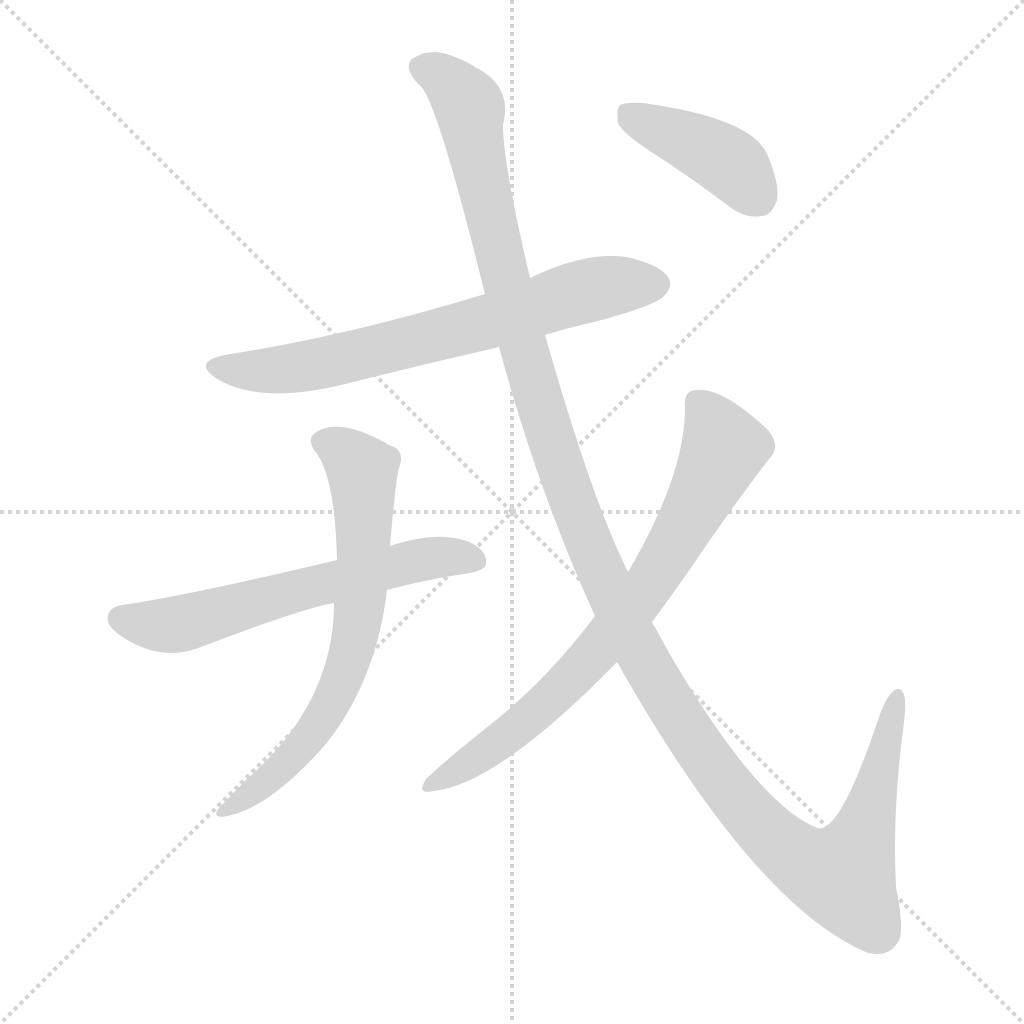
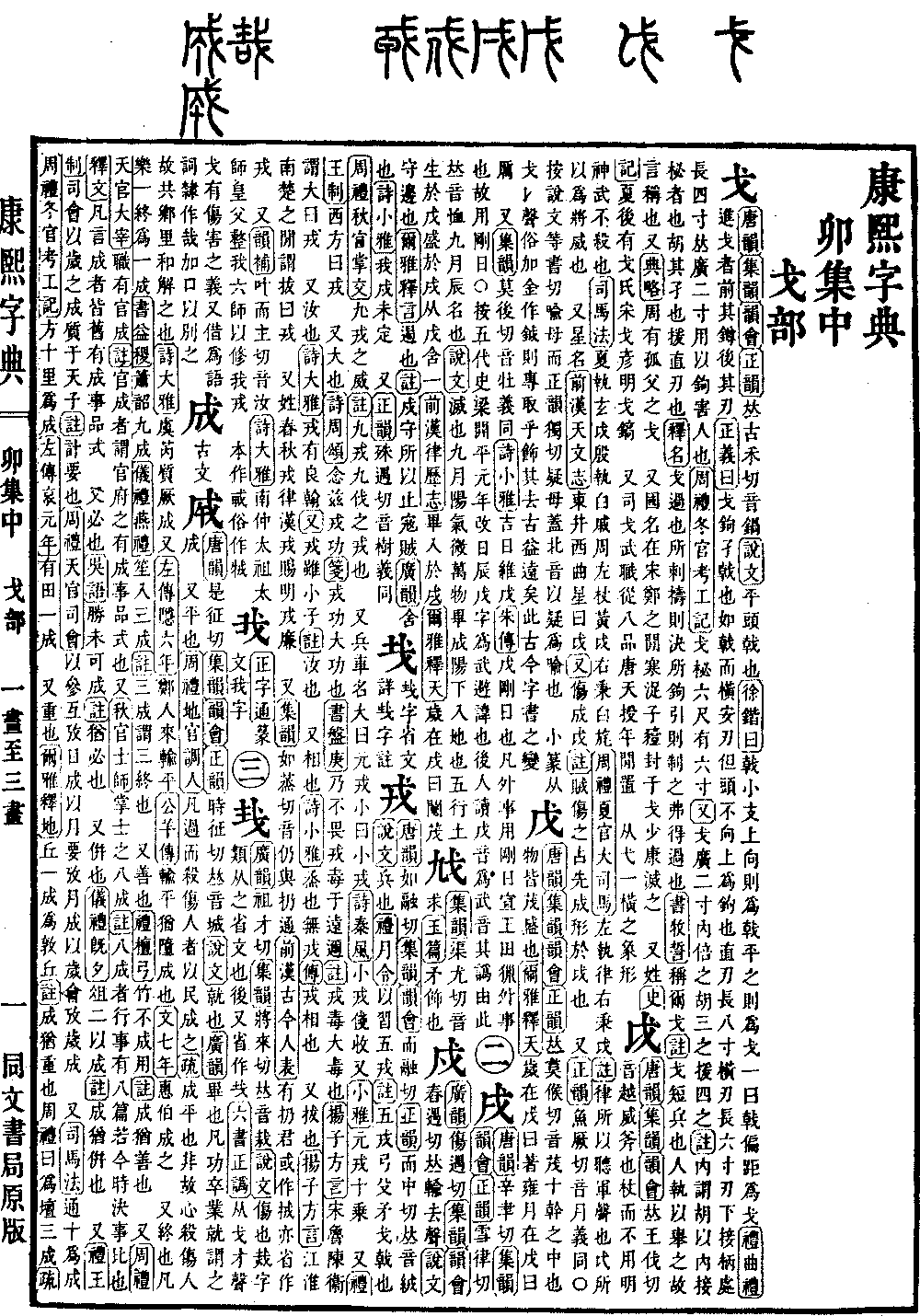
Mao Collection, Middle Volume. Radical: Dagger-axe (gē). Kangxi stroke count: 6. Page 411, Entry 08.
Pronounced rong. According to the Analytical Dictionary of Characters (Shuowen Jiezi), it refers to weaponry. As recorded in the Book of Rites (Liji), specifically the Monthly Ordinances (Yueling) section: To practice with the five weapons. The commentary explains that the five weapons refer to the bow, the club, the spear, the dagger-axe, and the halberd. In the Rites of Zhou (Zhouli), specifically the Autumn Officials (Qiuguan) section: The might of the nine martial affairs. The commentary explains that the nine martial affairs refer to nine types of military expeditions. It also refers to war chariots; large ones are called yuanrong, and small ones are called xiaorong. As found in the Book of Odes (Shijing), Qin Wind section: The small chariots have shallow bodies. Also, in the Minor Odes (Xiaoya) section: Ten great war chariots. Furthermore, in the Book of Rites (Liji), Royal Regulations (Wangzhi) section, it refers to the Western region as the Rong. It also denotes the meaning of large. In the Book of Odes (Shijing), Zhou Eulogies (Zhousong) section: Thinking of this great achievement. The commentary notes that great achievement means significant merit. In the Book of Documents (Shangshu), Pan Geng section: Then you do not fear the great poison from near and far. The commentary notes that great poison means intense harm. According to the Dialect (Fangyan) by Yang Xiong, in the regions of Song, Lu, and Wei, the word rong is used to mean large. It also functions as a pronoun meaning you. In the Book of Odes (Shijing), Greater Odes (Daya) section: You have fine pillars. Also: Although you are a young person. The commentary notes that rong means you. It further denotes the meaning of to assist. In the Book of Odes (Shijing), Minor Odes (Xiaoya) section: There is no one to assist. The commentary states that rong means to assist. It also denotes the meaning of to pull out. According to the Dialect (Fangyan), in the regions of Jiang, Huai, and Southern Chu, the word rong is used to mean to pull. It is also a surname. In the Spring and Autumn period there was Rong Lu, in the Han dynasty there was Rong Ci, and in the Ming dynasty there was Rong Lian. Additionally, some records note it is pronounced reng. It is interchangeable with the character meaning to throw or to pull. In the History of the Former Han (Qian Hanshu), Table of Ancient and Modern People, there is the figure Reng Jun. Some editions write it in a variant form. It is also written simply as rong. Furthermore, in the Supplement to the Rhymes (Yunbu), it is read with a rhyme matching the character for you. In the Book of Odes (Shijing), Greater Odes (Daya) section: Ancestor of Nanzhong, Grand Preceptor Huangfu, arranged our six armies, in order to cultivate our martial strength. Originally written in a variant form. Popularly written as niurong.