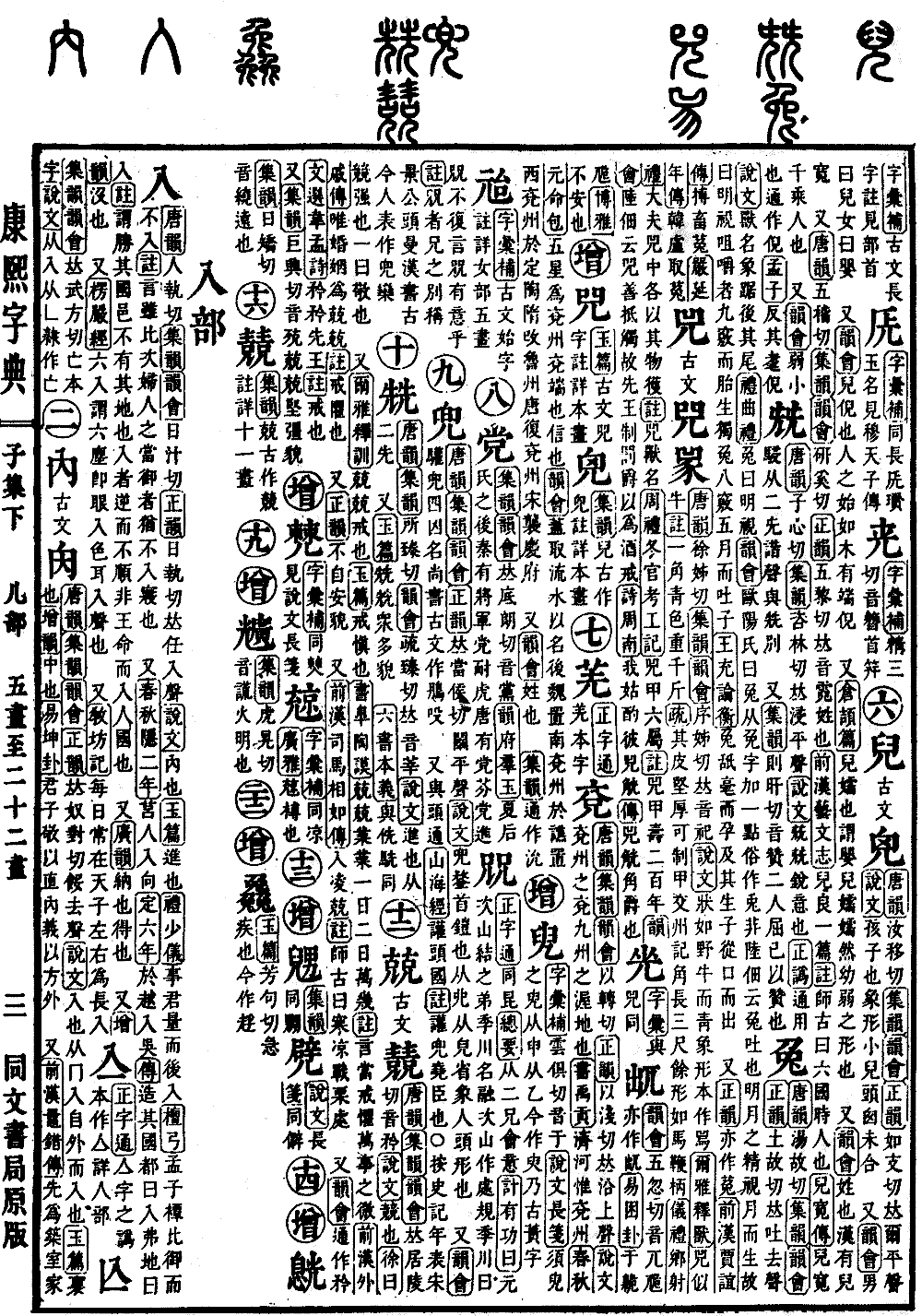
Zi Collection, Page Position: Lower. Radical: Enter (rù).
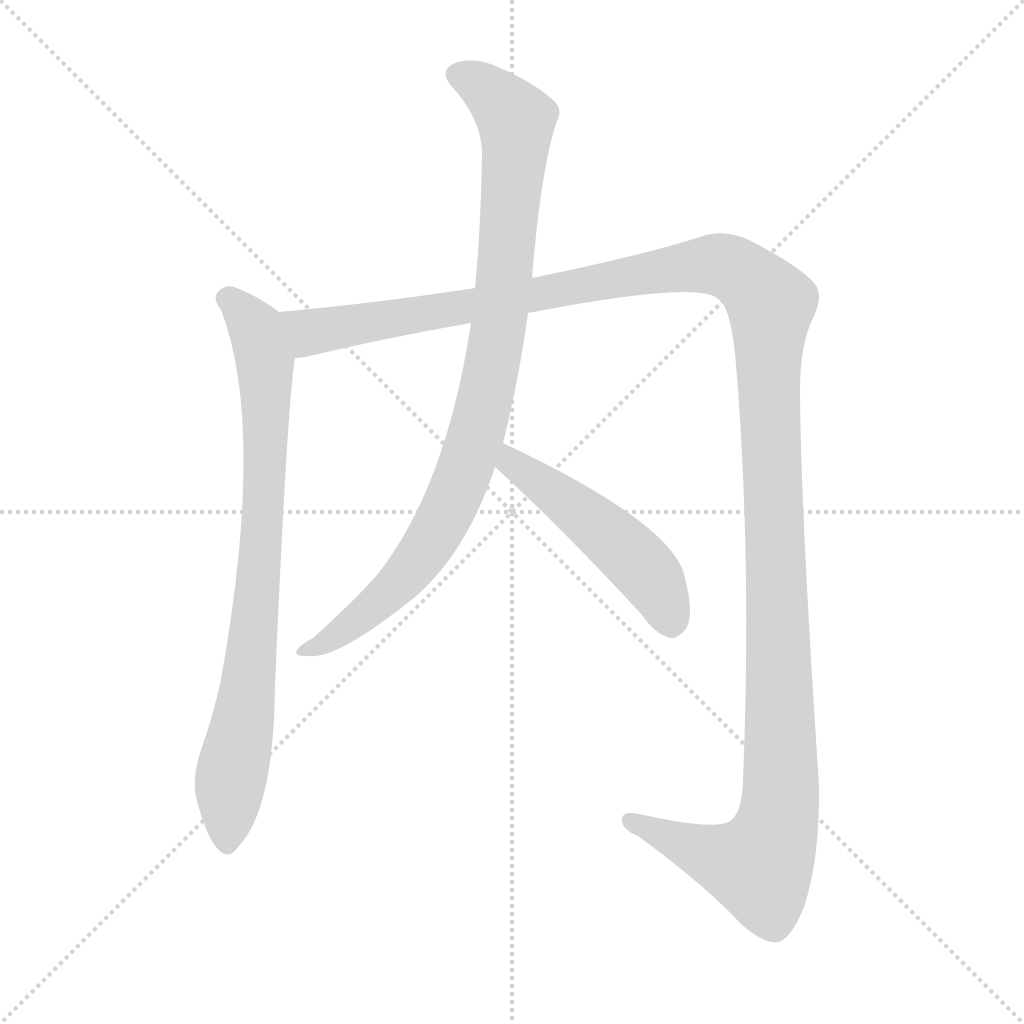
The character *nèi*. Kangxi stroke count: 4. Page 125. Ancient script.
According to the Tang Rhyme Book (Tangyun), Collected Rhymes (Jiyun), Rhyme Compendium (Yunhui), and Correct Rhymes (Zhengyun), pronounced *nèi*, corresponding to the falling tone of *něi*. In the Explaining Characters (Shuowen Jiezi), it means "to enter," derived from the radical *jiōng* and the character *rù*, signifying moving from outside to inside. In the Jade Chapters (Yupian), it means "inside." In the Augmented Rhymes (Zengyun), it means "middle." From the Hexagram Kun in the Book of Changes (Yijing): "The noble person cultivates inner uprightness with reverence and regulates outer conduct with righteousness." Also, from the Biography of Chao Cuo in the Book of Han (Hanshu): "First, build dwellings for the frontier guards, with one hall and two inner rooms." The commentary explains: "refers to two rooms." In the Rhyme Compendium (Yunhui), a room is called *nèi*, and the imperial forbidden palace is called *nèi*. Under the Han dynasty system, the emperor's palace was called *xíng*, and *nèi* was like the forbidden compound. In the Tang dynasty, there were three *nèi*: the Imperial City, located in the northwest corner of Chang'an, called the Western *Nèi*; Daming Palace, located to the east of the Western *Nèi*, called the Eastern *Nèi*; and Xingqing Palace, located to the south of the Eastern *Nèi*, called the Southern *Nèi*.
Also, *wǔ nèi* refers to the five viscera. From the Commentary on the Records of Wei (Sanguozhi, Weizhi): "Hearing the command, he was shocked and fearful, and all his five viscera and six bowels became abnormal." Also, *zhí nèi* is an official title. From the Commentary on the Rites of Zhou (Zhouli, Tianguan): "*Zhí nèi* is an official in charge of revenue. Similar to how a place currently managing monetary income is called *shào nèi*." Also, *Hénèi* is a place name. From the Rites of Zhou (Zhouli, Xiaguan, Zhifangshi): "The Henei region was called Jizhou, and its mountain town was Huoshan."
Also, according to the Collected Rhymes (Jiyun) and Correct Rhymes (Zhengyun), also pronounced *nèi*. It is equivalent to *ruì*, referring to the confluence of water. Sometimes abbreviated as *nèi*. Also, according to the Correct Rhymes (Zhengyun), it is equivalent to *ruì*. From the Commentary on the Rites of Zhou (Zhouli, Dongguan, Kaogongji): "Adjusting the mortise and inserting the tenon to join them." Also, according to the Correct Rhymes (Zhengyun), pronounced *nà*, it is equivalent to *nà*. From Mencius (Mengzi): "It is as if one pushed him into a ditch oneself."
Textual Note: The citation from the Rites of Zhou (Zhouli, Xiaguan, Zhifangshi) originally read "Henei is called Jibei"; this has been corrected to "Jizhou" according to the original text.