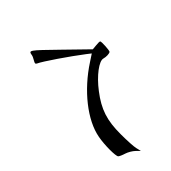
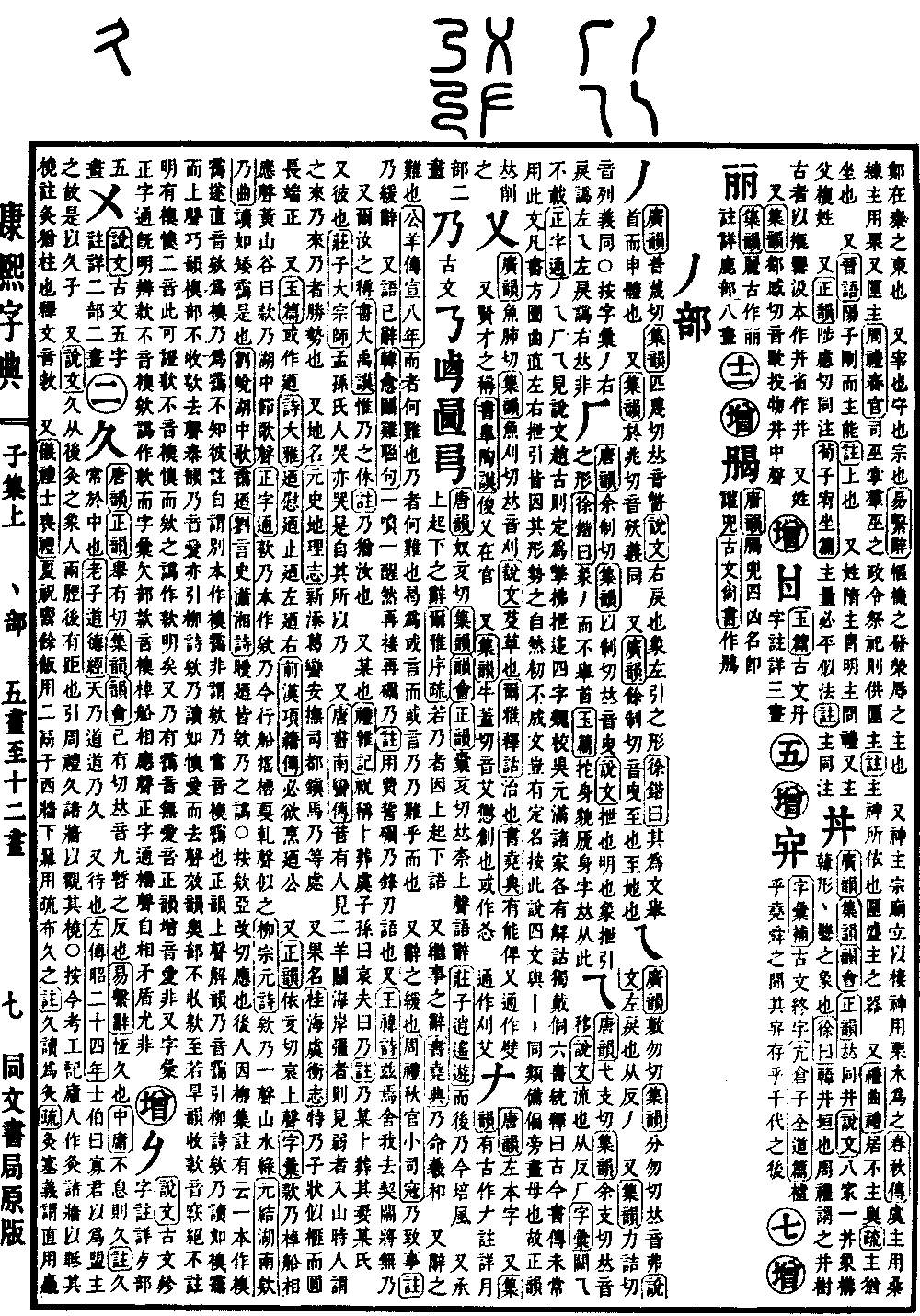
Zi Collection, Page Position: Upper. Radical: Slash (piě). Character: yí. Kangxi stroke count: 2. Page number: page 81, row 9.
Tang Rhymes (Tangyun): Pronounced with the initial of yì and the final of zhī. Collected Rhymes (Jiyun): Pronounced with the initial of yú and the final of zhī. The pronunciation is the same as the character yí.
Explaining Graphs and Analyzing Characters (Shuowen Jiezi) defines it as meaning to flow. The character form is evolved from the reversal of the stroke fú.
The Compendium of Characters (Zihui) does not include this character.
The Correct Character Mastery (Zhengzitong) mentions that stroke forms such as piě, fú, and yí are found in Explaining Graphs and Analyzing Characters. Zhao Guze identified them as the characters for brushing (piě), flicking (fú), dragging (yè), and shifting (yí). Scholars such as Wei Xiao and Wu Yuanman each provided annotations, but Dai Tong in the Unified System of the Six Scripts (Liushutong) states that these forms were not used as independent characters in ancient or modern literature. In writing, the drawing of strokes in square, round, curved, straight, left, or right directions is done according to natural movement; they were not originally distinct characters and had no fixed names. According to this view, these four forms belong to the same category as the vertical stroke gǔn and the dot zhǔ, being the ancestral forms of component strokes. For this reason, the Correct Rhymes (Zhengyun) omitted them.