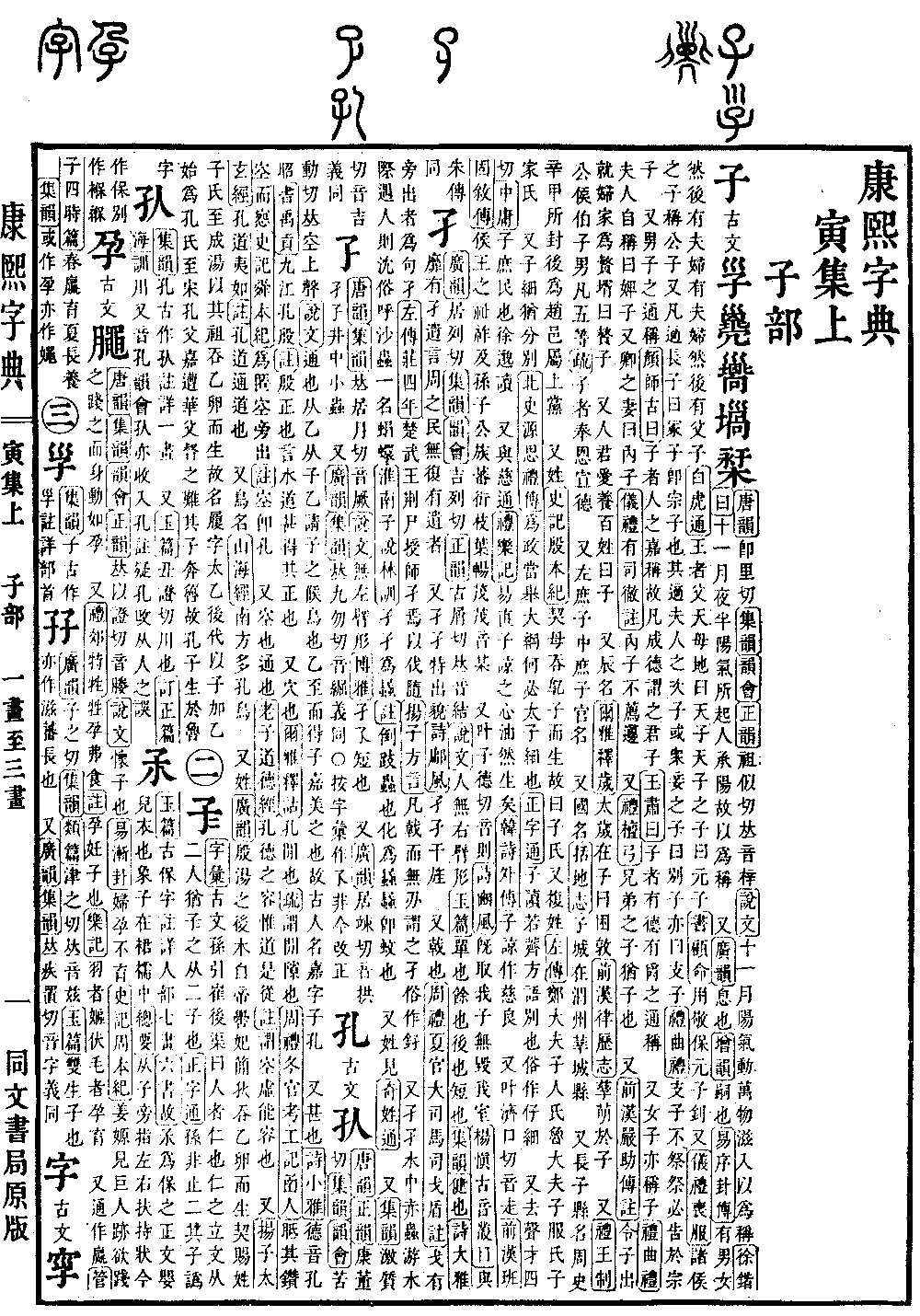
Yin Collection, Upper Volume
Radical: Child (zǐ)
Page 277, Entry 07
According to Guangyun, pronounced jie. According to Jiyun and Yunhui, pronounced jie. According to Zhengyun, pronounced gu (entering tone), sounds the same as jie.
Shuowen Jiezi explains the character as resembling the shape of a person without a right arm.
Yupian defines it as solitary, remaining, falling behind, or short and small.
Jiyun also notes it carries the meaning of being robust or healthy.
Book of Odes (Shijing), Daya: No remnants left behind. This refers to the people of the Zhou Dynasty no longer remaining.
Also, jie-jie describes something that is prominent or stands out.
Book of Odes (Shijing), Yongfeng: The prominent poles of the banners.
It also refers to a type of halberd-like weapon.
Rites of Zhou (Zhouli), Xia Guan, Dasi Ma, Si Ge Dun notes: A spear with a side-protruding blade is called a gou-jie.
Zuo Tradition (Zuozhuan), Duke Zhuang, 4th Year: King Wu of Chu utilized a battle formation named Jing Shi and issued his troops the weapon called jie to attack the State of Sui.
Yangzi: Fangyan: Any halberd lacking a sharp blade is called a jie. Commonly written in a variant form.
Also, jie-jue refers to small red insects in water. They swim at the water's edge and submerge when they encounter people. Commonly called sand insects. Another name is yuan-xuan.
Huainanzi: Shuolin Xun: Jie-jue will transform into mosquitoes.
Note: It is a type of insect that crawls in reverse and transforms into a mosquito. Wen is a mosquito.
There is also a surname. Found in Qixing Tong.
Also, according to Jiyun, pronounced ji (entering tone), sounds the same as ji. The meaning is the same.
Textual verification: The text states that jie-jie refers to red water insects. They swim at the water's edge and submerge when they encounter people. Commonly called sand insects. Another name is yuan-xuan. Huainanzi: Shuolin Xun: Jie-jue becomes a mosquito. In accordance with the original text, the two instances of jie-jie have been corrected to jie-jue.