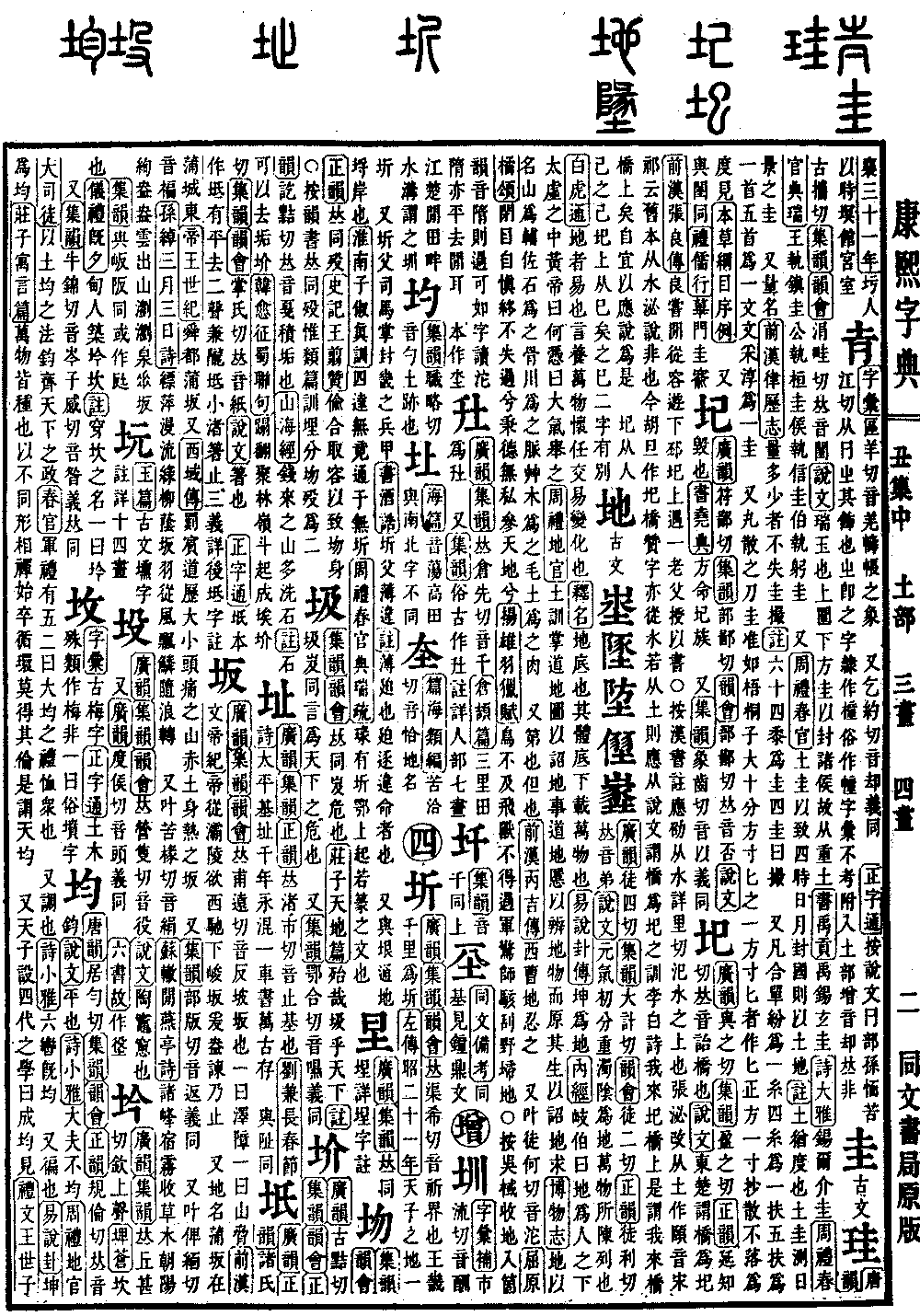
Chou Collection, Middle Volume. Radical: Earth (tǔ). Kangxi strokes: 6. Page 224, Entry 05. Pronounced yi. Refers to a bridge. According to the Explaining Graphs and Analyzing Characters (Shuowen Jiezi), in the Eastern Chu region, a bridge is called yi. The History of the Former Han (Qian Hanshu), Biography of Zhang Liang, records that Zhang Liang was once leisurely traveling through Xiapi and encountered an elder on a bridge, who bestowed a book upon him. According to the commentary on the History of the Han (Hanshu), Ying Shao believed the character should be written with the water radical and pronounced xiangli, referring to a bridge over the Si River. Zhang Mi altered it to the earth radical, pronouncing it like yi. Song Qi stated that old versions use the water radical and that Zhang Mi’s explanation is incorrect. Nowadays, Hu Dan wrote the Praise of the Yi Bridge, where the character is also written with the water radical; if one uses the earth radical, it should be based on the definition in the Explaining Graphs and Analyzing Characters, which identifies the bridge as yi. Li Bai’s poem states: I came upon the Yi Bridge. If written with the earth radical, it would read I came upon the Bridge Bridge. Naturally, Ying Shao’s view should be considered correct. The character is composed of the radical earth and the phonetic component ji. The upper portion of the character is derived from the cycle sign si. These two forms are distinct. A variant form is pi.