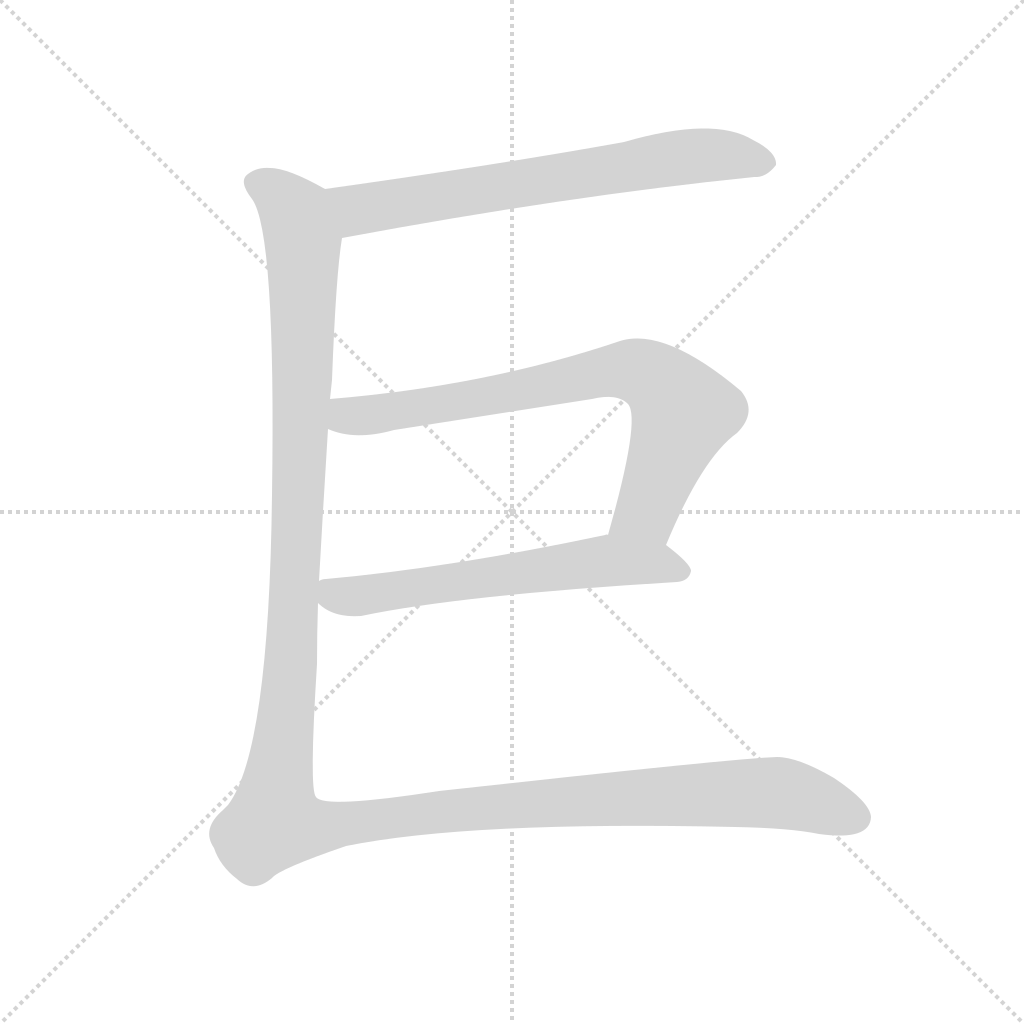
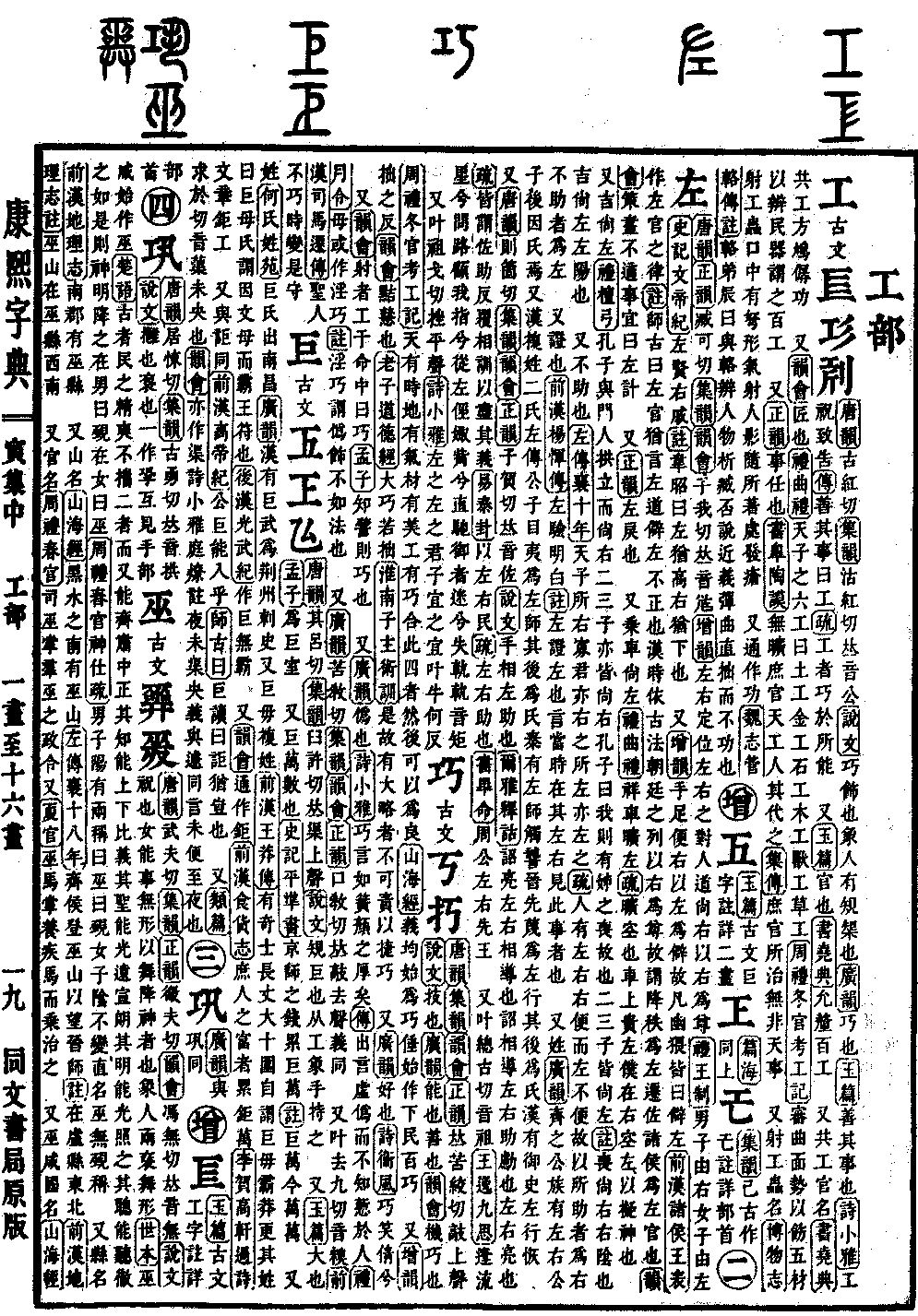
Yin Collection, Middle Volume. Radical: Work (gōng). 5 Kangxi strokes. Page 325, Entry 12.
Ancient form. Pronounced ju (rising tone). According to the Explaining Graphs and Analyzing Characters (Shuowen Jiezi), it is the character for giant. The form is derived from the radical for work, representing the image of something held by the hand. According to the Jade Chapters (Yupian), the meaning is large. In the Mencius (Mengzi), it refers to building massive palaces. It also refers to a great number, as in giant ten-thousands. In the Records of the Grand Historian (Shiji), Balance and Standards Treatise, it mentions that accumulated wealth in the capital reached giant ten-thousands. The commentary notes that giant ten-thousands is equivalent to the modern day hundred million. It is also used as a surname. According to the Garden of Surnames (He Shi Xing Yuan), the giant surname originated in Nanchang. The Broad Rhymes (Guangyun) mentions a man in the Han dynasty named Ju Wu who served as the governor of Jingzhou. There is also the compound surname Juwu. In the History of the Former Han (Qian Hanshu), Biography of Wang Mang, there was a man of unusual appearance, ten feet tall and ten spans in waist circumference, who called himself Juwuba. Wang Mang changed his surname to Jumushi, signifying that he obtained the mandate to rule through the mother of the emperor. In the History of the Later Han (Hou Hanshu), Chronicle of Emperor Guangwu, it is written as Juwuba. According to the Collected Rhymes (Yunhui), it is used interchangeably with the character meaning hard iron. In the History of the Former Han (Qian Hanshu), Treatise on Food and Money, it mentions that the wealth of wealthy commoners reached such a massive amount. In the poem Gao Xuan Guo by Li He, it refers to a master of literature. It is also equivalent to the character meaning how or why. In the History of the Former Han (Qian Hanshu), Chronicle of Emperor Gaozu, it asks could you have entered? The commentator Shigu says the pronunciation and meaning are the same as how or why. According to the Categorized Compilation (Leipian), it is pronounced qu (rising tone). The meaning is not yet finished. The Collected Rhymes (Yunhui) also writes it as qu. In the commentary to the Book of Odes (Shijing), Lesser Odes, Garden Torches, it mentions the night is not yet finished. The meaning is the same as the character for hurried, indicating that it is still far from the middle of the night.