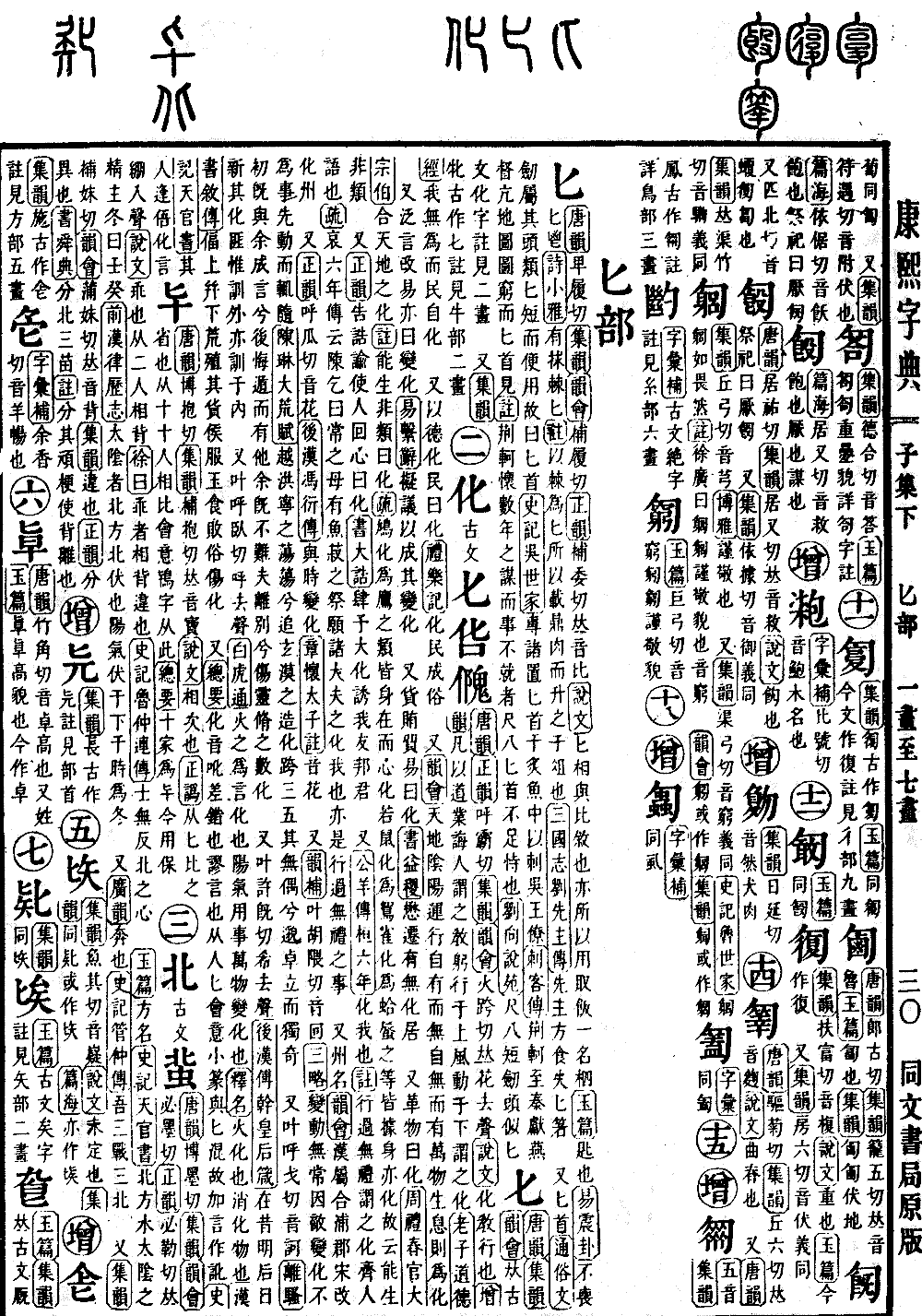
Zi Collection, Page Position: Lower
Radical: Spoon (bi)
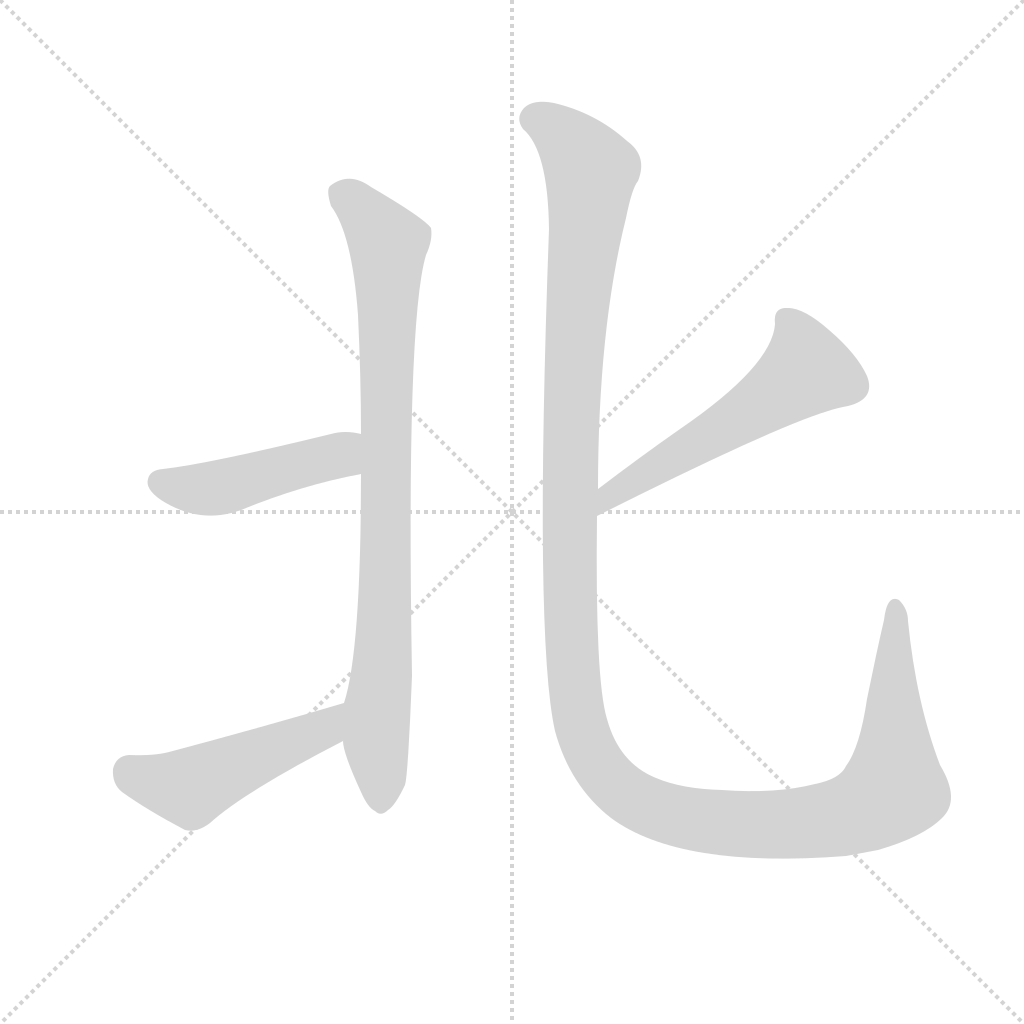
Character: North
Kangxi Dictionary Stroke Count: 5
Page 152, Entry 25
Ancient Records:
Tang Rhymes (Tangyun) provides the fanqie (phonetic spelling) of bo and mo. Collected Rhymes (Jiyun) and Rhyme Assembly (Yunhui) provide the fanqie of bi and mo. Correct Rhymes (Zhengyun) provides the fanqie of bi and le. The pronunciation is similar to the entering tone of beng.
Explaining Graphs and Analyzing Characters (Shuowen Jiezi) explains this as meaning to go against or to oppose. The character form is composed of two people standing back-to-back.
Xu Kai added that the term guai means to turn away from one another or to disobey.
The soldiers have no intention of turning back or rebelling — Records of the Grand Historian (Shiji), Biography of Lu Zhonglian.
Jade Chapters (Yupian) explains this as the name of a direction.
The North belongs to water and is the essence of the Great Yin (taiyin). It governs winter and corresponds to the Heavenly Stems ren and gui — Records of the Grand Historian, Book of Celestial Offices.
The Great Yin represents the North. The word for north (bei) carries the meaning of to lie hidden. The yang energy is concealed below, and the corresponding season is winter — Book of Han (Hanshu), Treatise on Rhythms and the Calendar.
Also, Expanded Rhymes (Guangyun) explains this as to be defeated and flee.
I fought three battles and suffered three defeats — Records of the Grand Historian, Biography of Guan Zhong.
Also, Collected Rhymes provides the fanqie pronunciation of bu and mei, and Rhyme Assembly provides the fanqie of pu and mei, sounding similar to the word bei (to turn the back on).
Collected Rhymes explains it as to go against.
Correct Rhymes explains it as to separate or to be distinct.
Separate and disperse the Sanmiao tribes — Book of Documents (Shangshu), Canon of Shun. Commentary: To cause the recalcitrant tribes to separate and turn away from their original group.