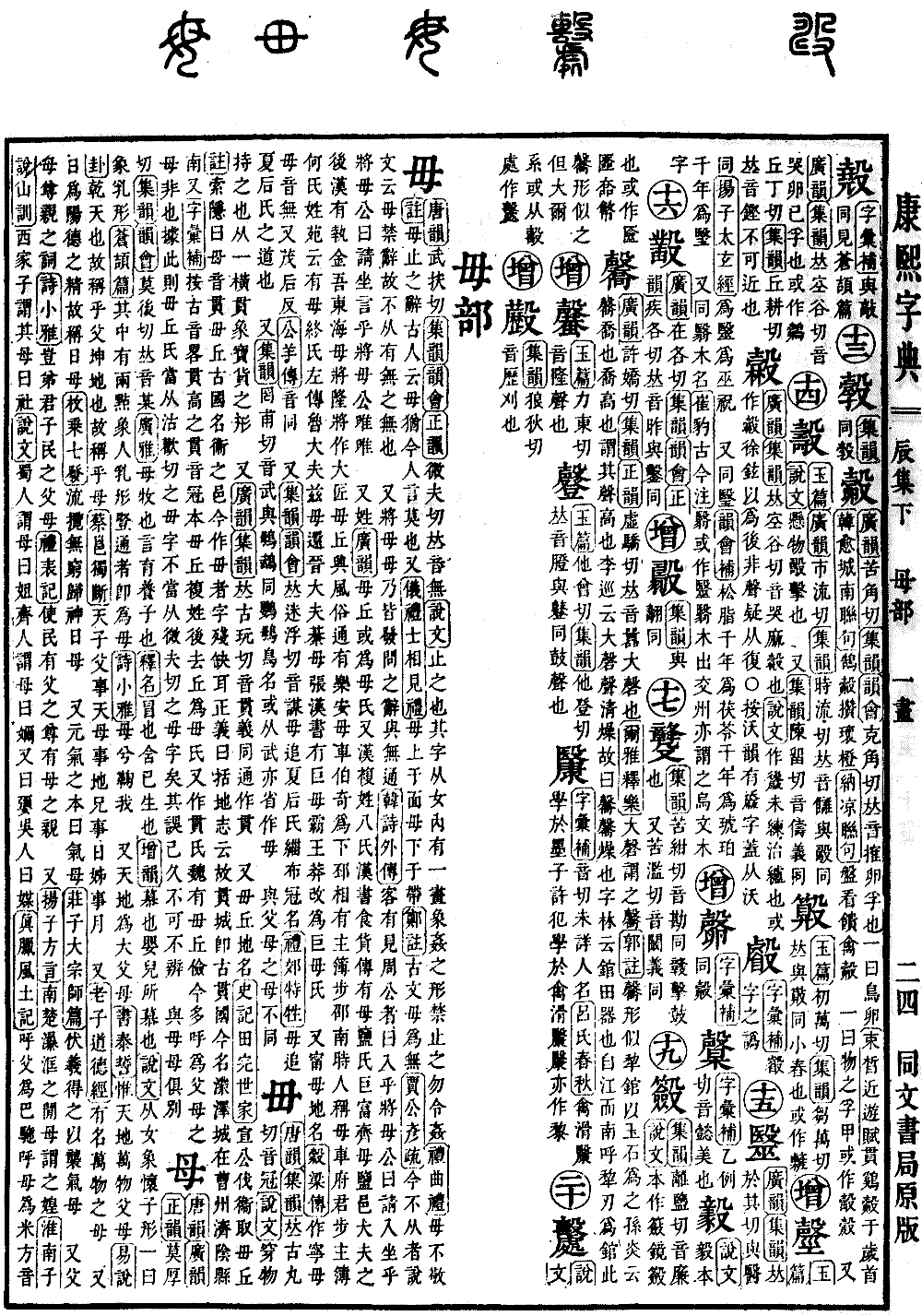
Chen Collection, Lower Volume
Radical: Not (wú)
Page 588, Entry 23
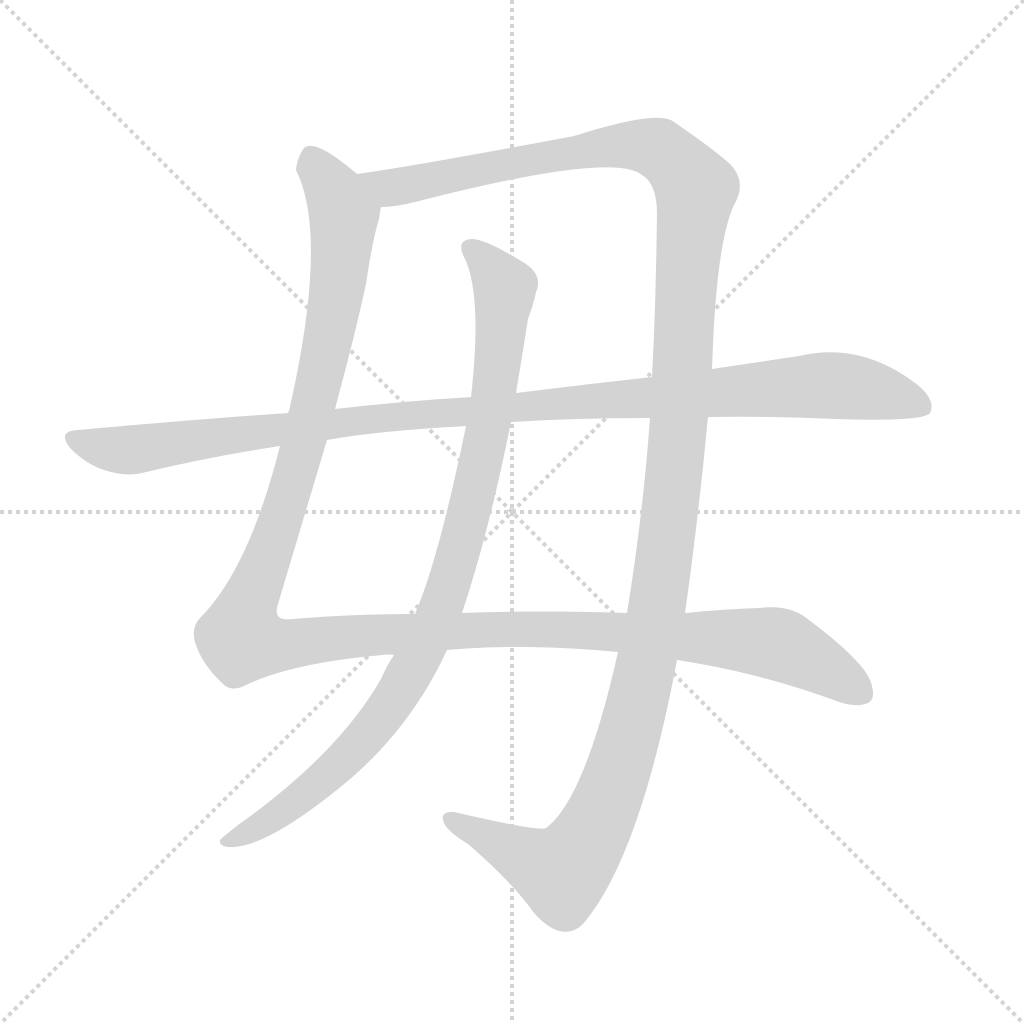
Pronounced wú.
According to the Explaining Graphs and Analyzing Characters (Shuowen Jiezi), it denotes prohibition. The character is derived from woman, with a single stroke inside, representing the form of illicit behavior. It signifies stopping or forbidding such behavior.
Book of Rites (Liji), Songs of Propriety (Quli): Do not be without reverence. Commentary: Wu is a term of prohibition. The ancients said that wu is what people nowadays call mo (do not).
Ceremonial Rites (Yili), Rites of Meeting for Scholars (Shi Xiangjian Li): Do not go above the face, do not go below the belt. Zheng Commentary: In ancient texts, wu was written as the character for nothing (wú). Jia Gongyan sub-commentary: That we do not follow this today is because the Explaining Graphs and Analyzing Characters states that wu is a term of prohibition, thus it does not follow the character for nothing (wú).
Also, phrases such as jiang wu (will it not) and wu nai (could it not be that) are both rhetorical expressions, and in these contexts, it is interchangeable with the character for nothing (wú).
Han’s Illustrations of the Odes (Hanshi Waizhuan): A guest came to see the Duke of Zhou and said: Shall I enter, or not? The Duke said: Please enter. Shall I sit, or not? The Duke said: Please sit. Shall I speak, or not? The Duke replied with a word of assent.
Also a surname. Broad Rimes (Guangyun): Wuqiu is sometimes written as the Wu clan. There were also eight dual-character surnames in the Han Dynasty. History of the Han (Hanshu), Biographies of Money-makers (Huozhi Zhuan): There was the Wuyan clan, who were extremely wealthy, descendants of the great official of Wuyan city in Qi. In the Han period, there was the Commandant of Justice Donghai Wujiang Long and the Minister of Works Wuqiu Xing. According to Customs and Traditions (Fengsu Tong), there was Le'an Wuche Boqi, who served as Chancellor of Xiapi, and an attendant named Bu Shaonan; people of the time referred to them as Lord Wuche and Attendant Bu. Mr. He’s Collection of Surnames states there is the Wuzhong clan. Zuo Commentary (Zuozhuan) mentions the Lu official Zimu Huan and the Jin official Qiwu Zhang. History of the Han mentions Jumu Ba, whose name Wang Mang changed to the Jumu clan.
Also Ningwu, a place name. Guliang Commentary (Guliang Zhuan) writes it as Ningwu. Wu is pronounced wú. Also pronounced mào. Gongyang Commentary (Gongyang Zhuan) provides the same pronunciation.
Pronounced móu. Wuzhui is the name of the black cloth cap of the Xia Dynasty. Record of Special Sacrifices (Jiao Tesheng): Wuzhui is the way of the Xia Dynasty.
Pronounced wǔ. Identical to the character for parrot (yīngwǔ). The name of a bird. Sometimes written with the radical for weapon, and sometimes abbreviated as the character for not (wú). This is different from the character for mother (mǔ).
Textual notes: In the History of the Han, Biographies of Money-makers (Huozhi Zhuan), corrected from the original text’s Biographies of Food and Money (Shihuo Zhuan) to Biographies of Money-makers (Huozhi Zhuan).