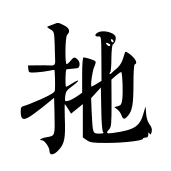
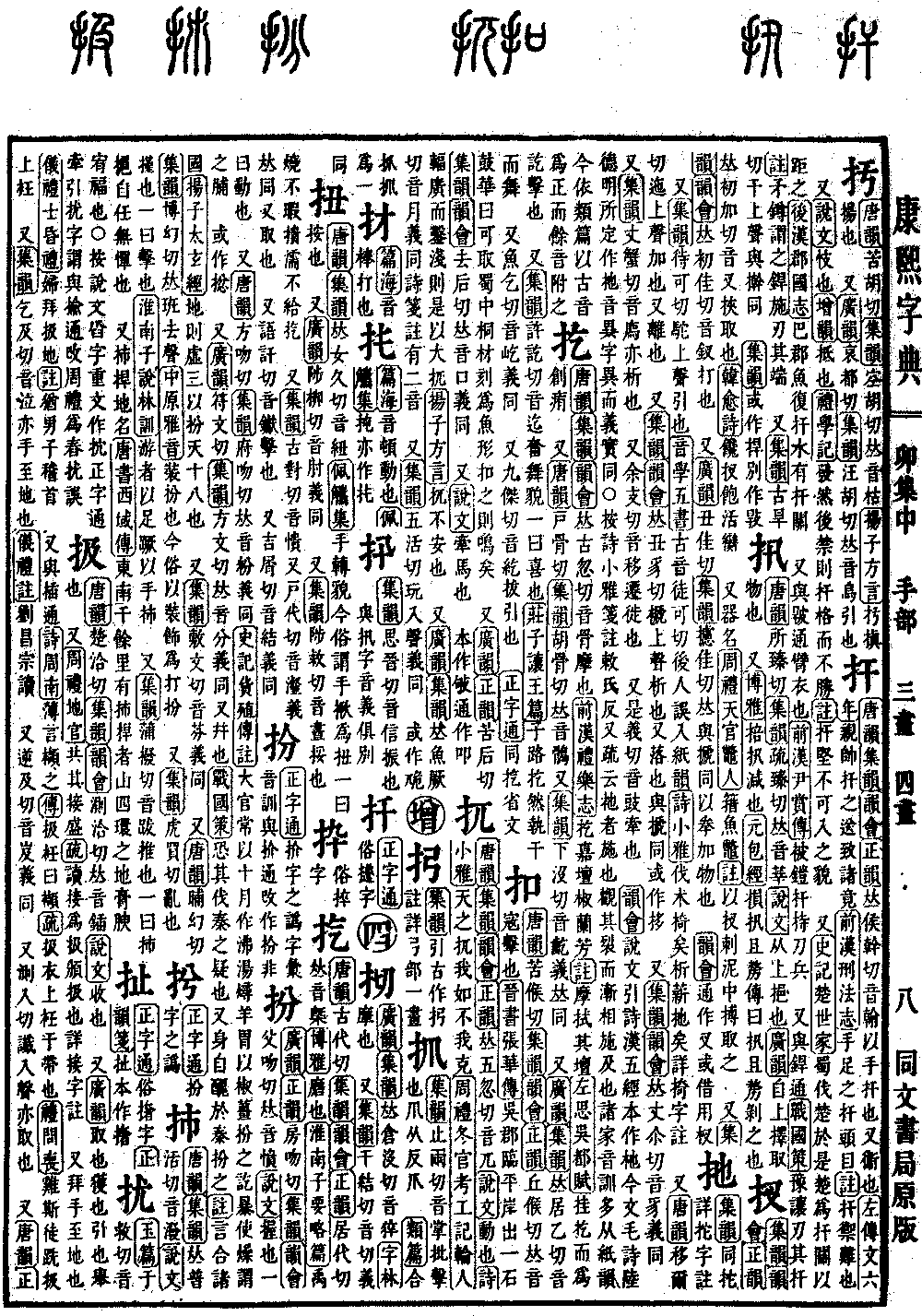
Mao Collection, Middle Volume. Radical: Hand (shǒu). Kangxi strokes: 7. Page 418, Entry 05.
Collected Rimes (Jiyun) states it is the same as the character tuō. See the notes for the character tuō for details.
Also, Collected Rimes (Jiyun) states it is pronounced tuo (rising tone). It means to pull or drag. Five Books on Phonology (Yinxue wushu) notes that in ancient times, it was pronounced tu. Later generations mistakenly classified it under the Zhi rime group.
Book of Odes (Shijing), Lesser Odes (Xiaoya): When felling trees, one pulls them; when splitting firewood, one pulls it apart. See the notes for the character ji for details.
Also, Tang Rime (Tangyun) states it is pronounced yi (rising tone). It means to apply or to separate.
Also, Collected Rimes (Jiyun) and Collection of Rimes (Yunhui) state it is pronounced chi (rising tone). It means to split or to fall off. It is the same as the character chuai. Sometimes written as the variant form yi.
Also, Collected Rimes (Jiyun) and Collection of Rimes (Yunhui) state it is pronounced zhi. The meaning is the same.
Also, Collected Rimes (Jiyun) states it is pronounced zhi. The meaning is also to split.
Also, it is pronounced yi. It means to relocate.
Also, it is pronounced chi. It means to pull or tow.
Collection of Rimes (Yunhui) notes: The Han Dynasty Five Classics version of the Book of Odes (Shijing), as quoted in Explaining Graphs and Analyzing Characters (Shuowen jiezi), is written as yi. The currently prevalent Mao Commentary on the Odes (Mao Shi), as determined by Lu Deming, is written as tuo; the pronunciation and form are different, but the meaning is the same. Examining the Commentary on Meanings (Shiwen) for the Book of Odes (Shijing), Lesser Odes (Xiaoya), the pronunciation is given as chi. The commentary further explains: tuo means to spread out, observing how wood splits and gradually extends. Most phonological interpretations classify it under the Zhi rime group; now, based on the Classified Compilation (Leipian), the ancient pronunciation is taken as the standard, and the remaining pronunciations are appended thereafter.
Verification: According to the annotations on the Book of Odes (Shijing), Lesser Odes (Xiaoya), the pronunciation is given as chi. We have carefully corrected the source text from annotation to Commentary on Meanings (Shiwen).