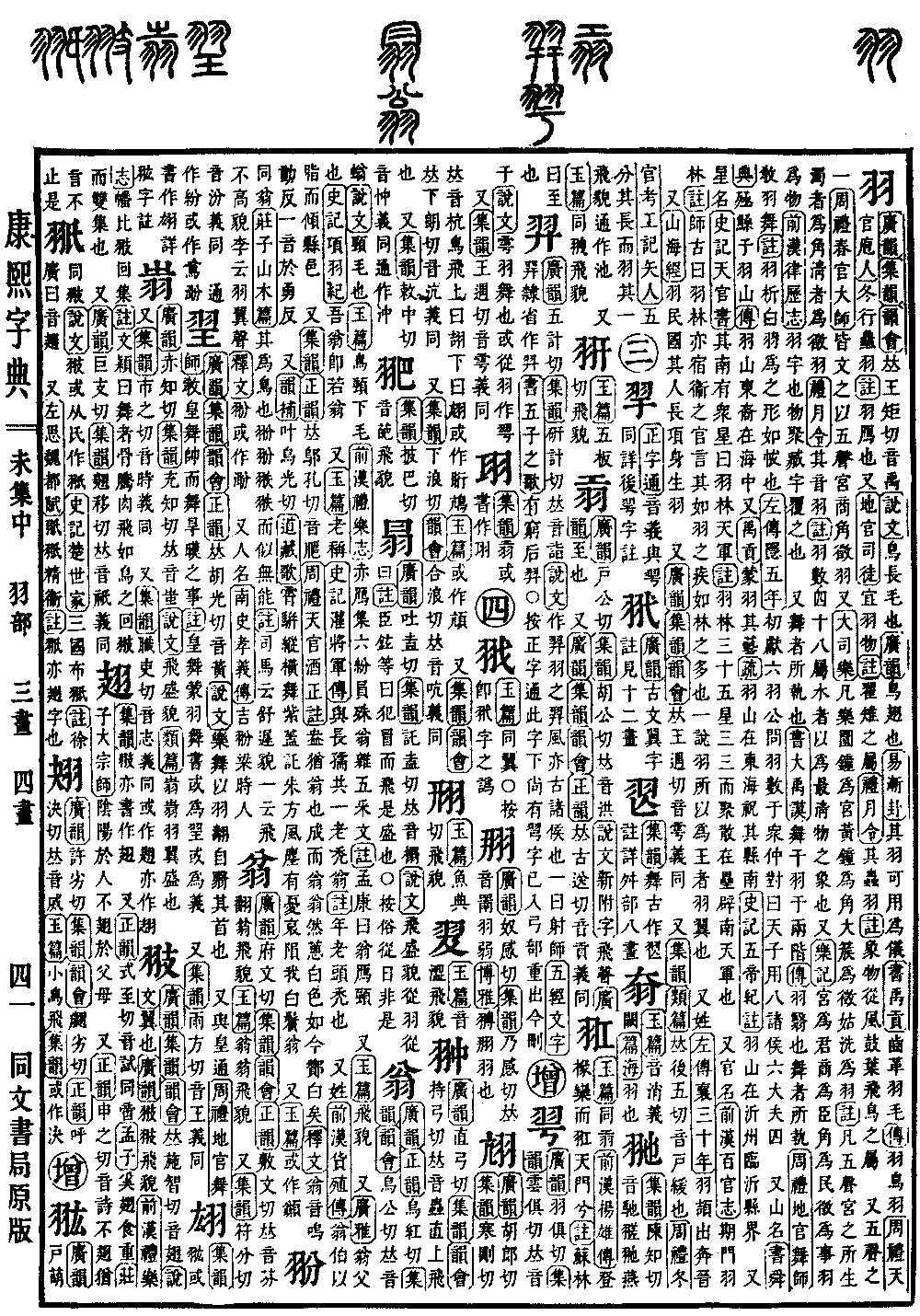
Wei Collection, Lower Volume
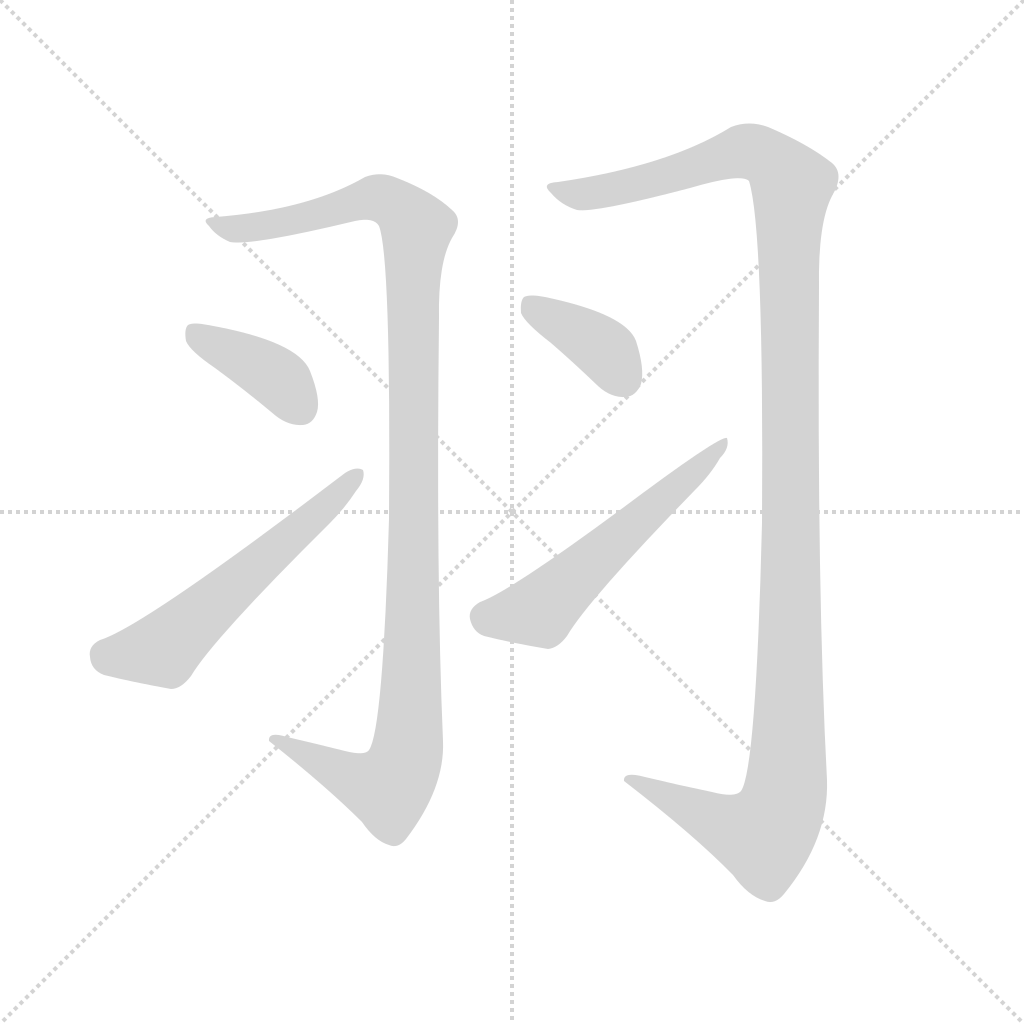
Radical: Feather (yǔ)
Page 955, Entry 01
Pronounced yu.
Shuowen Jiezi (Shuowen): Long feathers of a bird.
Guangyun (Guangyun): Bird wings.
Book of Changes (Yijing), Gradual Hexagram: Its feathers can be used as ritual ornaments.
Book of Documents (Shujing), Tribute of Yu (Yugong): Ivory, hides, bird feathers, and yak tails.
Commentary: Feather refers to the feathers of birds.
Rites of Zhou (Zhouli), Offices of Heaven: In winter, present fresh fish and wild geese.
Annotation: Feather refers to the wild goose.
Also in Offices of Earth, Minister of Instruction: Suitable for raising animals with feathers.
Annotation: Refers to types of pheasants.
Book of Rites (Liji), Monthly Ordinances (Yueling): Animals of this season belong to the feathered category.
Annotation: Symbolizes all things whose leaves sway in the wind, like flying birds.
Also one of the five tones.
Rites of Zhou (Zhouli), Offices of Spring, Grand Master: All are cultivated using the five sounds, which are gong, shang, jue, zhi, and yu.
Also in Grand Director of Music: Regarding all music, use the round bell for the gong tone, the yellow bell for the jue tone, the great cluster for the zhi tone, and the guxi for the yu tone.
Annotation: As for the five sounds, they are born from the gong tone; the sounds that are low and turbid are the jue tone, while the clear sounds are the zhi tone and the yu tone.
Book of Rites (Liji), Monthly Ordinances: The tone of this season is the yu tone.
Annotation: The pitch pipe for the yu tone measures forty-eight units; it belongs to the water element and is considered the symbol of the clearest of things.
Also in Record of Music (Yueji): Gong symbolizes the ruler, shang symbolizes the ministers, jue symbolizes the common people, zhi symbolizes affairs, and yu symbolizes all things.
History of the Former Han (Qianhan), Treatise on Music and Calendars: Yu means shelter, as all things gather and hide, covered beneath the eaves of a roof.
Also a prop held by dancers.
Book of Documents (Shujing), Counsels of the Great Yu (Dayu Mo): Dancing on both sides of the steps holding shields and pheasant feathers.
Commentary: Feather refers to decorative canopies made of feathers, which are items held by dancers.
Rites of Zhou (Zhouli), Offices of Earth, Dance Master: Teach the feather dance.
Annotation: The feather dance is made from split white feathers, shaped like a dancing scarf.
Zuo Tradition (Zuozhuan), Fifth Year of Duke Yin: First presentation of the six-feather dance. Duke Yin asked the crowd about the number of dancers, and Zhongzhong replied: The Son of Heaven uses eight rows, feudal lords use six rows, and senior officials use four rows.
Also the name of a mountain.
Book of Documents (Shujing), Canon of Shun (Shundian): Exiled Gun to Mount Yu.
Commentary: Mount Yu is in the distant eastern sea.
Also in Tribute of Yu: Mount Meng and Mount Yu are suitable for planting.
Sub-commentary: Mount Yu is located south of Zhuqi County in Donghai Commandery.
Records of the Grand Historian (Shiji), Annotations to the Annals of the Five Emperors: Mount Yu is within the borders of Linyi County, Yizhou.
Also the name of a star.
Records of the Grand Historian (Shiji), Treatise on the Celestial Offices: To its south are many stars called the Yulin Celestial Army.
Annotation: The Yulin stars number thirty-five; they cluster or scatter in groups of three, located south of the camp star officials, representing the celestial army.
Also an official title.
History of the Former Han (Qianhan), Treatise on Officials: The Qimen Army and the Yulin Army.
Annotation: Shigu says: Yulin is also a palace guard official, meaning they are as swift as feathers and as numerous as a forest. Another theory says that Yu is used to signify the wings of the ruler.
Also a surname.
Zuo Tradition (Zuozhuan), Thirtieth Year of Duke Xiang: Yu Jie fled to the state of Jin.
Also in Classic of Mountains and Seas (Shanhaijing): There is a Kingdom of Feathered People, where the people have long necks and their bodies are covered in feathers.
Pronounced yu. The meaning is the same.
Pronounced hu. The meaning is to relax or be lenient.
Rites of Zhou (Zhouli), Offices of Winter, Artificers' Record (Kaogongji), Bow and Arrow Maker: Divide the length of the arrow shaft into five parts, and the feathered portion occupies one of them.