Zi Collection, Page Position: Lower
Radical: Wrap (bāo)
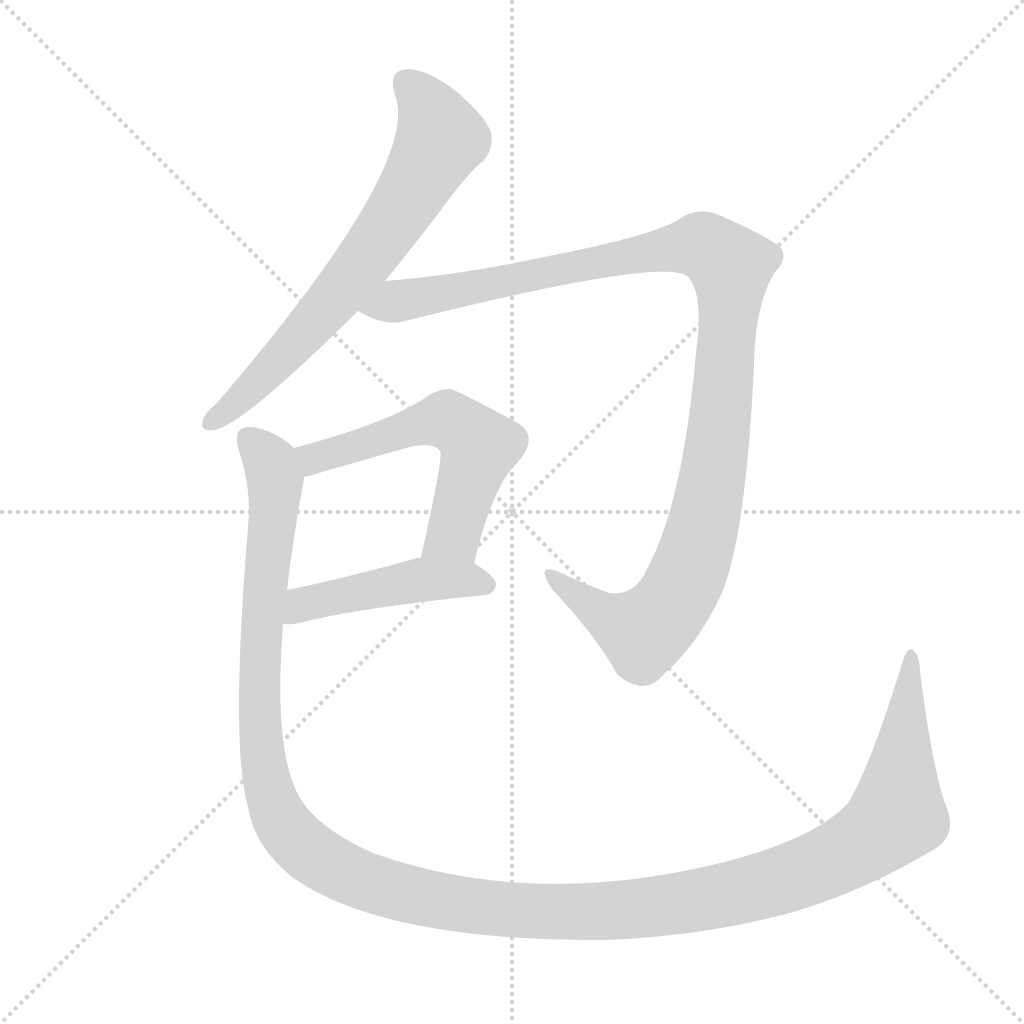
Bao
Kangxi stroke count: 5
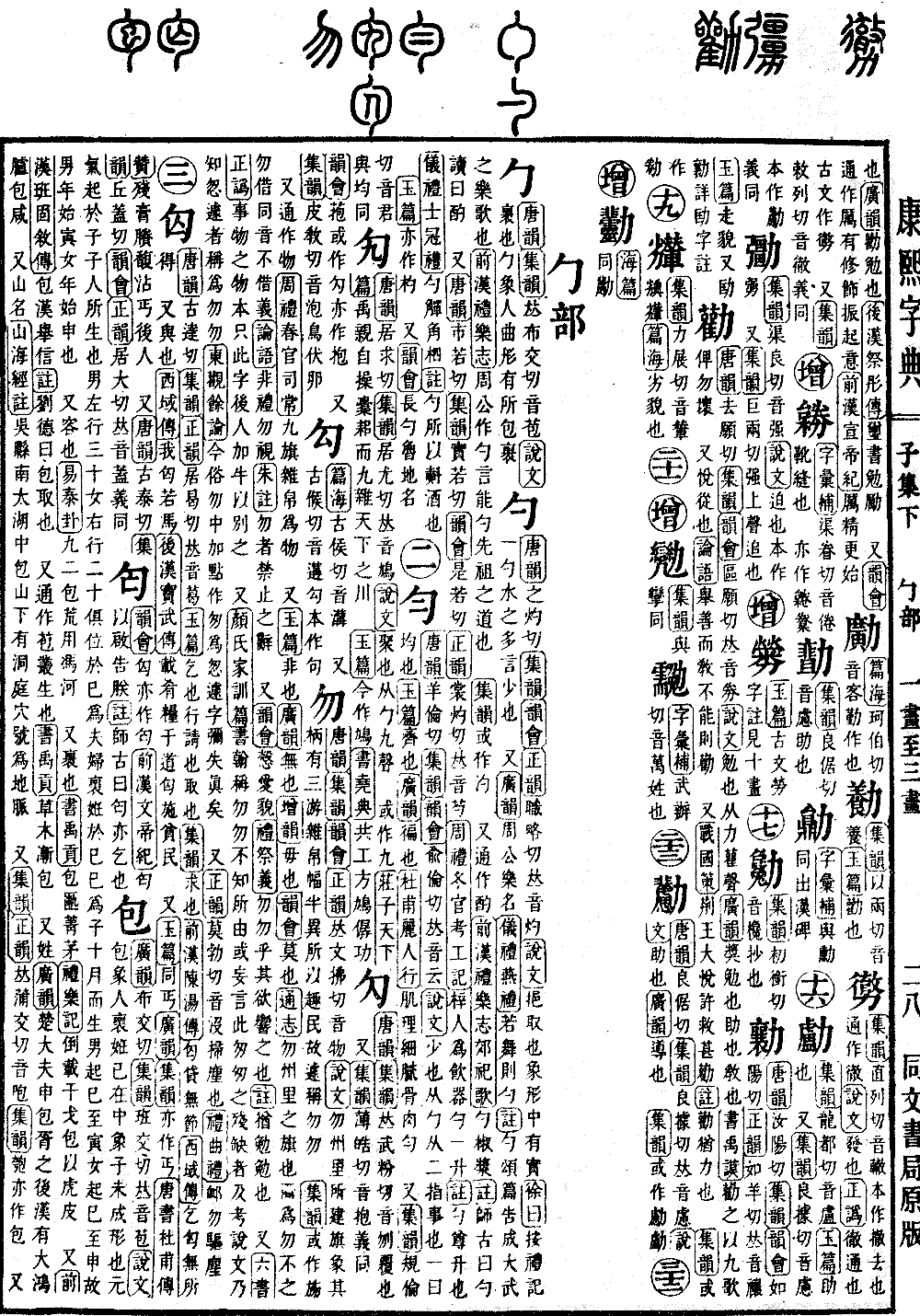
Page 150, Number 27
The Broad Rhymes (Guangyun) indicates the pronunciation as a combination of bù and jiāo, and the Collected Rhymes (Jiyun) indicates it as a combination of bān and jiāo, both pronounced the same as bāo.
The Explaining Graphs and Analyzing Characters (Shuowen Jiezi) explains: Bao represents a person being pregnant. The outer part bāo resembles the mother's body, and the inner part sì resembles a fetus that has not yet taken shape. Original energy begins with zǐ. Zǐ is the starting point of human birth. Men count thirty steps to the left, and women count twenty steps to the right, both standing at the position of sì, symbolizing the union of male and female at sì to conceive. Sì represents the fetus, which is born after ten months of pregnancy. Men count from sì to yín, and women count from sì to shēn; therefore, men begin counting their age from yín, and women from shēn.
It also means to contain. The Book of Changes (Yijing) in the line for the second nine of the Tai hexagram states: Containing the uncultivated, using one's strength to cross the river.
It also means to wrap. The Book of Documents (Shangshu) states: Bundled and boxed green thatch. The Book of Rites (Liji) states: Carrying weapons upside down and wrapping them in tiger skins.
Also, the History of the Han (Hanshu) in the narrative biography of Ban Gu states: Bao Han and elevated Xin. A note by Liu De says: Bao means to obtain.
It is also interchangeable with bāo, referring to the dense growth of plants and trees. The Book of Documents states: Plants and trees gradually grow thick.
It is also a surname. The Broad Rhymes records it as the descendants of Shen Baoxu, a high official of the State of Chu. In the Han Dynasty, there was the Minister of State Ceremonies, Bao Xian.
It is also the name of a mountain. The Commentary on the Classic of Mountains and Seas (Shanhaijing Zhu) records: To the south of Wu County, beneath Mount Bao in Lake Tai, there is the Dongting Cave, which is called a terrestrial vein.
Also, the Collected Rhymes and the Correct Rhymes (Zhengyun) indicate the pronunciation as a combination of pú and jiāo, pronounced the same as páo. The Collected Rhymes states: the character for gourd (páo) is also written as bāo.
Also, the character for kitchen (páo) is interchangeable with bāo. The Book of Changes in the Gou hexagram states: The kitchen has fish. The Great Commentary (Xici) states: In ancient times, Baoxi ruled the world.
Also, the Rhyme Supplement (Yunbu) indicates the pronunciation as a combination of fáng and yóu, pronounced the same as fú. It is a place name. During the Spring and Autumn period, the Duke and the people of Ju made a covenant at Baolai; the Zuo Commentary (Zuozhuan) writes this as Fú. The Comprehensive Refinement (Tongya) says: In ancient times, bāo was pronounced like fú; characters such as bladder (pāo) and placenta (bāo), raft (fú) and drumstick (fú), husks (fú) and luxuriant (bāo), or floating (fú) and embracing (bào) share the same origin and are used interchangeably.
Also, as a rhyming sound, it is a combination of bǔ and gǒu, pronounced like the rising tone of bāo, meaning to wrap. The Book of Odes (Shijing) states: In the wild is a dead deer, wrapped in white thatch. A girl is longing for spring, and a fine gentleman entices her.
Textual Research: The original text of the Explaining Graphs states "men move left thirty, women move right twenty, both standing at sì"; based on the original text, the word for "positioned" is changed to "standing."