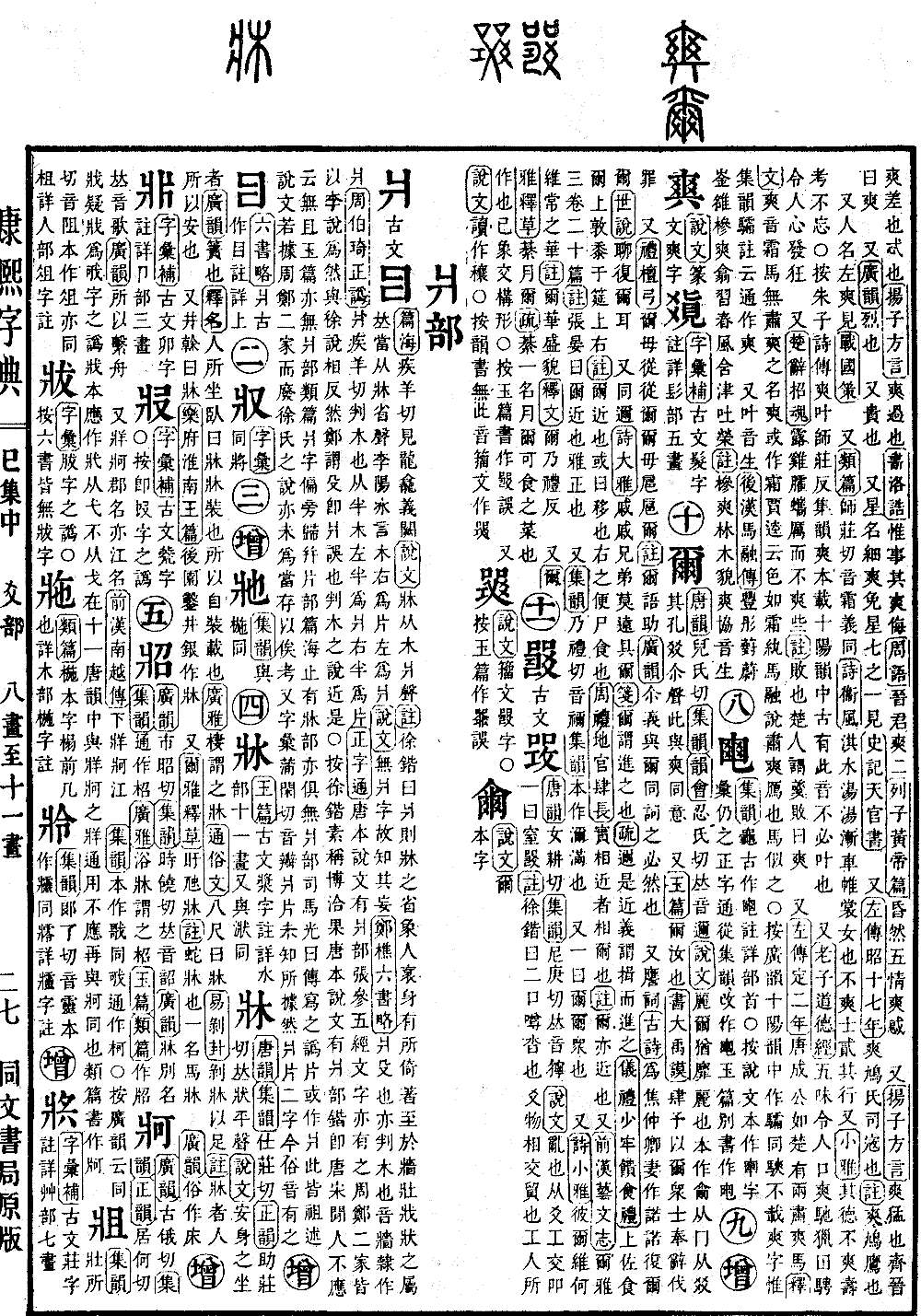
Si Collection, Middle Volume. Radical: Split Wood (bù). Four strokes. Page 691, Entry 09.
The dictionary Collection of Characters (Pianhai) states it is pronounced qiáng. Found in the book Dragon Shrine (Longkan). Meaning missing.
Explaining Graphs and Analyzing Characters (Shuowen Jiezi) states that the character for bed (chuáng) uses wood as a semantic element and this character as a phonetic element.
Commentary: Xu Kai says: This character is an abbreviated form of the character for bed. The character shape resembles a person leaning sideways. As for characters like wall, slaughter, and condition, they should be regarded as phonetic elements derived from the abbreviation of the character for bed. Li Yangbing says: on the right of the wood is the piece character, and on the left is this character.
The original text of Explaining Graphs and Analyzing Characters (Shuowen Jiezi) does not contain this character, so it is known that Li Yangbing's theory is incorrect.
Zheng Qiao's Summary of the Six Writings (Liushu Lue) says: This character means a weapon (shū). It also refers to split wood. Pronounced the same as wall. In clerical script, it is written as this character.
Zhou Boqi's Rectification of Errors in the Six Writings (Liushu Zheng'e) says: This character is pronounced qiáng and means split wood. The character shape is one half of the wood character. The left half is this character, and the right half is the piece character.
General Compilation of Characters (Zhengzitong) says: The Tang dynasty version of Explaining Graphs and Analyzing Characters (Shuowen Jiezi) includes a radical for this character. Zhang Can's Five Classics Characters (Wujing Wenzi) also includes it. Both Zhou Boqi and Zheng Qiao believe Li Yangbing's theory is correct. This contradicts the theory of Xu Kai. However, Zheng Qiao's statement that the weapon character is the same as this character is incorrect. The theory regarding split wood is closer to the truth.
Note: Xu Kai has always been known for his extensive learning. If the Tang dynasty version of Explaining Graphs and Analyzing Characters (Shuowen Jiezi) truly contained a radical for this character, Xu Kai, who lived between the Tang and Song dynasties, should not have stated that it did not. Moreover, the Jade Compilation (Yupian) does not have a radical for this character, the Categorized Compilation (Leipian) merges this character into the piece radical, and the Collection of Characters (Pianhai) only has a radical for bed and also lacks a radical for this character. Sima Guang says: This is an error caused by scribal transmission; the piece character is sometimes written as this character. These observations all follow the theories in Explaining Graphs and Analyzing Characters (Shuowen Jiezi). If one were to discard Xu Kai's theory in favor of those of Zhou Boqi and Zheng Qiao, it might not be entirely appropriate; therefore, the entry is reserved pending further verification.
Additionally, the Collection of Characters (Zihui) states it is pronounced bàn. The pronunciation of this character and the piece character is based on unknown origins, but these two characters do possess pronunciations in current colloquial usage.