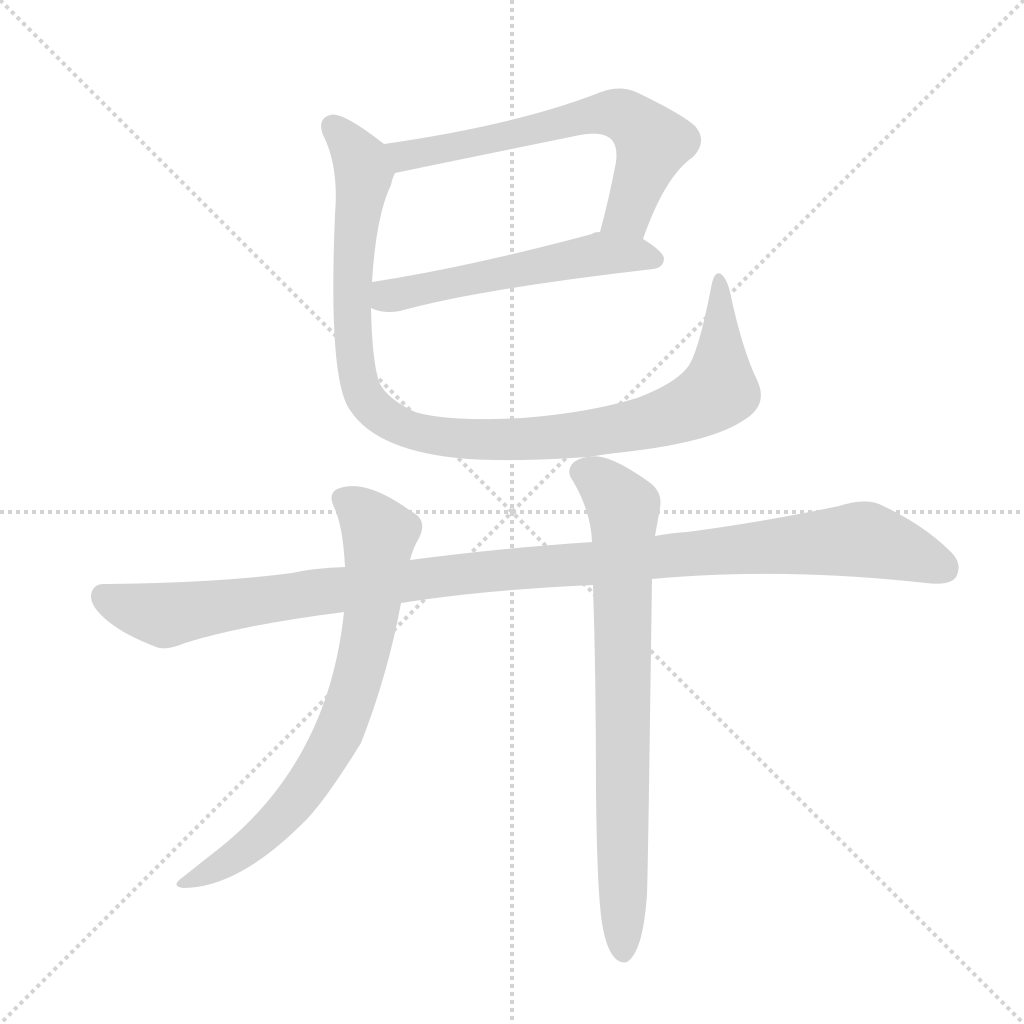
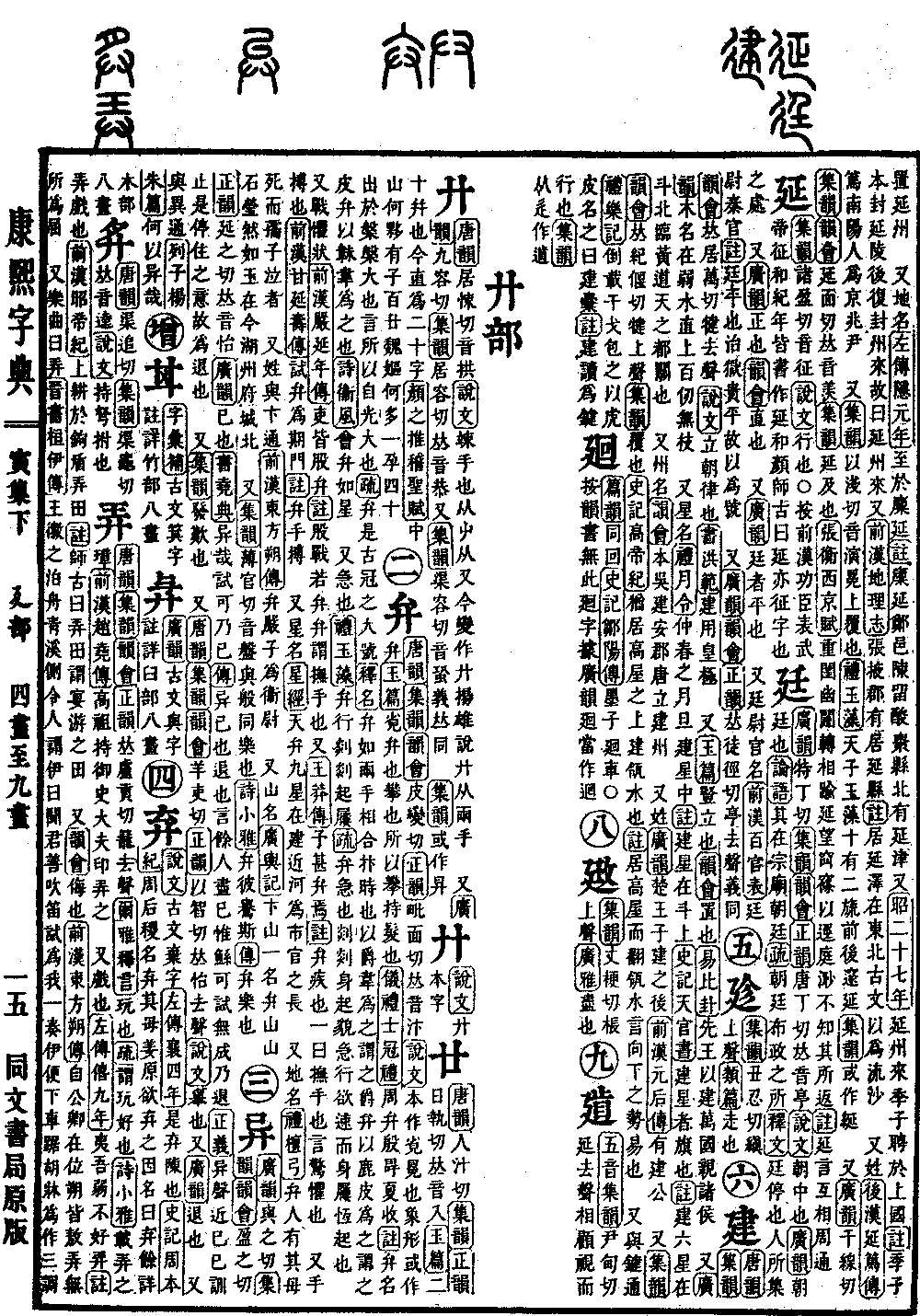
Yin Collection, Lower Volume
Radical: Twenty (gǒng)
Kangxi Strokes: 12
Page 353, Entry 12
Guangyun: Pronounced yi
Jiyun, Yunhui: Pronounced yi
Zhengyun: Pronounced yi (falling tone)
Guangyun: To stop.
Book of Documents (Shangshu), Canon of Yao: How extraordinary, test him and then stop.
Commentary: Yi means to stop, to withdraw. It means that while other people have all stopped, only Gun is worth testing; if he does not succeed, he must withdraw.
Correct Meaning: The sound of yi is close to that of yi (to stop). Yi is defined as to stop, meaning to pause, therefore it signifies withdrawal.
Also, Jiyun: An expression of sighing.
Also, Tangyun, Jiyun, Yunhui: Pronounced yi (falling tone)
Zhengyun: Pronounced yi (falling tone)
Shuowen Jiezi: To lift up.
Also, Guangyun: To withdraw.
Also, interchangeable with the character meaning different.
Liezi, Yang Zhu Chapter: Why should it be different?
The character yi (different) is the ancient form of the previous entry.
Tangyun, Jiyun, Yunhui: Pronounced yi (falling tone)
Zhengyun: Pronounced yi (falling tone)
Shuowen Jiezi: To divide. Composed of the radical twenty (gǒng) and the character yu.
Boya: Yi means to divide.
Records of the Grand Historian (Shiji), Biography of Shang Yang: If a family has two or more sons and they do not separate (divide the household), their taxes are doubled.
Also, not the same.
Book of Documents (Shangshu), Journey of the Hound: The King then displayed his virtue, extending it to states of different surnames.
Book of Rites (Liji), The Scholar's Conduct: One does not oppose those who are different, nor does one reject those who are different.
Sub-commentary: It means that if people are distant or different from oneself, but what they do is virtuous, then one does not oppose or slander them.
Also, strange.
Shiping: Yi means to be different from the norm.
Zuo Zhuan, 26th Year of Duke Zhao: Ju had something strange regarding this.
Annotation: Yi is synonymous with strange.
Records of the Grand Historian (Shiji), Biography of Qu Yuan and Jia Yi: To transform into a strange creature, what is there to worry about?
Also, extraordinary.
Rites of Zhou (Zhouli), Office of the Earth, Market Inspector: Responsible for regulating market goods and wealth, people, cattle and horses, weapons, and rare treasures.
Annotation: Rare treasures refer to seasonal food products.
Records of the Grand Historian (Shiji), Biographies of Confucius' Disciples: There were seventy-seven disciples who mastered his teachings, all of whom were men of extraordinary ability.
Also, to violate.
Also, a surname. In the Tang dynasty, Yimouxun submitted to the Tang and was enfeoffed as the King of Nanzhao. Today, the Baishui Man people have this surname.
Also, yi is the name of a medicinal grass.
Erya, Explanation of Plants: Lian yi qiao.
Also, wumingyi is the name of a medicine, which treats metal wounds and fractures.
Also, Yunbu: Rhymes with yi.
Book of Odes (Shijing), Bei Winds: Truly beautiful and extraordinary.
Rhymes with yi.
Also rhymes with yi.
Book of Odes (Shijing), Xiaoya: It only leads to further alienation.
Zhu Xi Annotation: Pronounced yi.
Anonymous, Le De Ge: What I saw was strange and wonderful. Rhymes with gan mei jiu shi.
Textual Correction:
Rites of Zhou (Zhouli), Office of the Earth, Market Inspector: In the text, the word shang (reward) is corrected to zhang (to hold/to regulate).